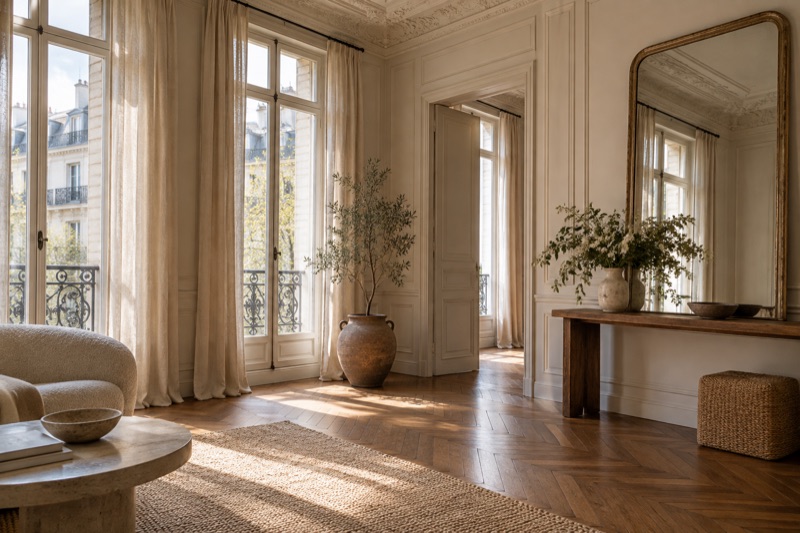
Parisian apartment decor starts with the building, not the furniture: high ceilings, ornate moldings, herringbone parquet and tall windows, the details of Haussmann-era buildings. The rest is restraint: a few old pieces mixed with a few modern ones, objects chosen for quality over quantity, and texture and scent in place of clutter. You can borrow the approach without the architecture.
The bones: moldings, parquet, light
The look people mean by Parisian apartment style stems from the Haussmann era. The Library of Congress notes that Napoleon III appointed Georges-Eugène Haussmann prefect of the Seine in 1853 and dismissed him in 1870. France's Cité de l'architecture et du patrimoine dates the urban transformation he directed from 1853 to 1870.
The buildings that lined the new boulevards share a facade. Haussmann required cut stone, usually the local cream-colored limestone. The Cité describes a continuous balcony on the main floor, the étage noble, built for the wealthiest residents, and a second one at the top of the stone facade for balance. Attic rooms under zinc roofs were meant for servants and students. Horizontal balconies and cornices run from building to building, which is why a Paris street reads as a wall.
Inside, the rules were looser. According to Wikipedia's summary, facades were strictly regulated while interiors were left to the owners. The interior details that define the look are typical of these apartments rather than required by the street rules. Livingetc associates Parisian style with tall ceilings, ornate ceiling roses, marble fireplaces and floor-to-ceiling windows. The designer Fabrice Juan adds herringbone parquet and 18th-century moldings as the classical features that bridge past and present.
Light is the other half of the architecture. A 2025 AOL feature quoting the designers Lexie Saine and Kerrie Kelly suggests airy linen sheers or café curtains, often hung high, with treatments kept minimal, so the windows and the ceiling stay visible.
If your apartment has none of this, keep what character it does have. The Paris designer Stéphanie Coutas says preserving a building's original character matters to her. Then work with what is cheap and removable. Paint the walls a muted color, which Domino's summary of Inès de la Fressange's advice says helps a collection stand out. Hang curtains high, add a wool or jute rug, and let a few pieces carry the formality the room lacks.
Mixing old and new
Parisian rooms mix eras. Kathryn Ivey, an American designer with a Paris firm, calls mixing ornate older details with contemporary pieces an art form, and says the point is to bring the past into the present rather than be bound by it. Aline Asmar d'Amman describes French living as mixing the old and new.
Domino's lessons from de la Fressange's book show what that looks like at home: modern classics, such as pieces by Eero Saarinen and Paola Navone, set beside heirlooms and flea-market finds. Its advice to skip the showroom look includes mismatched chairs "picked up here and there and repainted."
A workable formula:
- Let the building be the oldest thing in the room. Moldings and parquet already do the period work.
- Add one or two pieces with age: a gilded mirror, a Louis-style chair, a carved console.
- Balance them with something plainly modern, such as a clean-lined sofa or a sculptural lamp. The AOL feature advises a few streamlined modern pieces to keep the look fresh.
- Repeat one finish, brass or black iron, so the mix reads as chosen rather than accumulated.
Fewer, better objects
Restraint is the second rule. In Livingetc's five French design rules, the designer Lichelle Silvestry says Parisians value discretion and see showiness as out of touch, and that they prize quality above sheer volume, along with craftsmanship and attention to detail. Elliott Barnes adds that clean, precise rooms leave space for bold furniture, art and objects, and that things you can move keep an interior feeling fresh.
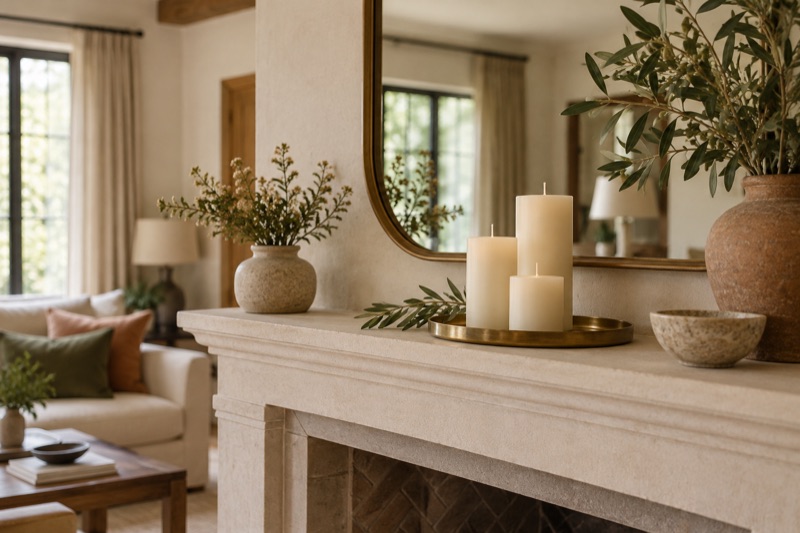
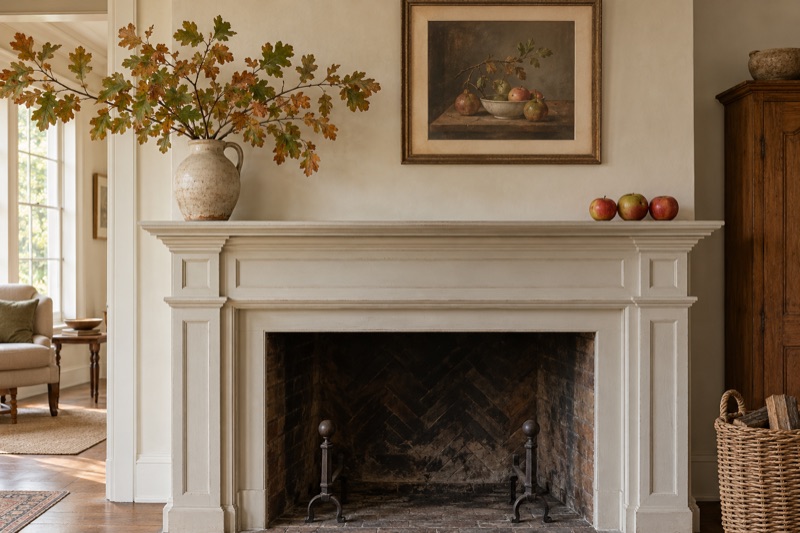
To edit a room the same way, clear a surface entirely, then put back only what you would choose again. Group what remains: one large piece, one small one, and one thing that is alive or scented. Leave at least half of every surface bare. This is advice rather than a rule, but it works the same way on a mantel, a console or a coffee table. Our guides to mantel decor and decorative candles you don't burn apply the idea to specific surfaces.
Scent and texture
What a restrained room has instead of clutter is texture. The 2025 AOL feature lists stonewashed linen, cotton voile and ticking stripes, with velvet or bouclé for depth, and layered jute or wool rugs. It also stresses patina: a worn surface is part of the look. In a Livingetc look at Coutas's Iéna project, an embossed olive-tree relief on a dining room wall changes how light moves through the apartment. Keep the palette quiet and vary the surfaces, not the colors.
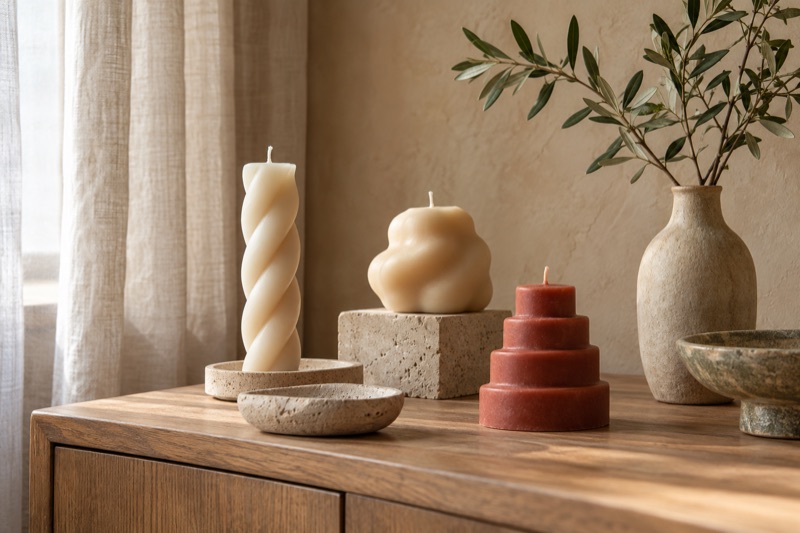
Scent follows the same logic. Choose one, and keep it low. Domino's summary of de la Fressange's advice lists scented candles among the things to display against a muted wall, with coffee table books and ceramics: one collected object among others.
Le Bonne Pomme suits that role. It is a hand-poured soy and beeswax apple, hand-painted one by one and presented under a handblown glass cloche. We design it in France. Displayed under its cloche, it scents a room without being lit. The fragrance lasts about 60 days, depending on room size. The published notes run from crisp apple skin, melon and peach through rose and red berries to caramel, musk and wood. It can be lit, but isn't meant to be: the painted finish will melt and the wax may drip, which is not a defect.
On a console, a stack of books or a mantel over a fireplace you don't use, it looks like a sculptural object first. Keep it out of direct sunlight and away from heat sources. For more ways to place it, see Sculptural Candles: When a Candle Becomes an Object, and for the country version of French style, What Is French Country Decor?
FAQ
What is Parisian style decor? A mix of classical Paris architecture, with its high ceilings, moldings, herringbone parquet and marble fireplaces, and modern pieces, kept understated. Designers quoted by Livingetc describe restraint, quality over volume, and rooms that blend eras.
How do you decorate a Parisian apartment? Start with the architecture and leave it visible. Mix a few old pieces with a few modern ones, edit objects down to what you would choose again, and add texture, such as linen, wool and velvet, and one quiet scent.
Can you get the look without Haussmann architecture? Yes. Use a muted wall color, hang curtains high, add a wool or jute rug, and carry the formality with one or two well-chosen antiques. The architecture helps, but the editing does most of the work.