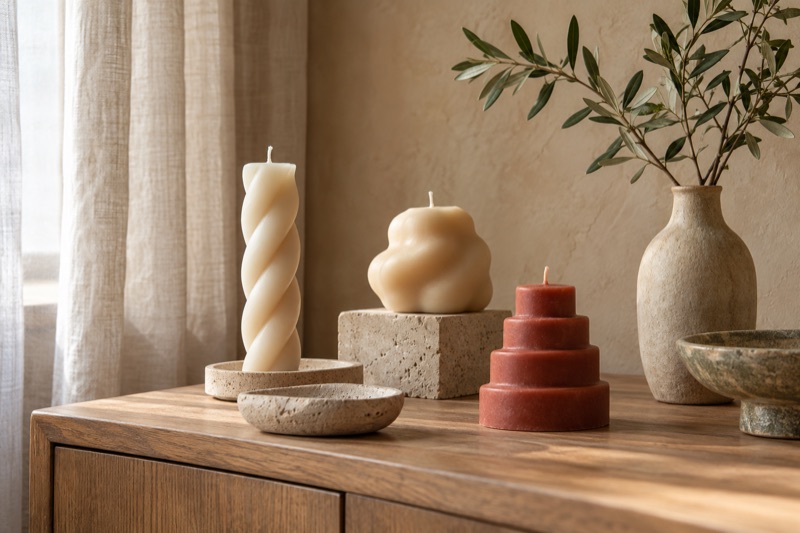
A sculptural candle is a candle whose shape is the point: a bust, a piece of fruit, a stepped tower, a coil of wax that holds its own on a shelf as an object. Some are made to burn and give up their form as they do. Others are made to be kept, and lighting one uses up the thing you bought. Knowing which kind you have is most of what it takes to live with one.
This is a short guide to the category: what makes a candle sculptural, where the idea comes from, the main forms, and how to live with one, lit or not.
What makes a candle sculptural
Every candle has a shape. In a sculptural candle, someone designed it. A pillar, a taper and a jar are formats; a bust, an apple or a twisted double-ended taper is a form someone modeled.
Three things usually mark one out:
- The form is modeled, not standard. It was sculpted, carved or cast to look like something, or to look like nothing but itself.
- It stands on its own. With no flame, and often with no holder, it reads as an object.
- Burning changes it. A pillar burns down and stays a pillar. A sculptural candle loses its profile, its carving or its finish.
Design magazines have followed the category for years. In 2021, Nuvo quoted Danielle Suppa of the Toronto shop Souvenir, who said that with these candles "the drivers to buy are shape and colour," and that most are unscented. The same year, Stylist put it more bluntly: "These statement candles are not meant to be burned." That holds for many of them, though not all.
Sculptural candles are one branch of a larger family. Decorative Candle Ideas: Styling Candles You Don't Burn covers the rest, from colored tapers to candles under glass.
A short lineage
Wax was a sculptor's material long before it became a candle's shape.
- The sketch. Sculptors worked out figures in wax before committing to stone. The V&A holds a red wax model of a prisoner by Michelangelo, made around 1519 over an armature on a cork base and linked to his designs for the tomb of Pope Julius II. According to Giorgio Vasari, Michelangelo would lower such a model into water and raise it a little at a time, to see how the figure would emerge from the block.
- The bronze. In the lost-wax method, a sculpture is first made in wax and encased in clay. The wax is melted out, and molten bronze is poured into the space it leaves. The Getty walks through each step in its explanation of lost-wax casting, using an ancient bronze Apollo. Every bronze cast this way began as a wax that was destroyed in the making.
- The likeness and the offering. Wax has long stood in for people and things. Romans gave wax fruit as gifts, and the Victorians kept wax fruit under glass domes, as our short history of wax fruit recounts. The Art of Wax: A Short History of Wax Sculpture covers the rest of the story, from votive offerings to anatomical models and wax museums.
Candlemakers have a lineage of their own. Trudon traces itself to 1643, when Claude Trudon kept a shop on rue Saint-Honoré in Paris selling spices and candles, and in 1737 Jérôme Trudon bought the Royal Wax Manufacture at Antony, south of Paris, according to the house's own history. Today the house also makes the wax busts described below.
Artists got there too, and chose to burn. At the 2011 Venice Biennale, the Swiss artist Urs Fischer showed a full-scale wax replica of Giambologna's Rape of the Sabine Women. Its wicks, hidden in the figures, were lit at the opening and the sculpture melted through the show, as the art historian Cristina Baldacci describes in a chapter on Fischer's candles. Fischer reworked the piece for the rotunda of the Bourse de Commerce in Paris, where the Pinault Collection lit it on the first day of its opening exhibition, 22 May 2021. In that work, the melting is the point.
Forms: busts, fruit, architecture
Busts
The bust is the most classical form, and the Paris candle house Cire Trudon makes a range of them. On its own site, Trudon lists its busts under interior and decoration, apart from its candles. Each product page says the piece was made in collaboration with the Plaster Cast Workshop of the Rmn – Grand Palais, the casting workshop of France's national museums organization. The range, as listed in October 2026:
| Bust | Height | Model, per Trudon |
|---|---|---|
| Napoléon | 24 cm | A portrait of the emperor |
| Marie-Antoinette | 22 cm | An idealized portrait attributed to one of the Brachard brothers |
| Louis XIV | 35 cm | After François Girardon's equestrian statue of the king, which stood in the Place Vendôme until 1792 |
| Ex Voto | 13 cm | A votive offering found in Syria in the 1850s, now in the Louvre |
Prices on Trudon's US site that month ran from $96 for the Ex Voto to $320 for Louis XIV. The Ex Voto has a wick, which Trudon says pays tribute to "the primary function of a candle." The same page describes the pieces as "meant to be collected rather than consumed."
Fruit
Fruit is the friendliest form, and one of the oldest in wax. Makers today cast candles from real fruit, or sculpt and hand-finish them, and the best of them work on you the way trompe-l'œil does: for a moment, you take them for the real thing. Fruit-Shaped Candles: A Guide to Wax Fruit, Old and New covers how they're made and who makes them.
Our own Le Bonne Pomme belongs here. It is an apple of hand-poured soy and beeswax, hand-painted one by one and presented under a handblown glass cloche.
Architecture and geometry
Not every sculptural candle depicts something. Some borrow from buildings, and some from pure geometry.
- Towers. Lex Pott, a designer based in Rotterdam, made his Pillar candles for HAY by treating the pillar as a building. Business of Home reported that he "re-imagined the archetype of the standard pillar candle as a sort of skyscraper."
- Coils. His later Twist candle, Disegno reported, is extruded rather than dipped, and "keeps its two ends upright by coiling artfully at the centre."
- Myths. Nuvo's 2021 roundup included the hand-poured, unscented candles of Octaevo, a Barcelona studio whose shapes draw on ancient mythology.
- Bubbles, cubes and clouds. Stylist's roundup the same year ran from bubble and cube candles to clouds and figures, and suggested them for bedside tables, chests of drawers and shelves.
Living with one
A sculptural candle asks to be treated like any small sculpture.
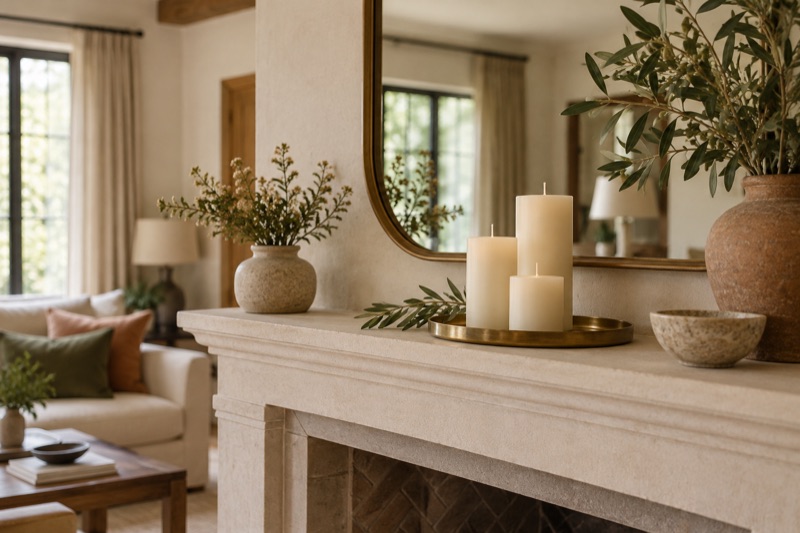
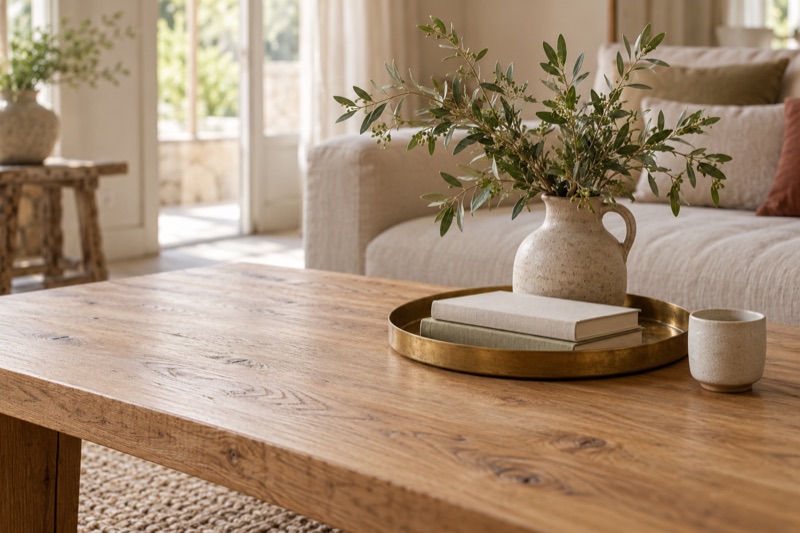
- Give it room. One strong form reads better than a crowd of them. On a mantel, let it hold one end against something taller; Mantel Decor Ideas for Every Season has more. On a coffee table, group it with two objects of different heights, as in Coffee Table Styling: The Rule of Three.
- Raise it. A stack of books, a small plinth, a stone tray or a plate gives a candle a base, the way a pedestal does for a bust.
- Watch the light. The National Candle Association advises keeping candles out of direct sunlight and harsh indoor lighting, "such as a spotlight," because they may fade. That matters for a piece you might be tempted to spotlight like a sculpture.
- Keep it cool. Wax softens with warmth. The V&A takes its Michelangelo wax off display in the warmer months for that reason. At home, keep a sculptural candle away from radiators, sunny windowsills and the mantel over a working fireplace.
- Dust it lightly. The NCA suggests a piece of nylon or a soft cloth. Carving and painted surfaces gather dust, and a glass cloche keeps it off. How to Use a Candle Cloche explains how, and why a cloche never goes over a flame.
Burn or keep
Whether to light a sculptural candle depends on the candle, and the maker usually tells you.
- Read the maker. A centered wick, a safety label and burn instructions mean it was made to burn. Words like "decoration," "display" or "collect" mean it was made to keep, as with Trudon's busts.
- Look at the finish. Paint, lacquer and gilding don't belong near a flame. In 2008 the US Consumer Product Safety Commission recalled about 185,000 decorative candles after reports of the gold paint on their exteriors igniting.
- Look at the shape. Thin or projecting parts melt first, and a lopsided form can drip or slump. Nuvo noted that many sculptural candles lose their shape as they burn, and suggested standing them on a plate.
- Decide what you bought it for. If you bought it for the shape, lighting it spends the shape. Fischer's candles turn this around: there, the melting was the work.
If you do light one, the NCA's safety tips apply: a stable, heat-resistant surface, at least 12 inches from anything that can burn, and never left unattended. Should Decorative Candles Be Lit? goes further.
Some pieces are designed to be kept and still do a candle's other job. Le Bonne Pomme is designed for cold diffusion: displayed under its cloche, it scents a room without being lit. It can be lit, but isn't meant to be: the painted finish will melt and the wax may drip, which is not a defect.
Frequently asked questions
What is a sculptural candle?
A candle whose form is designed as an object: a bust, a fruit, an architectural or geometric shape. It reads as decor without a flame, and burning it changes or destroys the form.
Are sculptural candles meant to be burned?
Some are and some aren't. Burn instructions and a centered wick mean the maker expects it to be lit. Pieces sold as decoration, or painted and lacquered ones, are better kept unlit.
What is the lost-wax method of sculpture?
It's a way of casting metal. The sculpture is made in wax and encased in clay, the wax is melted out, and molten bronze is poured into the cavity it leaves. The Getty's explainer shows each step.
How much does a candle statue cost?
It depends on the maker, the size and the finish. As one benchmark, Cire Trudon's wax busts ranged from $96 to $320 on its US site in October 2026.
How is a wax sculpture made?
It can be modeled by hand, often over an armature as Michelangelo's was, carved from a block, or cast in a mold taken from an original. Many sculptural candles are cast in a mold, then finished by hand.