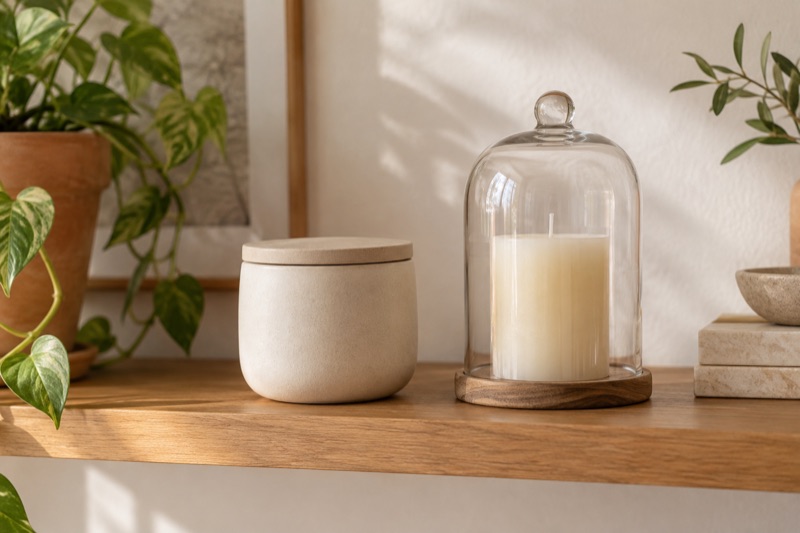
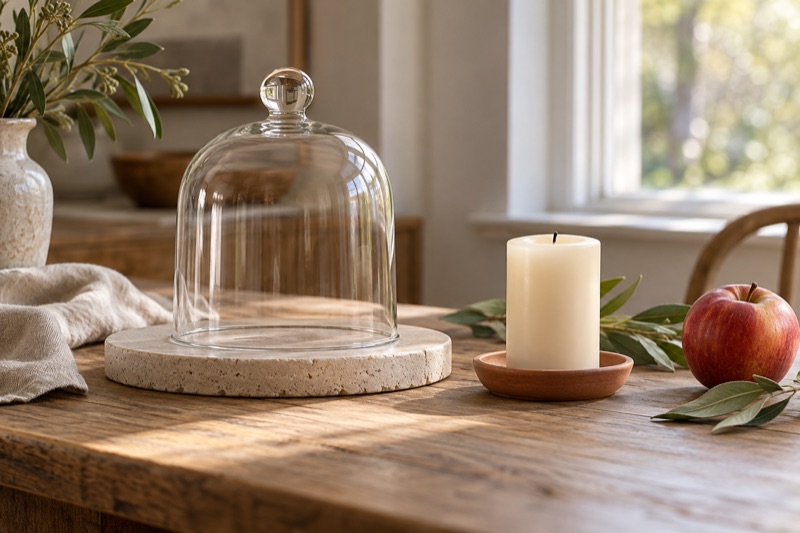
A candle cloche is a glass dome that sits over a candle when it isn't burning. It has two uses. It works as a lid that keeps a candle's scent between burns, and as a display case for an unlit scented object. In both cases, one rule never changes: a cloche never goes over a lit flame.
This guide covers each use, how to handle and clean the glass, and what to look for when you choose one.
What a candle cloche does
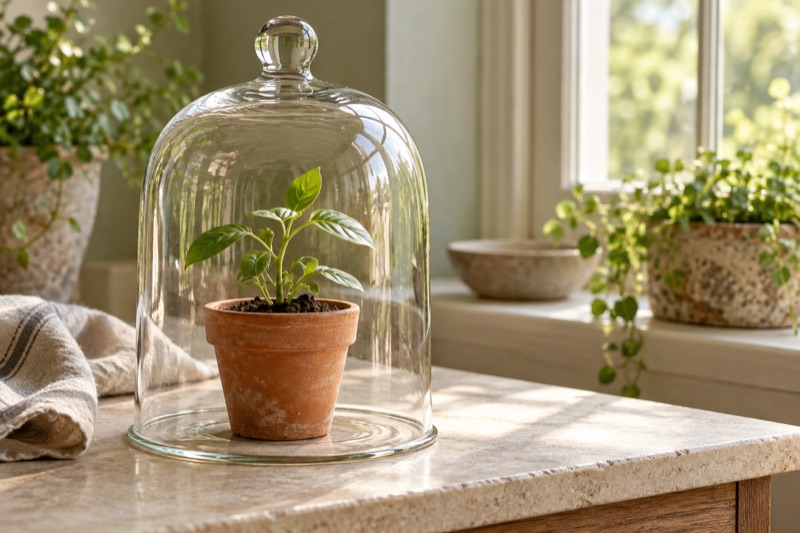
Cloche is French for bell. The first cloches were bell-shaped glass jars that 19th-century French market gardeners) set over young plants to protect them from the cold. Victorian households used glass domes indoors, displaying wax flowers, foliage and fruit. For the fuller story, see What Is a Glass Cloche? Names, History and Uses.
Over a candle, a cloche does two things.
It holds the scent in. According to the National Candle Association, scent leaves a candle by evaporation, both from the melted wax pool and from the solid candle. In a closed space, the air fills with vapor until molecules return to the surface about as fast as they leave, a balance chemists call dynamic equilibrium. A cloche isn't sealed, so some scent still escapes, but more slowly than it would into open air. When you lift the glass, the fragrance that has gathered underneath reaches the room all at once. For the science in more detail, read Does a Lid Keep a Candle's Scent?
It keeps dust off. The NCA recommends storing candles covered, partly to keep dust and debris off. A cloche does the same job for a candle you'd rather display than put away.
The candle house Trudon describes its own glass dome, La Cloche, as one that "protects the candle and concentrates its perfume". Both uses depend on that. What differs is whether you burn the candle underneath.
Cloche as lid: keeping scent between burns
If you burn the candle, the cloche acts as its lid. It comes off before you strike the match, and it goes back on only after the candle is out and cool. A simple routine:
- Lift the cloche off and set it well aside before lighting, on a folded cloth where it can't be knocked.
- Burn as usual. The NCA suggests trimming the wick to ¼ inch before every burn and burning no longer than four hours at a time.
- Put the flame out with a snuffer, not the cloche. The safety section below explains why.
- Wait until the wax has set and the candle is cool. The NCA advises leaving a candle alone until the wax has completely cooled.
- Lower the cloche. Fragrance that would otherwise drift off between burns stays under the glass.
A cloche keeps dust off, but it won't shade wax from a sunny windowsill. The NCA recommends a cool, dark, dry spot and warns that candles may fade in bright light over time.
A cloche is the answer for candles that can't take a lid: pillars, sculptural candles, and jar candles that came without one. It also suits any candle you want to see. A lid hides a candle, while a cloche shows it off.
Cloche as display: unlit scented objects
The second use doesn't involve a flame. Some scented objects are made to be displayed rather than burned, and the cloche is their natural setting. It protects a painted or carved surface, keeps dust off, and turns a single piece into a display.
Our Le Bonne Pomme is designed for exactly this. It is a sculptural apple of hand-poured soy and beeswax, hand-painted one by one and presented under a handblown glass cloche. Displayed under its cloche, it scents a room without being lit for about 60 days, depending on room size. Its notes are crisp apple skin, melon and peach over rose, red berries, caramel, musk and wood. It can be lit, but it isn't made for burning. The painted finish will melt and the wax may drip.
A few habits help any unlit piece:
- Keep it out of direct sun and away from heat. As temperature rises, evaporation speeds up, and bright light can fade wax. Radiators, stovetops and sunny sills are the places to avoid.
- Put it where you pass. An entry table, a desk, a sideboard near where guests gather. Scent is strongest near its source, so a spot you walk past every day does more than a corner.
- Keep it out of drafts. Moving air carries fragrance away from the surface, and airflow speeds evaporation, so a spot beside a fan, vent or open window spends scent faster.
For ideas on what to put under glass, and where, see Cloche Decor Ideas: Ways to Style a Glass Dome.
How to lift, place and clean a cloche
A glass dome is simple, but it's also the most handled object on the table. A few habits keep it clear and intact.
Lifting. Hold the knob at the top. If there isn't one, cup the dome with both hands near the rim. Lift straight up until the rim clears whatever is underneath, then move it aside. If you slide or tip it off, the rim can catch the wax or a painted surface.
Setting it down. Rest it on its rim on a folded cloth, never on its crown, where a rounded dome can roll. Keep it back from the table edge.
Placing. Lower it straight down and check that the rim sits flat, in the groove if the base has one. The glass shouldn't touch the object anywhere.
Cleaning the glass. Wash it by hand in lukewarm water with a little mild dish soap and a soft cloth, then rinse. Dry it with a lint-free cloth so no water spots end up under the dome. Avoid sudden temperature swings, such as running a cold dome under hot water. The Corning Museum of Glass explains that glass breaks from extreme changes in temperature, not from heat or cold alone. For the same reason, keep handblown glass out of the dishwasher.
Cleaning the base. Wipe wood with a dry or barely damp cloth. Use a pH-neutral cleaner on marble and limestone, because acids such as vinegar react with these stones.
The object underneath. The NCA suggests removing dust from candles with nylon or a soft cloth. With a cloche in place, there should be little to remove. On a hand-painted piece, let the glass do the dusting.
Safety: never cover a lit flame
Never put a cloche, lid or dome over a burning candle. That includes covering it for display, to concentrate the scent, or to put it out. Three things go wrong under the glass.
The flame is starved of air. A candle burns with oxygen from the surrounding air. The NCA describes cooler air rushing in at the base of the flame as heated air rises, and notes that a flame with too little air flickers and gives off soot, unburned carbon that escapes before it can burn. Under a dome, the flame gutters and smokes, and the soot coats the glass and the wax.
Heat builds up. Heat rises, and under a dome it collects against the glass. Fire services warn against enclosing a flame this way. Scottish Fire and Rescue advises against placing candles under shelves, because rising heat can start a fire. Derbyshire Fire & Rescue says not to place candles in enclosed spaces.
The glass can crack. Glass breaks when one part heats or cools faster than another, according to the Corning Museum of Glass. A flame under a dome heats the glass unevenly, hottest directly above. Even glass made to hold a candle has limits. Derbyshire Fire & Rescue reports candle jars that have shattered without warning once the wax runs low and stops absorbing heat. The US Consumer Product Safety Commission has recalled jar candles whose glass can crack or break during use.
How to put a candle out instead. Use a snuffer, which Derbyshire Fire & Rescue recommends and the NCA lists first, ahead of gently blowing the flame out. Never use water, which the NCA warns can splatter hot wax. Wait for the wax to set before the cloche goes back on.
The basics apply whenever a candle is lit. These come from the NFPA candle safety tip sheet:
- Put out every candle when you leave the room or go to bed.
- Keep candles at least 1 foot (30 cm) from anything that can burn.
- Use sturdy holders that won't tip, on an uncluttered surface.
- Don't burn a candle all the way down. Put it out before the flame gets too close to the holder or container.
The NFPA notes that over half of all candle fires start when something that can burn is too close to the candle.
Vented and open-top cloches. You'll sometimes see a candle cloche with a hole in the crown, or with an open top. Vents come from the garden: the Royal Horticultural Society sells a glass bell cloche with a removable stopper that you take out on warm days so plants don't overheat. An opening doesn't make a cloche into a candle holder. Treat a vented cloche exactly like a closed one, for unlit candles and objects only. An opening also lets out the fragrance a cloche is meant to hold.
Choosing a cloche: size, base, glass
Size. The dome should clear the candle on every side and above it, with enough room to lift it off without grazing the wax. Beyond that, smaller is better for scent. Less air fills faster, and the size of a container affects how long it takes to reach that equilibrium. As a reference point, Trudon's La Cloche stands 24 cm (about 9½ inches) tall and 14 cm (about 5½ inches) across, sized for the house's classic candle.
Base or no base. A candle cloche with a base is easier to live with. The base gives the rim a seat, often a groove, and it catches stray wax. It also lets you move the whole arrangement in one piece, and a close fit between rim and base lets less scent escape. A cloche without a base sits directly on a table or tray. That works for display, but give the wax a surface that won't mind it.
| Base | Why choose it | Care |
|---|---|---|
| Wood | Warm and light. Trudon pairs its blown-glass dome with polished wood. | Dry or barely damp cloth. |
| Marble or other stone | Heavy and steady, so a candle cloche with a marble or stone base is hard to knock. A glass cloche and stone base suit a kitchen counter or a console. | pH-neutral cleaner, no vinegar. The Natural Stone Institute notes that oil-based stains darken stone, so set the wax on a small dish if it will rest on the stone. |
| Glass | Almost disappears, so the object reads first. | Wash it with the dome. |
| No base | Simplest, and fine on a tray. | Put a dish under the wax to protect the furniture. |
Glass. Clear glass is the point, because you're displaying what's underneath. Handblown glass varies slightly from piece to piece. Even the RHS notes that the dimensions of its handblown cloche may vary. Look for a rim that sits flat and even, and a knob at the crown if you want to lift it with one hand.
FAQ
What does a candle cloche do? It slows the escape of a candle's fragrance between uses and keeps dust off the wax. Over an unlit scented object, it protects the surface while the object scents the room.
Is it safe to use a candle under a cloche? Only if the candle is unlit. Never light a candle under a glass dome. The flame runs short of air and smokes, heat collects under the glass, and uneven heating can crack it. Burn the candle uncovered, put it out with a snuffer, and lower the cloche once the wax has cooled.
Do you need a base for a candle cloche? No, but a base helps. It seats the rim, catches wax, protects the furniture, and closes the gap that lets scent escape. Without one, set the cloche on a tray.
Do candle cloches work? For holding scent and keeping dust off, yes. The NCA recommends storing candles covered for those reasons. Some pieces, like Le Bonne Pomme, are designed to live under a cloche and scent a room without being lit.