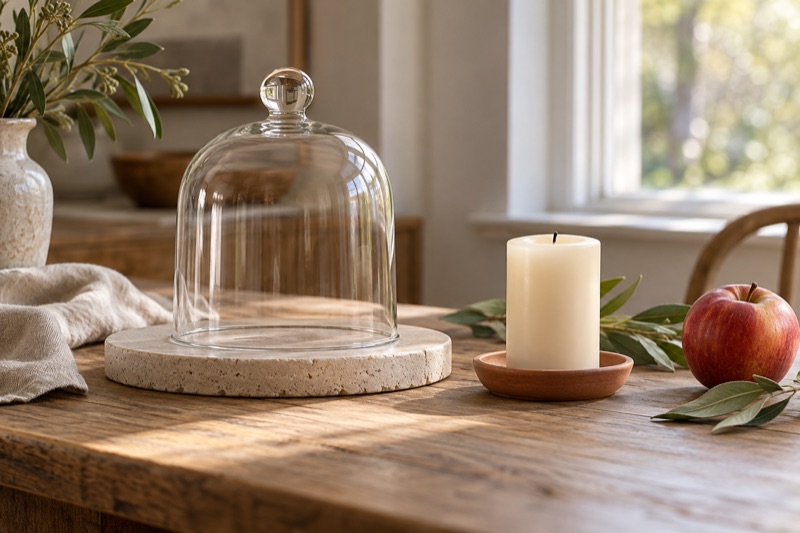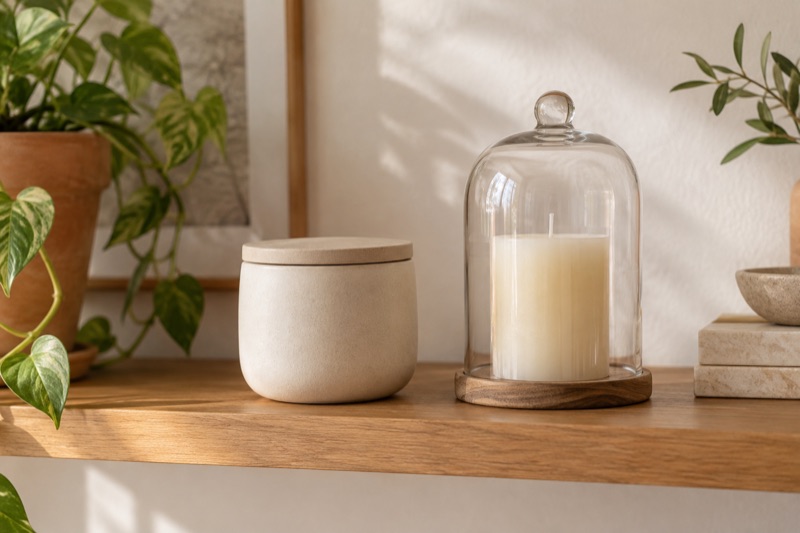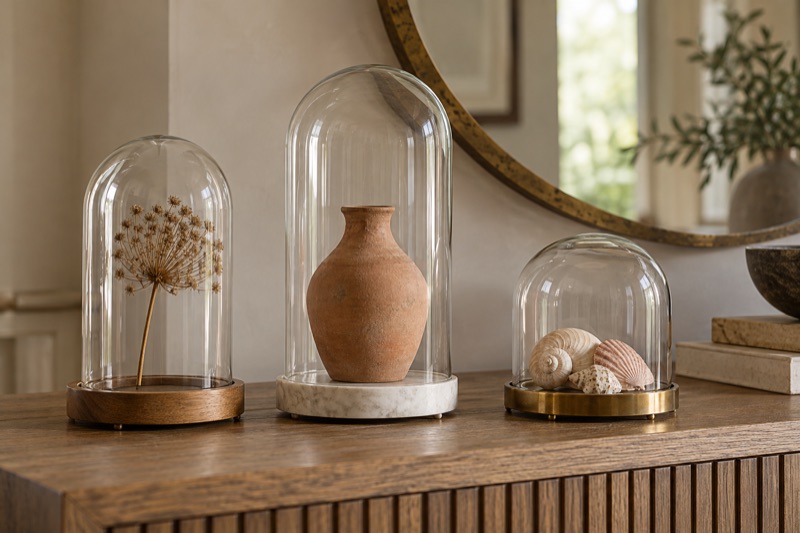
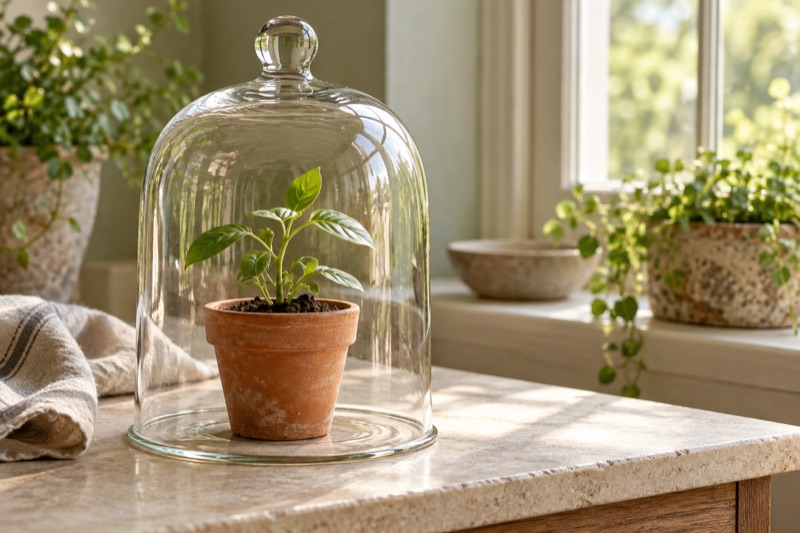
A glass cloche is a bell-shaped glass cover set over something to protect it. Cloche is the French word for bell, and the same object goes by other names: bell jar, glass dome and, in Victorian parlors, glass shade. Its best-known origin is the garden, where bell-shaped glass sheltered young plants from the cold, but the same shape has also covered wax fruit, cheese, laboratory experiments and candles.
This guide covers where the word comes from, how a gardener's tool became a parlor ornament, and what a cloche is used for today.
The word: cloche, bell jar, dome
The French word has a long list of meanings. Larousse's entry lists fourteen noun senses and begins with the metal bell. Three further down matter here: a bell-shaped glass shelter that concentrates the sun's heat on plants or protects them from cold; a domed cover that keeps food warm or stops it drying out, with the cheese dome as its example; and a piece of laboratory apparatus for collecting a gas. It also names a close-fitting women's hat.
English kept the French word for the garden and the table and added others for the same shape:
| Name | Where you'll meet it |
|---|---|
| Cloche | Over a plant in the garden, over food on the table, and over an unlit candle |
| Bell jar | In the laboratory, set on a base connected to a vacuum pump, as in the experiments of Robert Boyle and Joseph Priestley; and in Victorian display, where thin decorative versions covered clocks, taxidermy, shells and wax fruit and flowers |
| Glass dome | The general term. The Royal Collection's catalog describes a wax fruit arrangement as covered by a "glass dome" |
| Glass shade | The Victorian word. Emma Peachey's 1851 wax-flower guide says "glass shades are requisite" to cover a vase or basket of wax flowers |
So a glass dome is called a cloche when it covers plants, food or a candle, a bell jar when it sits in a lab or a Victorian display, and a shade in a nineteenth-century manual.
French market gardens
The garden cloche is French in name and in history. The Royal Horticultural Society says the word comes from the French for "bell", and that "the first cloches were glass bells." They work, it says, like little greenhouses, protecting early and overwintered crops from cold and wet.
The use of cloches is traced to market gardens in nineteenth-century France). Parisian growers set bell-shaped glass jars about 18 inches across over their plants and propped them open on sunny days with notched wooden sticks.
The Encyclopédie méthodique (Agasse, Paris, 1802) gives an early French description of garden cloches of glass shaped like bronze bells. They were once assembled from small panes held in lead and were by then blown in a single piece, with a knob on top to lift them. They covered delicate plants on hotbeds in the cold season, and a gardener raised them on small wooden forks to give the plants air.
By 1909, the scale was industrial. The English handbook French Market-Gardening, by John Weathers, estimated that some 1,300 growers around Paris farmed intensively and held between five and six million cloches among them. The best were about 17 inches across the mouth.
Glass cloches are still sold to gardeners. The RHS notes that glass bells stay in place without weights, that glass holds heat better overnight than plastic, and that many have vent holes in the top. A bell cloche without vents should be lifted slightly off the soil on pieces of wood.
The Victorian parlor dome
In Victorian homes, the dome was a showcase. In his review of John Whitenight's Under Glass: A Victorian Obsession, George P. Landow of the Victorian Web lists the contents of Victorian domes: wax flowers, foliage, fruit and figures; shell work; hair work; taxidermy; skeleton leaves; feather, bead and seed work. Wax arrangements appealed, he notes, because they could do what nature couldn't: their compositions knew no season, and roses could be mixed with tulips.
The glass was part of the craft. Peachey's 1851 Royal Guide to Wax Flower Modelling says glass shades are requisite for covering a wax bouquet, whether it stands in a vase or a basket. Museums hold the results. The Royal Collection has a nineteenth-century wax fruit arrangement: a small wicker basket of miniature wax fruit set in moss and covered by a glass dome. The Philadelphia Museum of Art's Wax Fruit and Dessert Arrangement, about 1860 to 1880, comes with a label noting that young American women of the 1860s to 1880s made wax fruit and flowers as a hobby and displayed them under glass domes in fashionable homes.
The dome did practical work as well. Conservation researchers name the build-up of dust as a major cause of deterioration in wax sculptures, and the Deutsches Hygiene-Museum Dresden's recommendations for preserving wax moulages, the lifelike medical models, call for closed, dust-tight display cases. A Victorian dome did the same job in a parlor. For the full story of these objects, see A Short History of Wax Fruit. The glass itself is the subject of How Hand-Blown Glass Is Made.
Cloches on the table and the cake stand
The French word for the garden shelter also names a cover for food. Larousse defines it as a domed cover that keeps food warm or protects it from drying out. Its example is the cloche à fromage, the cheese dome. Wikipedia's entry on tableware cloches) says they are traditionally silver, though sold today in glass, stoneware, marble and other materials. Its article on bell jars notes that similar glass domes serve as cheese domes or cake bells.
The logic is the garden's and the parlor's again: a clear cover that shelters what's under it and leaves it in view. Only the thing underneath changes.
Using a cloche today
Three uses cover most of what you'll see.
- Over plants. A glass bell cloche is still a way to start seedlings and protect early crops, with vents or a lifted edge for air.
- Over objects. A dome keeps dust off something you want to display and still see, and it frames a single piece. Cloche Decor Ideas shows ways to style one.
- Over candles. A candle cloche covers a candle or a scented object that isn't burning. Never put one over a lit flame. How to Use a Candle Cloche explains the rule, and Does a Lid Keep a Candle's Scent? covers what a cover does for fragrance.
Our Le Bonne Pomme belongs to the third group. It is a sculptural apple of hand-poured soy and beeswax, hand-painted one by one and presented under a handblown glass cloche. Displayed under its cloche, it scents a room without being lit. It can be lit, but isn't meant to be: the painted finish will melt and the wax may drip, which is not a defect. For looking after a painted wax piece, see how to care for a hand-painted wax object.
FAQ
What is a glass cloche used for? It covers something to protect it while keeping it visible: young plants in the garden, food on a table, wax objects and scented candles on display. It is a lid you can see through.
What are glass domes used for? Protection and display. Victorian domes covered wax flowers and fruit, shells, taxidermy and keepsakes. Museums still show fragile wax in closed cases for the same reason.
What is a glass dome called? A cloche, a bell jar or a glass shade, depending on context. Gardeners and cooks say cloche. In a laboratory, a bell jar sits on a vacuum pump. Victorian manuals say shade.
What are glass cloches for plants? They are small portable shelters that work like little greenhouses, warming the soil and protecting seedlings and early crops from cold and wet. Glass bell cloches need ventilation, from vent holes or a lifted edge.