Wax fruit is far older than the Victorian parlor. Romans gave wax fruit as presents at the end of the Saturnalia, and the grand dinners of eighteenth-century Europe set wax and sugar ornaments on the dessert table. In the nineteenth century, wax fruit under a glass dome became a fixture of the fashionable home in Britain and America.
Its appeal never changed: fruit shaped and painted so carefully that you take it, for a moment, for the real thing. This short history runs from Roman gift-giving through the Victorian dome and the museum laboratory to the wax fruit, and fruit candles, made today.
Wax, the material of imitation
Beeswax suits imitation. As Britannica's entry on wax sculpture explains, it can be cut and shaped at room temperature, melts at a low heat, takes any color mixed into it, and holds a painted surface well.
The Romans used it for portrait masks of their ancestors. They also used it for fruit. According to Britannica, the closing days of the Saturnalia were called the Sigillaria, after the custom of giving wax models of fruit and small wax figures as presents.
The measure of success was always being mistaken for the real thing. In 1851 the wax-flower artist Emma Peachey reprinted a letter from the 1680s, taken from Agnes Strickland's life of Mary of Modena, queen to James II. The letter praised the queen's wax "fruit and flowers," saying that those "that see 'em can hardly think 'em other than the real."
By the eighteenth century, wax was a material of the grand dinner table. The Victoria and Albert Museum notes that sets of porcelain figures were first made for the dessert course from about 1740, and were set out instead of, or next to, ornaments made of sugar paste or wax.
Victorian wax fruit under glass
Peachey is a good guide to how the Victorian fashion took hold. In the preface to her Royal Guide to Wax Flower Modelling (1851), she recalls making a wax bouquet for the young Queen Victoria in 1837. It was placed in one of the royal palaces, and two years later the Queen arranged a royal warrant naming Peachey her artist in wax flowers. Peachey also says she made more than ten thousand wax roses for the Queen's marriage to Prince Albert, on 10 February 1840.
Wax flower models were shown at the Great Exhibition of 1851, and handbooks taught amateurs to make flowers and fruit at home.
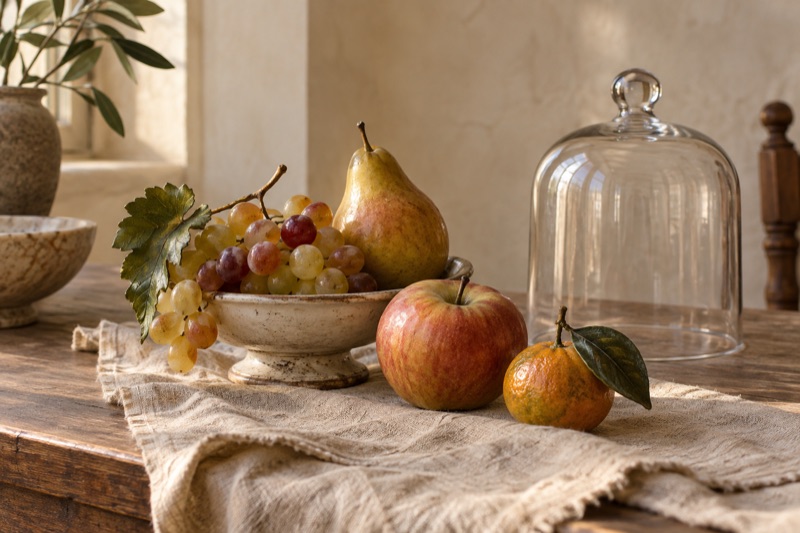
The glass came with the wax. Peachey told her readers that a wax bouquet, whether in a vase or a basket, needed a glass shade over it. The Horticultural Artifacts Collection at Smithsonian Gardens explains why. By the early 1800s, glass was available and versatile enough to display and protect keepsakes, and behind it the Victorians kept dried flowers, shellwork, hair work, and wax flowers and fruit. Peachey called the cover a shade; the Smithsonian's catalog describes it as a glass dome, "also called a bell jar or cloche."
The method is set out in an American manual, Wax Flowers: How to Make Them, with New Methods of Sheeting Wax, Modelling Fruit, &c. (Boston: J. E. Tilton, 1864):
- The mold. Plaster of Paris was poured around a real fruit in two halves.
- The cast. Melted, tinted wax was poured into the mold and turned until it coated the inside, which made a hollow fruit in its lightest natural color.
- The finish. A blush of powdered carmine was rubbed on with flannel. Streaks and specks were laid on with a brush, and plums and grapes got a powdery bloom.
- The details. The eye of an apple was a heated clove pressed into the wax. Stalks were wire wrapped in silk and dipped in wax.
Its author is plain about the goal: done well, "the most practised eye cannot sometimes detect the real from the artificial."
Surviving pieces bear this out. The Philadelphia Museum of Art's Wax Fruit and Dessert Arrangement, dated about 1860 to 1880, keeps the bright colors these arrangements were known for. The Smithsonian's basket of about 1870 holds a banana, lemons, cherries, half a peach with its pit, a very green pear and apples. It sits on a black wooden base grooved to take the dome. Even the Royal Collection holds a small wicker basket of miniature wax fruit on moss under a glass dome.
Who made it, and for whom
Much Victorian wax fruit was made at home, by women. The Philadelphia Museum of Art notes that from the 1860s to the 1880s, young American women with any spare time took up wax fruit and flowers. The finished domes decorated "the most stylish home interiors." In Britain, the historian Ann B. Shteir has described wax modeling as one of the "accomplishments" that showed a middle-class woman's skill and standing.
Not every piece was a showpiece. Historic New England keeps a single wax pear from a Massachusetts house. It was dipped in pale wax, blushed pink and given a paper stem.
Professionals worked alongside the amateurs. Peachey sold finished work, gave lessons and supplied glass shades from her London address. Others worked for science and trade:
- Turin. Francesco Garnier Valletti (1808–1889) trained as a confectioner before turning to wax flowers and fruit, according to Atlas Obscura. The Whipple Museum of the History of Science in Cambridge holds a case of twenty-four life-size wax apples attributed to him, about 1850. The apples run from crab apples to cooking apples, bruises and all. In 1858 he moved to a more durable mixture of alabaster dust, natural waxes, plaster, vegetable ash and rosin. Turin's Museo della Frutta, opened in 2007, holds more than a thousand of his models.
- Melbourne. Museums Victoria holds more than 1,800 wax fruit and vegetable models. Most were made by artisans the museum employed between 1873 and 1960, and its trained modelers were mainly women. They recorded every bruise, every patch of mold and the color of each season, documenting healthy, diseased and unusual fruit for agriculture and science. Some were shown at the Melbourne International Exhibition of 1880.
Decline and revival
The parlor fashion faded first. The Philadelphia Museum of Art places the height of the American craze between the 1860s and the 1880s.
The scientific models lasted longer, until photography replaced them. Museums Victoria notes that once color photography arrived in the 1960s, wax models were no longer needed to record fruit and vegetable specimens.
Plastic changed how artificial fruit was seen. The design writer Sarah Archer, author of The Midcentury Kitchen, has traced fake fruit's kitsch reputation to the arrival of household plastics after the Second World War.
The revival has come through museums and collectors. Garnier Valletti's fruit was found at Turin's former agricultural research station when it closed in the early 2000s, and went on display in 2007. John Whitenight's Under Glass: A Victorian Obsession (2013) put wax fruit and flowers among the dome arts of the period. In his review for the Victorian Web, George P. Landow wrote that what had been folk art and hobby "now has become Fine Art."
Wax fruit today
Much of the wax fruit sold today is a candle, which reverses the Victorian idea. The manuals treat wax fruit as an ornament for the drawing room, and nothing in them suggests lighting it.
The two were never far apart, though. The 1864 manual recommends half-burnt candle ends as perfectly good casting wax, and candle wicks for the stalks of pears. Even in the Victorian parlor, wax fruit and candles shared their materials.
Today's fruit candles come in two broad kinds:
- Candles to burn. In Puglia, Cereria Introna, in the wax trade since 1840 by its own account, added decorative candles to its votive work in the early 1990s. Fruit and vegetables are among its themes, drawn from a library of more than 3,000 molds.
- Candles to keep. Some are made to be looked at rather than burned. Le Bonne Pomme belongs here. It is hand-poured from soy and beeswax, hand-painted one at a time and presented under a handblown glass cloche. Its fragrance is by Mane, the French fragrance house founded in 1871. Displayed under its cloche, it is designed to scent a room without being lit.
Victorian wax fruit was made for the eye, though some already wanted more. A newspaper review that Peachey printed at the back of her 1851 guide wished that the pleasure of seeing her flowers could be joined by the pleasure of smelling them. She herself suggested scenting wax flowers worn in the hair by putting perfume on the ribbon of the stem.
We don't claim a direct line from any of these objects to our own. The kinship is narrower: wax shaped and painted until the eye hesitates, then set under glass. There is more on these objects, old and new, in our guide to fruit-shaped candles, and on the wider art of fooling the eye with fruit in Trompe-l'Œil Fruit: The Art of Fooling the Eye. If you're curious about the scent itself, start with what an apple candle smells like or our notes on apple candles without the cinnamon.
The 1864 manual set one test: whether a practiced eye could tell the copy from the fruit. Le Bonne Pomme is made for the same moment. It's an apple you could mistake for the real thing, until you notice the room smells of it.
Frequently asked questions
When was wax fruit popular?
Wax fruit was at its most fashionable in the mid- to late nineteenth century. The Philadelphia Museum of Art dates the American enthusiasm to the 1860s through the 1880s. Scientific wax fruit models were made much longer; Museums Victoria's modelers worked until 1960.
How was Victorian wax fruit made?
A two-part plaster mold was taken from a real fruit. Tinted wax was poured into the mold and turned until it set as a hollow shell. The fruit was then finished by hand with powdered color, painted streaks, a clove for an apple's eye and wire stalks wrapped in silk.
Why did Victorians keep wax fruit under glass domes?
The dome protected the fragile wax and turned the arrangement into a display piece. The Smithsonian notes that by the early 1800s, glass made it practical to protect and show off keepsakes of all kinds this way.
Is wax fruit the same as a fruit candle?
No. Victorian wax fruit was an ornament with no wick, made only to be looked at. If you're shopping for wax fruit for candles, look for pieces made with a wick. Some modern pieces can be lit but are made mainly to be displayed, and to scent a room unlit.
Where can I see antique wax fruit?
Museum examples include the Philadelphia Museum of Art, the Smithsonian's Horticultural Artifacts Collection, Historic New England, the Royal Collection and the Whipple Museum in Cambridge. The two largest collections of scientific fruit models are at Museums Victoria in Melbourne and the Museo della Frutta in Turin.