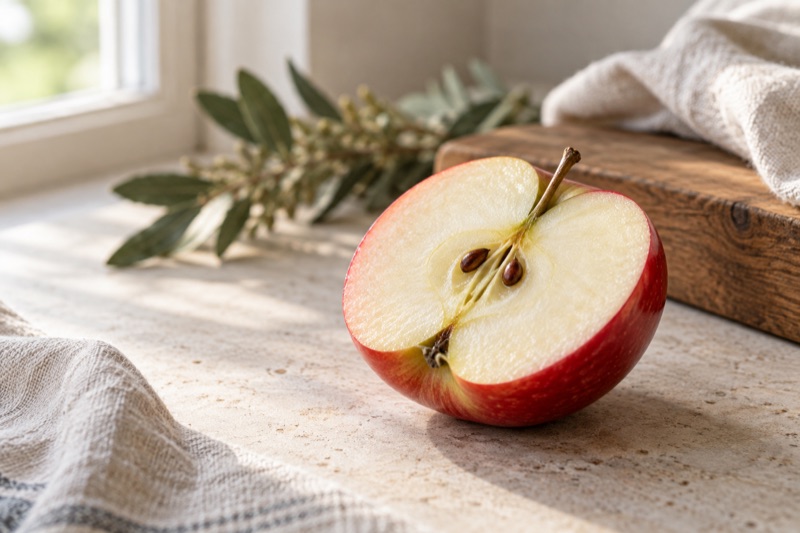
A fresh apple candle smells crisp, tart and juicy: cold apple skin, a sharp, watery sweetness and a green edge close to crushed leaves. That puts it a long way from the warm, buttery, cinnamon-heavy apple on most candle shelves in autumn, which is really a baked apple. Search "what does an apple candle smell like" and you'll find both, so it helps to know how each one is made.
Neither, as it happens, comes from an apple.
Why there's no "apple oil"
Perfumers work with natural extracts and with single aroma molecules. Some fruits give up a usable oil: bergamot oil, for one, is cold-pressed from the rind. The apple doesn't. The fragrance encyclopedia Osmoz notes that no essential oil can be drawn from apples, so perfumers assemble the note in the lab from other materials.
Part of the problem is that an apple's smell is a crowd. A 2016 review in Food Technology and Biotechnology reports more than 300 volatile compounds identified in apples, of which only a few shape the aroma we recognize. In ripe fruit, most of them are esters, the compounds behind many fruity smells.
So an apple scent for a candle or a perfume is an accord: a small composition of aroma molecules, several of which also occur in real apples, balanced until the whole reads as apple. A handful of materials come up again and again.
| Material | What it smells like | Its job in an apple accord |
|---|---|---|
| Hexyl acetate | Green, fruity, sweet; apple and pear | Juicy body. It's also one of the key esters in real apples. |
| Ethyl 2-methylbutyrate | Sharp, sweet green apple; apple peel | The tart snap of the skin, and another key apple ester |
| Manzanate (Givaudan's name for ethyl 2-methylpentanoate) | Fruity apple with cider and pineapple facets, and a green, melon-like side | Lift and juiciness at the top |
| Verdox | Fresh, fruity apple with a woody side | Bridges fruit and wood |
| Allyl hexanoate | Sweet and fruity, mostly pineapple | Used in red-apple accords |
Crisp apple vs baked apple
Both start from the same fruit and end up in very different places.
A crisp apple accord lives at the top of a fragrance. It's built from sharp esters and green notes, with a watery sweetness and very little sugar. Think of a cold apple straight from the fridge.
A baked apple is what happens when heat gets involved. Cooking changes the fruit's chemistry: β-damascenone, a molecule Flavornet describes as smelling of apple, rose and honey, is released from precursors when apple products are heated. Sugars caramelize. Then the recipe adds its spices, led by cinnamon, whose smell comes from cinnamaldehyde. A baked-apple candle copies the pie, not the fruit.
| Crisp apple | Baked apple | |
|---|---|---|
| Smells like | Cold skin, tart juice, crushed leaves | Soft fruit, brown sugar, butter, spice |
| Built from | Fruity esters and green notes | Honeyed fruit, caramel, vanilla, cinnamon, clove |
| Where it sits | Top notes, the first impression | Heart and base, slow and warm |
| Reads as | Morning, an open window | Evening, the oven on |
Between the two sits the woody apple: riper and sweeter than a crisp apple, set over woods. That's the territory of scent names like "mahogany apple." In general, a woody apple accord pairs a ripe red apple with dark, polished woods. Verdox shows how close the two families sit, since it reads as both fruit and wood.
What gives an apple accord its crunch
The crunch you smell when you bite an apple is real chemistry. Breaking the fruit's tissue sets off a pathway that turns fatty acids into green-smelling aldehydes. The same 2016 review finds high levels of hexanal and hexenals in crushed apple tissue; its tables describe hexanal as green and grassy, and trans-2-hexenal as green fruit.
Perfumers rebuild that moment with contrast. Green materials such as cis-3-hexenyl acetate, which Osmoz notes gives an apple accord its green accents, sit against sharp esters like ethyl 2-methylbutyrate. Keep the sugar low and the accord stays crisp. Add caramel, vanilla or too much ripe fruit and it softens toward baked.
The wording on a notes list helps here. Perfumery references describe ethyl 2-methylbutyrate as smelling of apple peel, and "apple skin" or "apple peel" on a label is a good sign you're getting the crisp end of the spectrum.
The Le Bonne Pomme pyramid
Our own apple makes a useful worked example. Le Bonne Pomme is a hand-painted soy and beeswax apple, presented under a handblown glass cloche and designed to scent a room without being lit. Its fragrance is by Mane, the French fragrance house founded in 1871, and it's written as a classic pyramid. Top notes are the most volatile materials, the ones you smell first; base notes are the least volatile), the ones that stay.
Top: crisp apple skin, melon, peach. This is the fresh end. "Skin" rather than "apple" points to the tart peel. Melon adds a cool, watery sweetness that keeps the apple from turning sugary, and some apple materials carry a melon facet of their own. Peach softens the edges with riper fruit.
Heart: rose, red berries. Rose is less of a leap than it sounds. Apples, peaches, strawberries, raspberries and roses all belong to the same plant family, Rosaceae, and β-damascenone, the molecule released in cooked apple, smells of rose as well as apple. Red berries add a tart, jammy brightness.
Base: caramel, musk, wood. Here's the warmth people want from an autumn apple, without the spice. Caramel nods to the baked apple, musk gives a soft roundness, and wood keeps the whole thing dry.
Displayed under its cloche, it scents a room for about 60 days, depending on room size.
Pairings
If you like a crisp apple, these directions keep it fresh:
- Pear. The closest match, in botany and in scent. Hexyl acetate alone is described as both apple and pear.
- Melon. Cool, watery and green, for early autumn.
- Rose. Turns the apple floral and gives it more body for evening.
- Light woods and musk. Drier and calmer, for anyone who finds fruit too sweet.
For a baked apple, the classic partners are cinnamon, clove, nutmeg, vanilla and brown sugar. We make the case for leaving the spice out in Apple Candles Without the Cinnamon: Fresh Apple Scents for Autumn, and for styling apples around the house in Apple Decor Ideas for the Kitchen, Table and Mantel. For the longer story of wax fruit, see Fruit-Shaped Candles: A Guide to Wax Fruit, Old and New.
FAQ
What does a mahogany apple candle smell like?
"Mahogany apple" is a scent name, not a perfumery term, so each brand's version differs. In general it means a woody apple: a ripe apple over warm, dark woods, sweeter and heavier than a crisp apple. For the exact notes, and for whether a particular candle is seasonal, check the maker's own product page.
How do I find the best apple scented candle?
Decide which apple you want, then read the notes rather than the name. Crisp or green apple, apple skin, pear and melon point to a fresh scent. Cinnamon, clove, brown sugar and butter point to a baked one.
Is apple a top note?
Usually. The esters that make an apple smell crisp are light and volatile, so perfumers place them at the top, where they make the first impression.
Does an apple candle have to be lit to smell?
No. Fragrance evaporates from wax at room temperature too; heat speeds it up. Some candles are made to be displayed unlit, often under a cloche, and scent the room that way.