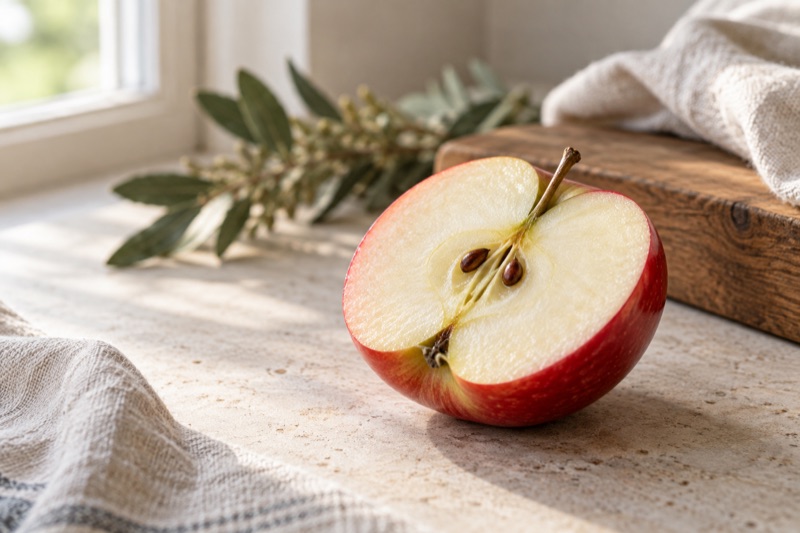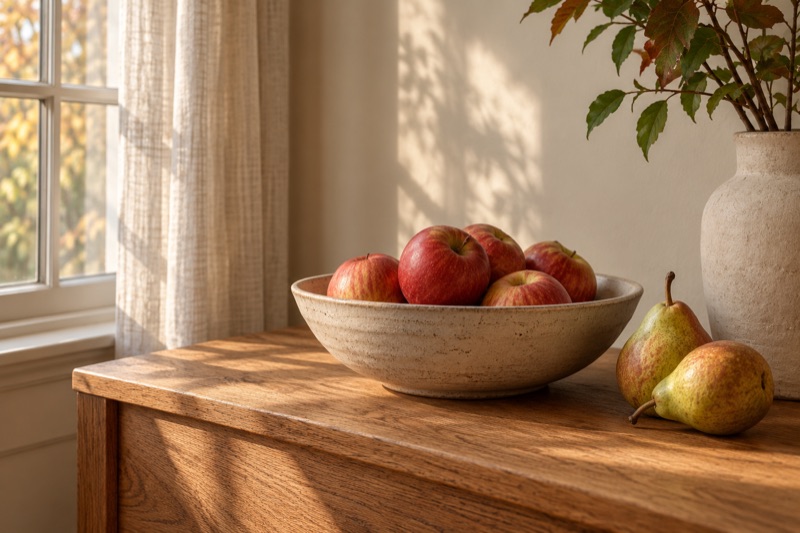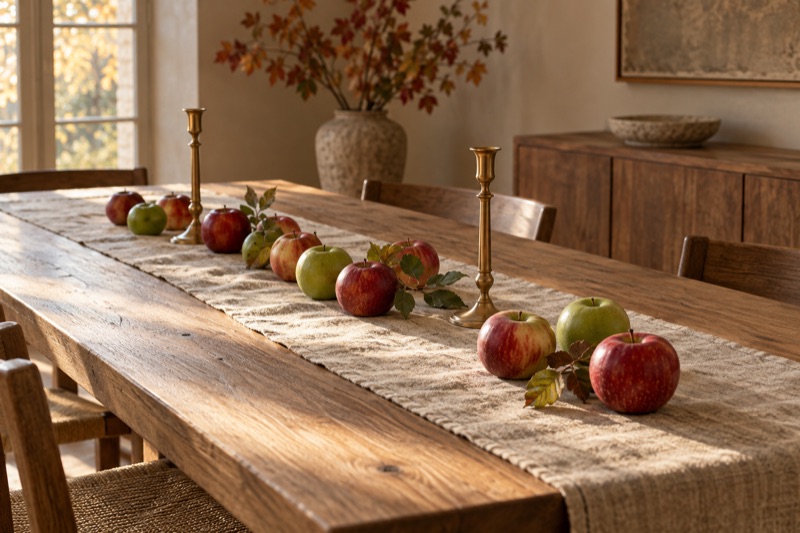
Fruit-shaped candles are candles molded, sculpted or painted to look like fruit: an apple, a pear, a lemon, a fig. Some are made to burn, with a wick and a burn time like any other candle. Others are made mainly to be looked at, and they descend from the wax fruit the Victorians kept under glass domes. Which kind you have decides almost everything else, from whether it's scented to where it should sit.
This guide covers where fruit candles come from, how they're made, what scent adds, and how to display and choose one, with a fair look at who makes them today.
What fruit candles are
"Fruit candle" covers three different objects, and shop listings often mix them up.
- Candles shaped like fruit. The wax itself is the fruit: an apple or a pear cast or modeled in wax, then colored, often with a wick at the stem. This guide is mostly about these.
- Fruit-shaped candle jars. An ordinary container candle poured into a glass or ceramic vessel shaped like a fruit. The apple-shaped candle jar is the familiar example. The fruit is the jar, the wax inside is a plain candle, and the vessel usually outlives it.
- Fruit-shaped candle holders. A holder in the form of a fruit, made to carry a taper or a tealight. Here the fruit never burns.
The first group belongs to a wider family of sculptural candles, candles made as objects. It splits again, into candles made to burn and candles made to keep. A fruit candle made to burn has a centered wick and burn instructions, and it loses its shape as it goes. One made to keep puts the form and the finish first. Many of those have wicks too, which is where the confusion starts. Should Decorative Candles Be Lit? explains how to tell them apart.
A short history of wax fruit
Wax fruit is far older than the fruit candle. Our short history of wax fruit traces it from Roman gifts at the Saturnalia to Victorian fruit under glass domes and the scientific fruit models of Turin and Melbourne.
The Victorian pieces were ornaments, not candles, and they were made the way many fruit candles still are. A Boston manual of 1864, Wax Flowers: How to Make Them, describes taking a plaster mold from a real fruit, pouring tinted wax into it to make a hollow cast, and then finishing the surface by hand with powdered color and painted streaks. Mold, cast, finish: the steps haven't changed much. The Philadelphia Museum of Art dates the American enthusiasm for wax fruit to the 1860s through the 1880s, the period of its Wax Fruit and Dessert Arrangement.
Wax fruit is one chapter in a longer story of fruit made from something else. Painters, potters and pastry chefs have all tried to fool the eye with it, as Trompe-l'Œil Fruit: The Art of Fooling the Eye shows. Fruit has a long life in painting too: see famous fruit still life paintings, and how to read them, why Cézanne painted apples and what the apple has symbolized, from Eden on.
The fruit candle, wax fruit with a wick, is the more recent turn. Cereria Introna, a candlemaker in Puglia that has been in the wax trade since 1840 by its own account, says it began making artistic candles alongside its votive candles in the early 1990s. Fruit and vegetables are among its themes.
How fruit candles are made: molding, sculpting, painting
Most fruit candles pass through three stages: a shape is made, wax is poured, and the surface is finished. Makers differ in how much of each is done by hand.
Molding
Casting is the simplest way to get a true-to-life shape. Melted wax is poured into a mold and released once it sets. A mold taken from real fruit carries over the dimples and creases of the skin. Happy Organics, a Los Angeles candlemaker, makes its Granny Smith apple from pure beeswax, hand-poured into molds cast from real apples, according to its stockist Lenox.
Cereria Introna works at a larger scale. By its own account it has built a library of more than 3,000 molds. It pours in paraffin with pure cotton wicks and says its artistic pieces are all handcrafted.
Sculpting and hand-finishing
Some makers sculpt the original by hand and take a mold from it, so the modeling happens once and each candle is poured from that mold. The hand comes back after the pour. Seams are cleaned, stems are set and the surface is worked until the piece reads as fruit rather than as a casting.
Fallow, a studio in St Leonards-on-Sea in Sussex, hand-pours its produce candles and finishes each one individually. Tonal shifts and markings are applied by hand, so no two are quite alike, according to Holly & Co, which stocks its apples and pears. Its other stockist, Maison Flâneur, describes the studio's work as sculptural, nature-inspired candles.
Painting and finishing
Color can go into the wax, onto it, or both. Dye mixed into the wax gives an even ground color. Paint, powder or lacquer on the surface adds what makes fruit look like fruit: the blush on an apple's cheek, the freckles on a pear, the shine on a cherry.
Finishes vary widely. Fallow uses dyed wax and then marks the surface by hand. Bitossi Home's apple candles are a wax blend with a resin coating, finished in a glossy red or green lacquer, according to its US stockist Stardust.
A painted surface changes what happens if you light the candle. Paint isn't wax, and as the wax underneath softens, the finish slumps, smears or runs. Some exterior coatings can catch fire. In 2008 the US Consumer Product Safety Commission announced a recall of decorative candles after reports of the gold paint on their exteriors igniting. Can You Burn a Painted Candle? goes into how hand-painting works and what a flame does to it.
| Method | What it gives you | What to look for |
|---|---|---|
| Cast from real fruit | True-to-life skin texture and a consistent shape | Clean seams, and a stem that isn't an afterthought |
| Sculpted and hand-finished | Individual markings; no two quite alike | Variation that looks intended, not accidental |
| Painted or lacquered | Blush, speckle and shine | Whether the maker says it can be lit |
Scented or unscented
A fruit shape doesn't promise a fruit scent. Many fruit candles are unscented: Holly & Co lists Fallow's Granny Smith apple as unscented. Beeswax brings a scent of its own, and Lenox describes Happy Organics' apple as having a "gentle natural honey aroma." Others carry a fragrance, which may or may not smell of the fruit they look like.
Two terms help here. Candlemakers call the scent a candle gives off before it's lit its cold throw, and the scent while it burns its hot throw. CandleScience, a candle-making supplier, defines cold throw as the strength of fragrance "before a candle has been burned for the first time." Most scented candles are built around their hot throw and smell faint until lit. A few objects are built the other way, to scent a room with no flame. Candles That Scent a Room Without Being Lit explains what makes them work, and Cold Throw vs Hot Throw compares the two.
| Unscented | Scented, made to burn | Scented, made to scent unlit | |
|---|---|---|---|
| What you smell | Nothing, or the wax itself | Little until it's lit | The fragrance, with no flame |
| The shape | Lost if you burn it | Lost as it burns | Kept |
| Suits | Dinner tables and kitchens | Living rooms in the evening | Entries, shelves, bedside tables |
On a dining table, an unscented candle has nothing to compete with the food. In a room you want to smell of something, scent is the point.
If you do want an apple that smells of apple, know that apple covers a wide range in fragrance, from crisp green skin to baked fruit and spice. What Does an Apple Candle Smell Like? breaks down the fresh side, Apple Candles Without the Cinnamon is for anyone tired of apple pie, and Fruit Notes in Fragrance covers pear, peach, fig and melon as well.
How to display fruit candles
The best displays treat a fruit candle as fruit first and candle second.
- In a bowl with real fruit. Set a wax apple among real ones and see who notices. It's the trick behind every piece of trompe-l'œil fruit.
- Under glass. The Victorians kept wax fruit under domes, and the logic still holds. Glass keeps dust off a surface that's hard to clean and turns a single piece into a display. A cloche is for unlit pieces only, never a lit flame. How to Use a Candle Cloche covers sizing, bases and safety.
- On a small plate or cake stand. A plate gives a single fruit a stage and catches drips if it's ever lit. In a roundup of sculptural candles, Nuvo noted that many "lose their distinctive shape as they burn" and suggested setting them on a plate.
- On a party table. Fruit candles make good place-setting favors, or a centerpiece run down the middle of a long table. If they'll be lit, choose ones made to burn, and keep them clear of napkins and flowers.
- Through the year. An apple suits a spring kitchen as well as an autumn mantel. See Apple Decor Ideas for the Kitchen, Table and Mantel, Faux Fruit Decor That Doesn't Look Fake and Fruit Is the New Floral.
A few habits keep a fruit candle looking like fruit:
- Keep it out of bright light. The National Candle Association warns that candles may fade in bright light over time, and recommends storing them somewhere cool, dark and dry.
- Keep it away from heat. Radiators, stovetops, sunny windowsills and the mantel over a working fireplace all soften wax.
- Dust it gently. The NCA suggests a piece of nylon or a soft cloth. On a painted piece, a cloche saves you the trouble.
- Expect bloom on natural wax. Fallow's listing on Holly & Co notes that natural waxes can "bloom," leaving a dusty look that a warm hand will lift.
- If you light one, watch it. The NCA's safety tips apply to every candle: a stable, heat-resistant surface, at least 12 inches from anything that can burn, and never left unattended.
Choosing one
Five questions narrow it down.
- Will you burn it? If so, look for a centered wick and burn instructions, and accept that the shape is temporary. If not, choose for form and finish, and read what the maker says about lighting it.
- Do you want scent? Unscented for the table. Scented for a room. If you want scent without a flame, look for a piece designed for it, because most candles aren't.
- How big? A life-size fruit reads as real fruit at a glance, which is the pleasure of the thing. Larger pieces read as sculpture.
- What wax and finish? Beeswax, paraffin, soy and blends all take a mold. A painted or lacquered surface is the most delicate, and the least suited to a flame.
- Who made it? Hand-finished pieces vary from one to the next. That's the mark of the hand, not a fault.
Here is how some of today's fruit candles compare, from each maker's own site or its stockists, checked in October 2026.
| Maker | Based | Wax | How it's made | Scent | Made to |
|---|---|---|---|---|---|
| Cereria Introna | Puglia, Italy | Paraffin, cotton wicks | Cast from more than 3,000 molds; artistic pieces handcrafted | Not stated for its fruit | Burn |
| Fallow | St Leonards-on-Sea, Sussex | Natural wax blend | Hand-poured, finished by hand | Granny Smith apple is unscented | Burn; listed at 5 hours |
| Happy Organics | Los Angeles | 100% beeswax | Poured by hand into molds cast from real apples | Beeswax's honey aroma | Burn; listed at about 20 hours |
| Bitossi Home | Italy | Wax blend, resin coating | Red or green lacquer finish | Not stated | Burn; wick-trimming instructions given |
| Le Bonne Pomme | Designed in France | Hand-poured soy and beeswax | Hand-painted one by one; presented under a handblown glass cloche | Fragrance by Mane, the French fragrance house founded in 1871 | Scent a room unlit |
That last one is ours. Le Bonne Pomme is a 50 g (1.76 oz) apple, handcrafted one at a time, in small runs. It's designed for cold diffusion: displayed under its cloche, it scents a room without being lit, for about 60 days, depending on room size. Its notes open on crisp apple skin, melon and peach, with rose and red berries at the heart and caramel, musk and wood at the base. It can be lit, but isn't meant to be: the painted finish will melt and the wax may drip, which is not a defect.
A fruit you could mistake for the real thing
Every good fruit candle, old or new, asks for a second look. The Victorians wanted their wax fruit taken for real until someone reached for it; today's makers add a wick, a scent or both. If you're drawn to the name as much as the object, What Does 'Pommette' Mean? explains ours. And if you'd like an apple that keeps its shape and scents the room instead, Le Bonne Pomme was made for exactly that.
Frequently asked questions
Are fruit-shaped candles meant to be burned?
Some are and some aren't. A centered wick, a safety label and burn instructions mean the maker expects you to burn it. If a piece is painted or lacquered, or sold for display, treat it as an object and leave it unlit.
What's the difference between wax fruit and a fruit candle?
Wax fruit is an ornament with no wick, made only to be looked at, like the Victorian fruit kept under glass domes. A fruit candle adds a wick, and sometimes a scent. Some modern pieces sit between the two: they have a wick but are made mainly for display.
Do fruit-shaped candles smell like fruit?
Not necessarily. Many are unscented, and beeswax ones smell faintly of honey. Scented ones may smell of the fruit they depict or of something else entirely, so read the notes rather than trusting the shape.
Are fruit-shaped candles good for a party?
Yes, as favors at each place or as a centerpiece. Choose unscented candles for a dinner table, and if you plan to light them, choose ones made to burn and set them on plates.
What is an apple-shaped candle jar?
It's a container candle poured into a glass or ceramic vessel shaped like an apple. The vessel is the fruit, and you can usually reuse it once the candle has burned down.