Paul Cézanne painted apples because they held still. A few apples on a table kept their shape and color through the long sessions a famously slow painter needed, and that patience let him study what mattered to him most: how color builds form, how solid things sit in space and how each object on a table leans on its neighbors. Few painters have asked so much of a piece of fruit, and what Cézanne did with it helped turn painting toward the 20th century.
He knew how much he was asking. The critic Gustave Geffroy remembered him vowing to astonish Paris with an apple. Here is where he came from, what the apples were for, the paintings to see, and what happened to the apple after him.
Cézanne and Provence
Cézanne was born in Aix-en-Provence in 1839 and died there in 1906. His father made and sold hats on the Cours Mirabeau before opening a bank, and in 1859 he bought the Jas de Bouffan, a country house west of Aix. It became the young painter's studio and refuge until the family sold it in 1899, according to the Atelier des Lauves visitor guide.
Even his name belongs to Provence. For its 2022 exhibition, Tate spelled it Cezanne, without the accent, after the painter's grandson argued that the accent was a Paris habit the south didn't share, as The Art Newspaper reported. The Courtauld kept it, and so do we.
At the Collège Bourbon in Aix he became close friends with Émile Zola, who encouraged him through his first difficult years in Paris. From about 1858 to 1872 he moved between the capital and home. He showed with the Impressionists in 1874 and 1877, and Britannica notes that his pictures were the most severely criticized in both shows. He kept working, and kept going back south for the light.
After the Jas de Bouffan was sold, he bought land on the Lauves hill above Aix and in 1902 moved into a studio built to his design. It has a north-facing window five meters by three, and he had the walls painted gray for a soft, even light. Jars and the plaster Cupid from his still lifes are still in the room. In October 1906 he was caught in a storm while painting outdoors, and he died a few days later.
What the apples were for
Patience
Cézanne painted slowly. Cut flowers wilted under his gaze, so, as the Met notes, he rarely painted them and preferred artificial ones. Geffroy remembered him bringing an artificial rose to the sittings for Geffroy's portrait.
Sitters were worse. When the dealer Ambroise Vollard dozed off during a sitting and toppled off his chair, Cézanne scolded him, by Vollard's account: "Does an apple move?" In the same memoir, Vollard explains that models willing to sit still were hard to find, so Cézanne turned to apples and to paper flowers, though even those faded in the end.
Form
An apple is close to a sphere, and spheres were on his mind. In a letter of April 1904 he urged the young painter Émile Bernard to treat nature "by the cylinder, the sphere, the cone" (Bernard, Souvenirs sur Paul Cézanne; our translation). In his apples, the Met observes, a sense of solidity is closely tied to their spherical geometry. They read as weight as much as color.
Color
From the mid-1870s he stopped relying on strong light and shadow. Instead, the Met's essay on Cézanne explains, he built volume with small, graded strokes of color placed side by side. By about 1890 his fruit was modeled almost entirely through subtle shifts of hue.
Structure
He also gave up single-point perspective. In his still lifes, each object keeps its own space, and the relations between objects matter more than a consistent vanishing point. At the Lauves studio, the guide explains that he walked around his arrangements and combined several viewpoints in one canvas, so that a jar shows its front, its top and a little of its inside at once. The tilted tables and slipping tablecloths that look like mistakes are the point.
Ambition
Still life sat at the bottom of the French Academy's ranking of subjects, as Tate explains. The Musée de l'Orangerie writes that Cézanne set out to restore the genre's standing, and the Musée d'Orsay sees him renewing a French tradition that ran back to Chardin.
That is the context for his most quoted line. Geffroy, who knew him through Monet and sat for an unfinished portrait in 1895, wrote in his 1922 book on Monet that Cézanne used to proclaim: "Avec une pomme, je veux étonner Paris!" With an apple, I want to astonish Paris. It reaches us secondhand, published 16 years after the painter died, and when the Musée de l'Orangerie and the Met's catalogue quote it, they credit Geffroy.
The apple had a personal history for him, too. Cézanne told the poet Joachim Gasquet that his friendship with Zola began at school, when he took a beating from the other boys for talking to the one they shunned. The next day, Zola brought him a big basket of apples. "There you are, Cézanne's apples," the painter said; "they go back a long way" (Gasquet, Cézanne; our translation).
Key paintings
Cézanne made about two hundred still lifes over four decades, according to MoMA, and apples turn up again and again. These are among the best known, each with a museum page where you can look closely.
| Painting | Date | Collection | What to look for |
|---|---|---|---|
| Still Life with Fruit Dish | 1879–80 | MoMA, New York | Paul Gauguin owned it, called it "an exceptional pearl, the apple of my eye," and sold it only when he needed money for medical care |
| Apples and Biscuits | 1880 | Musée de l'Orangerie, Paris | A plate and a few apples on a chest, balanced with almost nothing else |
| Still Life with Apples and a Pot of Primroses | c. 1890 | The Met, New York | Once Claude Monet's, a gift from the painter Paul Helleu in 1894 |
| Still Life with Apples and Pears | c. 1891–92 | The Met | Provençal apples and Beurré Diel pears, seen straight on, from above and from the side |
| The Basket of Apples | c. 1893 | Art Institute of Chicago | A misaligned tabletop, a tilting bottle and a stack of biscuits that ought to topple; he signed it, which he rarely did |
| Still Life with Plaster Cupid | c. 1894 | The Courtauld, London | A green apple at the back that looks too big, on a floor that seems to tilt |
| Still Life with Apples | 1895–98 | MoMA | Lillie P. Bliss paid $21,000 for it in 1922, and her will barred the museum from ever selling it |
| Apples and Oranges | c. 1899 | Musée d'Orsay, Paris | One of six still lifes painted in his Paris studio in 1899 with the same props; the Orsay ranks it his most important still life of the late 1890s |
| Still Life with Apples and Peaches | c. 1905 | National Gallery of Art, Washington | A table that tilts unexpectedly and a flowered pitcher he kept in the studio |
For a larger group in one place, the Barnes Foundation in Philadelphia owns 69 works by Cézanne, 16 of them still lifes. In 2014 it showed them together under the title The World Is an Apple. Pictures go on and off view, so check a museum's page before you travel to see one.
The apple after Cézanne
In any history of apples in art, Cézanne is the hinge. Recognition came late. Vollard gave him his first solo show in 1895, and a retrospective at the Salon d'Automne in 1907, the year after his death, established his legacy, as the Met puts it.
Painters were looking earlier than that. In 1890 Gauguin set Still Life with Fruit Dish behind the sitter in his Woman in Front of a Still Life by Cezanne, at nearly the size of the original. Cézanne complained to Geffroy that Gauguin had stolen his "petite sensation," and the Art Institute of Chicago suggests this picture may be what he had in mind.
Then came the Cubists. Britannica credits Cézanne's spatial experiments with laying the foundation for Picasso's Cubism, and the Met sees his geometric landscapes anticipating Braque's work around 1908. Britannica also records Picasso calling him "the father of us all."
Art historians kept arguing about what the apples meant. In 1968 Meyer Schapiro published "The Apples of Cézanne: An Essay on the Meaning of Still-Life," listed in the Cézanne catalogue raisonné. He read the fruit as an outlet for desires the painter kept in check, a psychological interpretation that has been debated ever since.
Living with the apple today
The Lauves studio, owned by the city of Aix-en-Provence since 1969, still keeps the props he painted. If you plan a visit, check Cezanne en Provence for opening dates.
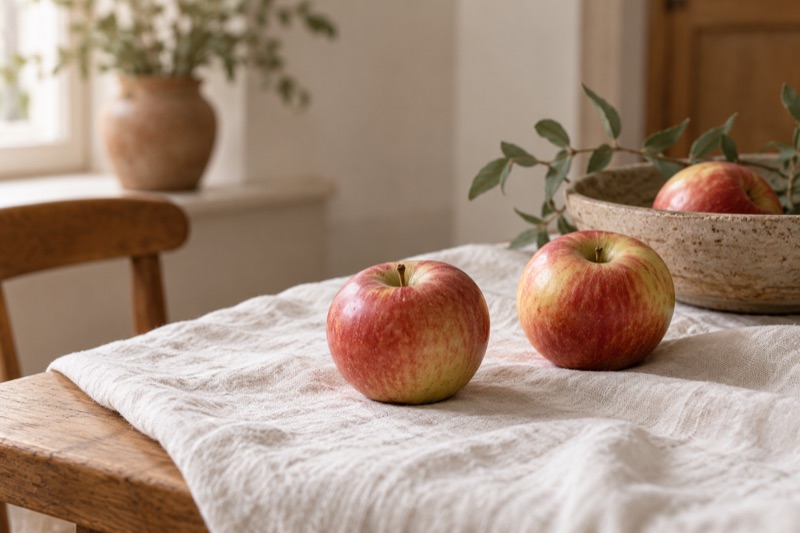
At home, the lesson of Cézanne's apples is to give a still life time. Set three or four apples on a white cloth near a north-facing window and look at them on different days and at different hours. Watch where the color turns as one fruit meets the next, and how the cloth folds into small hills around them.
Le Bonne Pomme is our apple that holds still. It is hand-poured from soy and beeswax, hand-painted one by one and presented under a handblown glass cloche, and it is designed in France. Displayed under its cloche, it scents a room without being lit, opening on crisp apple skin, melon and peach, with rose and red berries at its heart and caramel, musk and wood beneath. It can be lit, but isn't meant to be: the painted finish will melt and the wax may drip, which is not a defect.
For more fruit in wax and paint, see our guide to fruit-shaped candles, a short history of wax fruit and Trompe-l'Œil Fruit: The Art of Fooling the Eye. Cézanne's apples sit in a longer line, traced in famous fruit still life paintings, and how to read them and in what the apple has symbolized, from Eden on. For the scent itself, read what an apple candle smells like and our notes on apple candles without the cinnamon.
Le Bonne Pomme won't astonish Paris. It sits still, the way Cézanne liked his apples, and lets the room smell of them.
Frequently asked questions
Why did Cézanne paint so many apples?
Apples held still and kept their color through his slow sessions, which flowers and restless sitters didn't. Their near-spherical shape also suited his study of form, color and space, and he wanted to show that a humble still life could carry ambitious painting.
Did Cézanne really say he would astonish Paris with an apple?
The line comes from the critic Gustave Geffroy, who knew him and recalled it in his 1922 book on Monet: "With an apple, I want to astonish Paris!" The Musée de l'Orangerie and the Met's catalogue both credit Geffroy for it.
Where can I see Cézanne's apple paintings?
MoMA and the Met in New York, the Art Institute of Chicago, the National Gallery of Art in Washington, the Courtauld in London, and the Musée d'Orsay and Musée de l'Orangerie in Paris all hold examples, and the Barnes Foundation in Philadelphia has 16 of his still lifes. Displays change, so check before you go.
What is Cézanne's most famous apple painting?
There's no single answer. The Basket of Apples in Chicago, Still Life with Fruit Dish at MoMA, which Gauguin treasured, and Apples and Oranges at the Musée d'Orsay, which the museum ranks as his most important still life of the late 1890s, are among the most celebrated.