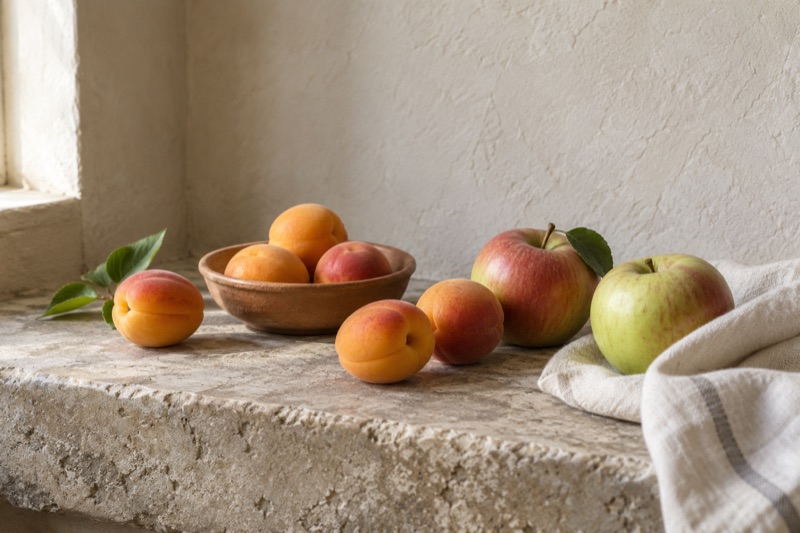
The most famous fruit still life paintings include Caravaggio's Basket of Fruit, Juan Sánchez Cotán's quince and cabbage hanging in a window, the Dutch Golden Age tables of Balthasar van der Ast, Willem Kalf and Adriaen Coorte, Chardin's pyramid of strawberries and Cézanne's apples. Each sets fruit on a ledge or table and asks you to look harder than you usually would. Read the fruit closely and these pictures speak of plenty, of the pleasures of the senses and of time running out.
Here is what a still life is, how to read the fruit in one, and nine paintings worth seeking out, each with a link to the museum that holds it.
What a still life is
A still life is a picture of things that don't move. Tate defines it as one of the principal genres of Western art, whose subject is anything that does not move or is dead. In English the term dates to 1695, according to Merriam-Webster, and the plural is still lifes. The French call it nature morte, "dead nature."
Painters had included fruit and flowers in religious pictures for centuries, but still life as an independent specialty first flourished in the Netherlands in the early 1600s, as the Met explains, with Italian and Spanish traditions growing up at the same time. It was not a prestigious genre. The French Academy ranked still life last among subjects in the 17th century because it had no human figures in it, and that low rank later became a challenge to painters such as Cézanne.
Reading the fruit
Fruit in a still life can mean several things at once. These are the signals to look for.
| What the fruit signals | What to look for | Where to see it |
|---|---|---|
| Abundance and trade | Heaped fruit, imported citrus, Chinese porcelain, silver | Kalf |
| The senses | Skins you can almost feel: velvety apricots, pitted citron peel, the bloom on grapes | Coorte, Garzoni |
| Transience | Wormholes, rot spots, curling leaves, insects | Caravaggio, van der Ast |
| Vanitas | Fruit beside a skull or a pocket watch, as a reminder that pleasure is brief | Dutch vanitas pieces |
| Sin and redemption | In religious painting, apples for the Fall | Crivelli |
| Order | A few pieces of fruit, spaced like a demonstration | Sánchez Cotán, Cézanne |
Hold the symbols lightly. In Carlo Crivelli's Madonna and Child, the Met reads the apples and a fly as signs of sin and the cucumber and goldfinch as signs of redemption. In Abraham van Beyeren's lavish Still Life with Lobster and Fruit, though, the same museum suggests that the pocket watch may be more of an intellectual conceit than a sober warning. Often the fruit is there because it was beautiful, expensive or in season, and the painter wanted to show off. For more on the apple's meanings, see what the apple has symbolized, from Eden on.
Nine paintings
Caravaggio, Basket of Fruit, late 1590s or early 1600s
A wicker basket of fruit and leaves juts over the edge of a ledge against a plain, pale ground. Look closely and nothing is perfect: an apple has a wormhole, and the leaves are spotted and curling. Cardinal Federico Borromeo gave it to the Pinacoteca Ambrosiana in Milan in 1618. The museum calls it a prototype of the still life genre and reads the fresh and worm-eaten fruit side by side as an image of time passing.
Juan Sánchez Cotán, Quince, Cabbage, Melon and Cucumber, c. 1602
A quince and a cabbage hang on strings inside a stone window frame. Below them, a cut melon, a slice of it and a cucumber sit on the sill, the cucumber poking out over the edge. It belongs to the San Diego Museum of Art, whose curator points out that every item was a staple of Spanish cooking, much of it brought to Iberia during what historians call the Arab Agricultural Revolution. The Meadows Museum ranks it among the earliest and best still lifes in European art and describes Sánchez Cotán as an artist-turned-monk. The picture has a monk's economy: five objects, a dark void and a great deal of attention.
Balthasar van der Ast, Still Life of Fruit and Flowers, 1620–21
This is the Dutch still life at its most crowded: flowers in a vase, a bowl of fruit, exotic shells and a small army of insects. The Rijksmuseum invites you to marvel at the richness of creation, and then to notice the decay spreading through it. The fruit has its first rotten spots, caterpillars and snails have eaten the leaves, and ants are dragging away a dead fly. Plenty and transience share a single tabletop.
Giovanna Garzoni, Still Life with Bowl of Citrons, late 1640s
Garzoni painted in tempera on vellum, in meticulous detail. Here citrons with their leafy branches still attached overflow a worn ceramic bowl, and a wasp hovers in front. The Getty points to the contrasts she worked so hard on: rough, heavy rind against sharp branches, glossy leaves and star-like blossoms. Pictures of natura sospesa, "nature suspended," were fashionable among courtiers interested in science, and hers were among the most coveted. This is a painting about the senses, especially touch.
Willem Kalf, Still Life with a Silver Jug and a Porcelain Bowl, 1655–60
By the 1650s Amsterdam was the Dutch Republic's financial capital, and painters like Kalf made pronk, or display, still lifes of imported fruit, Chinese porcelain and silver, the Met explains. Here oranges and a half-peeled lemon spill from a blue-and-white bowl beside an ornate silver jug and a glass of wine in a gilded holder. The Rijksmuseum notes that Kalf usually chose rare porcelain that was already decades old, and sometimes combined details from several pieces into one. Everything on the ledge says money, and the fruit is part of the display.
Adriaen Coorte, Still Life with Five Apricots, 1704
Working at the very end of the Golden Age, Coorte painted small pictures with one simple layout: a little fruit on a stone ledge, in light, against the dark. This one is only 30 by 23.5 centimeters. The Mauritshuis singles out how velvety and tactile the five apricots look. The Frick adds that Coorte preferred common objects to costly ones. It reads his perishable fruit and the insect holes in the leaves as a possible nod to vanitas.
Jean Siméon Chardin, Basket of Wild Strawberries, shown in 1761
Chardin showed this picture at the Louvre's Salon in the summer of 1761, at the height of his career, and it is one of his last still lifes. A compact pyramid of strawberries in a basket is balanced by a glass of water. The Louvre describes the challenge he set himself: painting the red mass as one solid form and as a fragile stack of small, unsteady berries at the same time. It stayed in private hands until 2024, when the Louvre acquired it with help from 10,000 individual donors.
Luis Meléndez, Still Life with Oranges and Walnuts, 1772
The Spanish painter piled a plate high with walnuts and scattered chestnuts and oranges beside it, with a huge melon behind. The National Gallery in London draws attention to the intense light that brings out every texture, from the dimpled orange peel to the nutshells. Some of the walnuts have been opened but not eaten, as though someone had started to prepare a meal and stepped away.
Paul Cézanne, The Basket of Apples, c. 1893
Cézanne took the old genre apart. In this picture at the Art Institute of Chicago, the tabletop doesn't line up, the bottle leans, the apples cascade and a stack of biscuits stops just short of falling out of the frame. The museum calls it controlled chaos. Cézanne rarely signed his work, so his signature here suggests how much the picture mattered to him. The Musée d'Orsay sees his still lifes renewing a French tradition that ran back to Chardin. Read why Cézanne painted apples for the full story.
Still life at home
You can read any fruit still life with three questions. What condition is the fruit in: perfect, bruised or beginning to turn? Where does the light come from, and what does it touch? What sits next to the fruit, and what does that tell you about the household, its wealth or its piety?
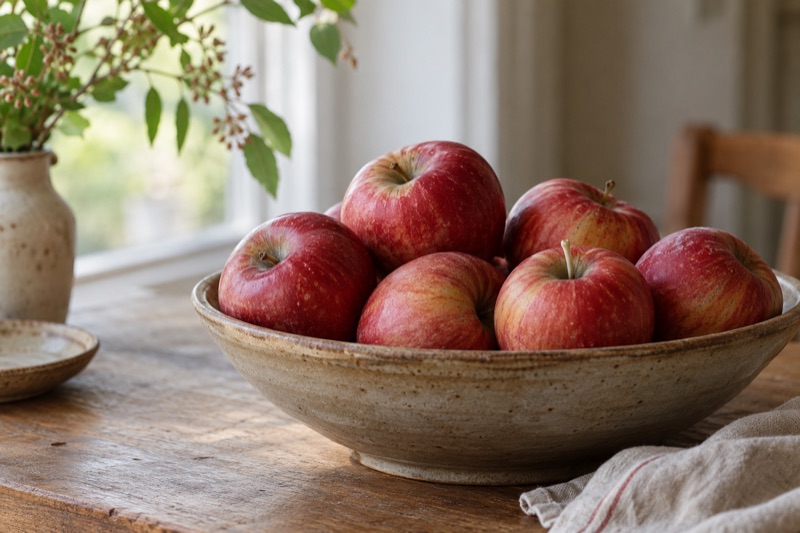
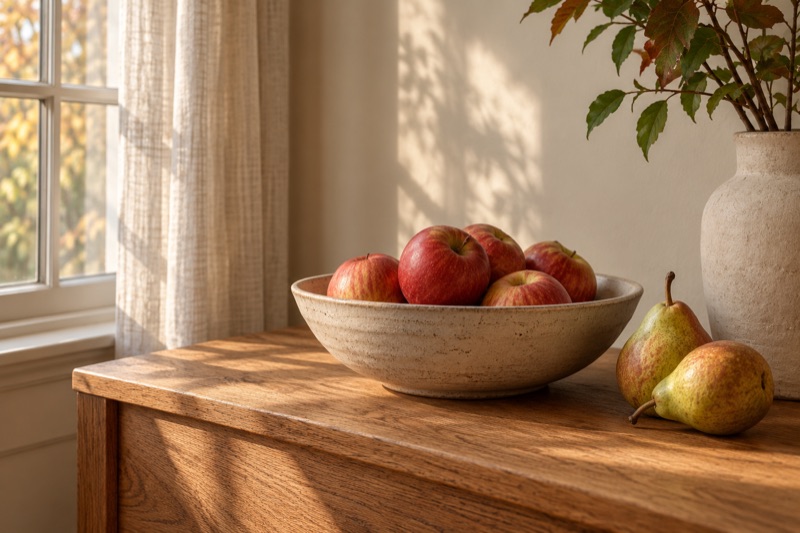
You can also set one up. Choose a few pieces of fruit with different skins, put them on a plain cloth near a single window, and leave them for a few days. Notice how the color shifts as they ripen and how the arrangement changes the room. Real fruit doesn't last, of course, which is exactly what the vanitas painters wanted you to feel.
Le Bonne Pomme is a still life that won't ripen, and it does something the paintings can't: it scents the room. It is a single apple of hand-poured soy and beeswax, hand-painted one by one and presented under a handblown glass cloche. Displayed under its cloche, it scents a room without being lit, with notes of crisp apple skin, melon and peach over rose, red berries, caramel, musk and wood. It can be lit, but isn't meant to be: the painted finish will melt and the wax may drip, which is not a defect.
Fruit made to fool the eye has its own history, told in Trompe-l'Œil Fruit: The Art of Fooling the Eye and a short history of wax fruit. For fruit candles today, see our guide to fruit-shaped candles, and for the scent, what an apple candle smells like and apple candles without the cinnamon.
A still life asks you to slow down and look. Le Bonne Pomme asks the same, under glass.
Frequently asked questions
What is a still life with fruit?
It's a painting, drawing or photograph in which fruit is the main subject, usually arranged on a table or ledge with dishes, cloth or flowers. The genre took off in the Netherlands in the early 1600s, with Italian and Spanish painters working in it at the same time, and it has never really gone away.
What is considered a still life?
Any picture whose subject is inanimate: fruit, flowers, food, tableware, books, instruments, even dead game. Merriam-Webster defines it as a picture consisting mainly of inanimate objects.
How do you draw a still life of fruit?
Set up a few pieces of fruit with one strong light source to the side. Sketch each piece as a simple shape first, a circle or an oval, and check how they overlap. Then find the light: the brightest highlight, the darkest part of the shadow on the fruit, and the cast shadow on the table. Build the color or tone gradually rather than outlining hard, and look at the fruit more than at your paper.
Why do still life paintings show rotting fruit?
Often as a reminder that beauty and pleasure don't last. The Ambrosiana reads the worm-eaten fruit in Caravaggio's Basket of Fruit as an image of time passing, and the Rijksmuseum sees van der Ast's spoiling fruit as a picture of impermanence.