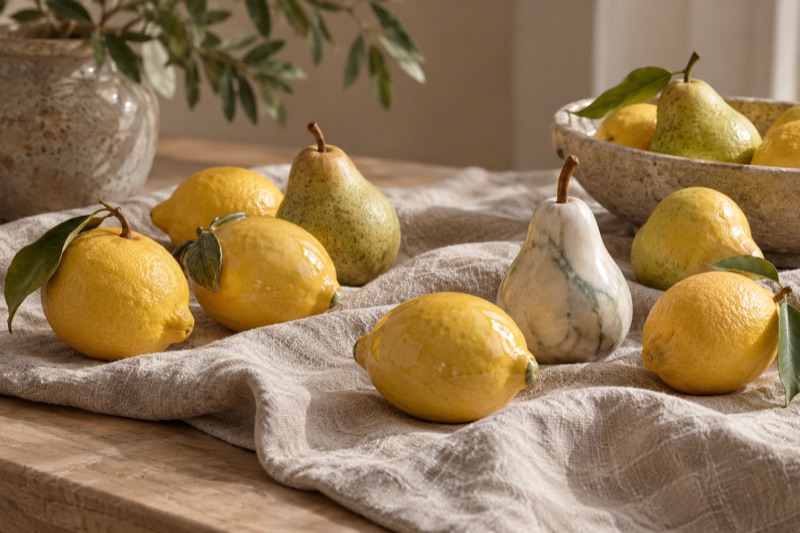
Trompe-l'œil fruit is fruit made from something else, such as paint, glazed earthenware, porcelain, sugar or wax, so convincingly that the eye takes it for the real thing, at least for a moment. The French phrase means "deceive the eye." It came into use around 1800, but the game is far older.
It runs from a Greek painter's grapes to the faïence cabbages of eighteenth-century French tables and the sculpted fruit pastries of Paris today. This is a short tour of how artists, potters and pastry chefs have fooled the eye with fruit, and why fruit suits the trick so well.
What trompe-l'œil means
Literally, trompe-l'œil means "deceives the eye". English usually writes it trompe l'oeil, with no ligature or hyphen, and Merriam-Webster dates its first English use to 1889.
The French term is younger than the practice. According to the Musée Marmottan Monet, it is believed to have been used first by the painter Louis-Léopold Boilly, in the caption of a work shown at the Paris Salon of 1800. The Académie française adopted it in 1835.
The National Gallery of Art in Washington, in its 2002 survey of the genre, defined its subject as works that "momentarily fool the eye with the appearance of reality."
Realism alone isn't enough. In the teaching notes for its 2024–25 exhibition, the Marmottan sets out the conventions of trompe-l'œil:
- Objects are shown at life size.
- The artist's brushwork, and often the signature, is hidden.
- Depth is kept shallow.
- The picture suits the place where it hangs.
Above all, the artist means to deceive. A still life can be faithful without trying to fool anyone; a trompe-l'œil sets out to.
Fruit suits the trick. Everyone knows how an apple or a bunch of grapes should look, so a good copy is believed at a glance, and the moment of doubt is all the sweeter.
The painters
The founding story is about fruit. In his Natural History, Pliny the Elder tells how the Greek painter Zeuxis painted grapes so naturally that birds flew down to them. His rival Parrhasius then showed a painted curtain, and Zeuxis asked for it to be drawn aside. Zeuxis conceded the contest, admitting that he "had only deceived the birds, Parrhasius had deceived him."
The ancient world had a word for painted food, too. The Roman architect Vitruvius records that Greek hosts sent guests gifts of chickens, eggs, vegetables and fruit. He adds that painters called pictures of such gifts "xenia". The National Gallery of Art opened its 2002 survey with Zeuxis's grapes and with xenia.
Later painters kept answering Zeuxis. In 1677 the French portraitist Nicolas de Largillière painted two bunches of grapes nailed to a wall. The Fondation Custodia in Paris, which owns the panel, calls it unique in his work. It hung in the Marmottan's trompe-l'œil exhibition alongside work by Boilly himself.
Faïence fruit and the French table
In the eighteenth century, the illusion moved from the wall to the dinner table, in faïence.
Faïence is tin-glazed earthenware, with a milky white glaze made opaque with tin oxide. The Metropolitan Museum of Art notes that it appeared in France in the sixteenth century and was used at the court of Louis XIV for elaborate meals and displays. Later, a lower-temperature firing known as petit feu allowed more precise painting and a wider range of colors, which suited naturalistic fruit and leaves.
The table they were made for was a stage. As the Philadelphia Museum of Art explains, a formal eighteenth-century dinner was treated as a kind of theater, and dessert, its closing act, was the most lavish and costly course. Its centerpieces often followed designs like those the French confectioner Joseph Gilliers published in Le Cannameliste français in 1751.
French potteries supplied those tables with cabbages, lettuces and leaves that were not what they seemed:
- Strasbourg. The Musée des Arts Décoratifs in Paris holds a vegetable dish and stand in the form of a cabbage from Paul Hannong's manufactory, about 1748–1754. The museum also displays trompe-l'œil service pieces of animals, vegetables and fruit in faïence and porcelain. The Musée Calvet in Avignon notes that Strasbourg produced a great many cabbages and lettuces between 1748 and 1754.
- Sceaux. The pottery near Paris made a cabbage tureen in yellow and green, dated between 1748 and 1763, now in the Musée du Domaine départemental de Sceaux. The V&A holds a Sceaux dessert dish of about 1755–1770, whose border is molded and painted as overlapping leaves.
- Niderviller. The Lorraine factory made a cabbage tureen with a matching platter between 1777 and 1780, now at the Detroit Institute of Arts.
The fashion was European. The Metropolitan Museum of Art holds a group of six tin-glazed earthenware fruits from around 1750–1775, and Meissen made a porcelain box in the form of a lemon around 1750–1755.
Part of the fun was what lay inside. The V&A's Chelsea cauliflower tureen of about 1755 probably held stewed fruit or other sweets at dessert, not vegetables. The V&A's essay on trompe-l'œil ceramics describes sweet contents sometimes hidden behind savory shapes, and notes that guests handled the pieces themselves, since servants did not attend dessert. In 1758 Benjamin Franklin sent his daughter English china "Melons and Leaves for a Desert of Fruit and Cream."
The idea has never quite gone away. In 2025 the Associated Press reported that cabbageware and lettuceware, popular in the eighteenth and nineteenth centuries and again in the 1960s, were back in fashion.
Fruit pastries that fool the eye
Trompe-l'œil fruit desserts grew up at the same table. The Philadelphia Museum of Art traces sugar sculpture as table decoration back to twelfth-century North Africa. It also notes that the porcelain figures Vincennes/Sèvres began making around 1751 resembled sugar sculpture but lasted longer.
One tradition survives intact. In Sicily, frutta martorana is almond paste shaped into fruit and vegetables, painted with food coloring and glazed with gum arabic. The Sicilian Region's tourism office notes that it appears in pastry-shop windows for the Day of the Dead on November 2. Tradition credits the nuns of the Martorana monastery in Palermo.
In modern pastry, the chef most associated with trompe-l'œil fruit is Cédric Grolet. He began a pastry apprenticeship at 13, worked at Fauchon in Paris from 2006, and joined Le Meurice, where he was given the dessert menu in 2013. His sculpted fruit made his name:
- The Lemon. One of his signature pieces pairs lemon curd and poached lemon with a white chocolate and yuzu ganache, inside a yellow lemon coating. A lemon-and-sugar spray gives it the texture of peel, and it is finished with a golden airbrush.
- Recognition. His first book, Fruits, came out in autumn 2017. In 2018 he was named The World's Best Pastry Chef by The World's 50 Best Restaurants.
- The boutique. Le Meurice opened his first pastry boutique in Paris on 20 March 2018.
Cut one open and these are, in effect, mousse cakes in disguise. The shop menus list their layers: mousse or whipped cream, gel or confit, sponge or a crisp praline base.
If you want to buy trompe-l'œil fruit pastries, the most direct route is Grolet's own counters. In Paris, La Pâtisserie du Meurice, at 6 rue de Castiglione, sells his Fruits Sculptés to take away; there is no seating. He also has a shop at 35 avenue de l'Opéra and, according to his website, counters at The Berkeley in London and in Saint-Tropez, Monaco and Singapore. The selection changes with the seasons, and the shops take pre-orders for click and collect.
An apple you could mistake for the real thing
Every piece in this story asks for a second look. Zeuxis wanted a bird to swoop, the eighteenth-century potter wanted a guest to lift the lid of a cabbage, and Grolet wants you to cut into a lemon.
Le Bonne Pomme asks for the same second look, in wax. It is hand-poured from soy and beeswax, hand-painted one at a time and presented under a handblown glass cloche. It isn't meant to be eaten, and it isn't a vessel. Its surprise is fragrance: displayed under its cloche, it is designed to scent a room without being lit, with top notes of crisp apple skin, melon and peach, a heart of rose and red berries, and a base of caramel, musk and wood. The fragrance is by Mane, the French fragrance house founded in 1871.
We don't claim kinship with Zeuxis or the Hannongs. The aim is simpler: an apple you could mistake for the real thing until you notice the room smells of it. For more fruit in wax, old and new, see our guide to fruit-shaped candles and a short history of wax fruit. For the scent itself, read what an apple candle smells like and our notes on apple candles without the cinnamon.
Frequently asked questions
What is trompe-l'œil painting?
It is painting meant to deceive the viewer, briefly, into believing a painted object is real. Objects are usually shown at life size, with shallow depth and invisible brushwork. Classic subjects include fruit, letter racks, hunting trophies, curtains, and objects set in niches or cupboards.
How do you pronounce trompe-l'œil?
In English it's usually said "tromp-LOY." Merriam-Webster also lists "tromp-luh-EE" and the French pronunciation, which has a nasal vowel.
What are some famous examples of trompe-l'œil fruit?
Zeuxis's grapes, known from Pliny, are the legendary first. Others include Largillière's two bunches of grapes nailed to a wall (1677), the faïence cabbage tureens of Strasbourg, Sceaux and Niderviller, and Cédric Grolet's sculpted lemons and other fruit in Paris.
Where can you buy trompe-l'œil fruit pastries?
Cédric Grolet sells his sculpted fruit at La Pâtisserie du Meurice and his Opéra shop in Paris, and at The Berkeley in London, among other locations. In Sicily, painted almond-paste frutta martorana is sold in pastry shops, especially around November 2.