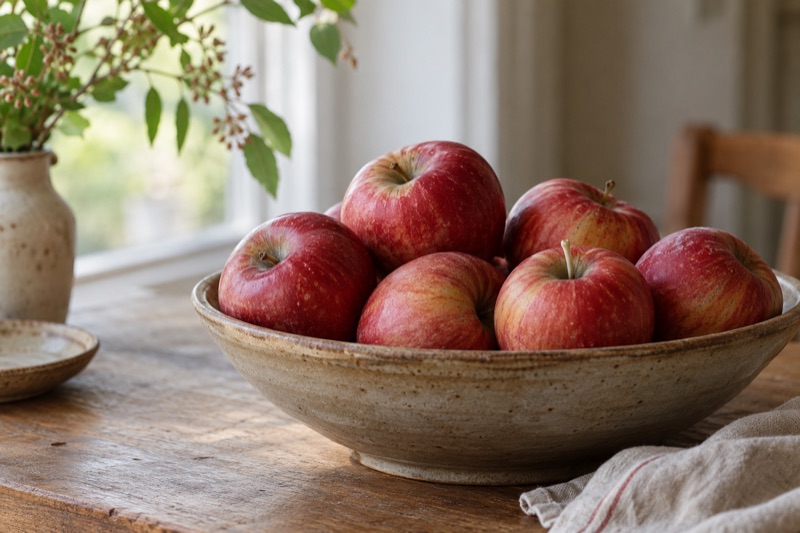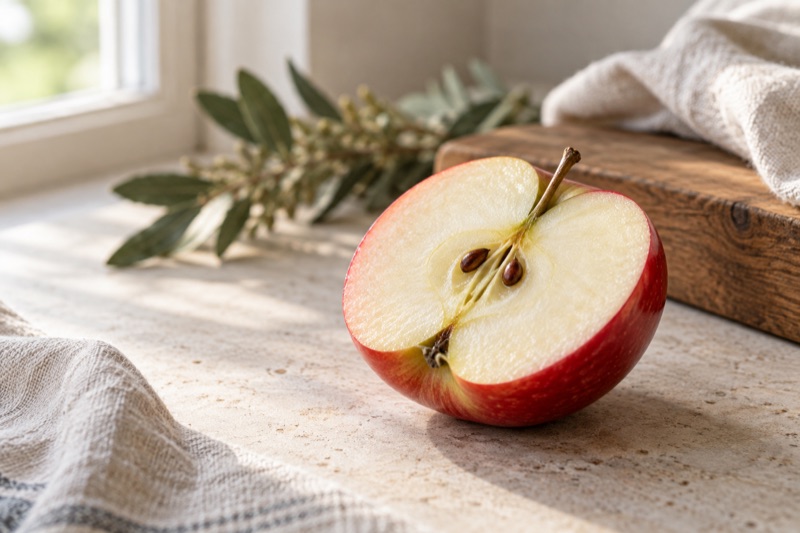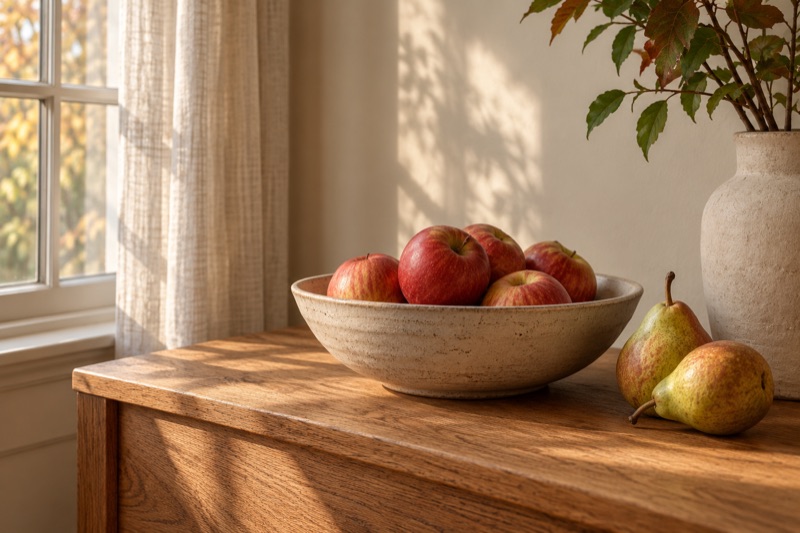
Faux fruit decor looks real when it gets the details a real fruit has: a skin that isn't glossy, color that shifts across the surface, a mark or two, some weight in the hand and a believable stem. It looks fake when it's shiny, identical and bought by the dozen. So choose one well-made piece in wax, ceramic or glass over a bowl of matching plastic, give it a surface of its own, and keep something real nearby.
This guide covers why most faux fruit gives itself away, how the materials compare, whether to use one piece or a bowl, and seven styling ideas.
Why most faux fruit looks fake
Plastic gets the blame, and design writer Sarah Archer, quoted in Slate, ties fake fruit's kitsch reputation to household plastics after the Second World War. But the problem is in the details, and there are five tells.
- The shine. Slate's Chason Gordon says that even as fakes get more realistic, the too-shiny look and the artificial feel still give them away. A real apple does carry its own wax, a thin natural layer that shines when you buff it with a cloth, but it isn't a lacquer applied evenly all over.
- The sameness. Real fruit is flawed. Russet, a rough, light brown patch, can cover a small area or nearly the whole apple, and a variety like Roxbury Russet is usually fully covered. The Whipple Museum's set of twenty-four wax apples, made around 1850, runs from crab apples to cooking apples and includes realistic bruises and skin damage.
- The eye and the stalk. An 1864 manual on modeling wax fruit has the maker press a heated clove into an apple's base to imitate the remains of the calyx, and notes that apple and plum stalks are generally bent. A 1999 US patent for mass-produced fruit admits that hand-wrapped paper stems could unravel and look unrealistic.
- The weight. The same patent says artificial fruit was traditionally molded foam, and names a realistic weight and feel among its aims. Fruit gets picked up. A piece that weighs nothing gives itself away.
- The company it keeps. A dozen identical pieces ask the eye to compare each one with real fruit. One piece asks for a second look.
The Victorians understood all of this. The 1864 manual tells makers to add specks and patches in crimson and brown, and observes that the decay spots of apples and pears are brown only. It sets a high bar: done well, wax fruit should leave the most practiced eye unable to tell the real from the artificial. Our short history of wax fruit tells that story, and Trompe-l'Œil Fruit follows it through ceramics and pastry.
Materials: wax, ceramic, glass and resin
| Material | Why it works | Watch for |
|---|---|---|
| Wax | Takes color, holds paint and can be cast from a mold of real fruit, as Victorian makers did. | Soft. Beeswax melts at 62 to 64 °C (144 to 147 °F), so keep it away from radiators, stoves and sunny sills. |
| Ceramic | The glaze can be matte or uneven. Fruit in clay is old: the Met holds a group of tin-glazed earthenware fruit from about 1750 to 1775 and a Meissen porcelain box shaped like a lemon from about 1750 to 1755. | High gloss reads as ornament. Choose a matte, crackled or speckled finish. |
| Glass | Slate notes that Murano made hand-blown glass fruit. It catches light in a way nothing else does. | It reads as glass, not as fruit, so treat it as sculpture. See how hand-blown glass is made. |
| Resin | Cast in a mold like wax, so the shape can be exact. The paint does the rest. | Quality varies widely. Judge the paint and the stem, not the material. |
Cheaper fruit is typically foam. The patent describes a weighted core in a molded foam shell, coated, textured and painted. It's the fruit most people picture when they say faux fruit looks fake.
Painted pieces fade and soften. The Canadian Conservation Institute says light fades colors, and the damage can't be undone. The National Candle Association says candles may fade in bright light and should be kept cool, dark and dry. Treat any painted fruit the same way: out of direct sun, away from heat, dusted with a soft cloth.
One piece or a bowl?
Start with one. A single piece can't be compared with anything, so its flaws read as character, and it gives you a reason to leave the rest of the surface bare.
| One piece | A bowl | |
|---|---|---|
| Best for | A console, shelf, tray or table center | A kitchen counter, a dining table |
| Risk | Looks lost if it's too small | Identical pieces expose each other |
| Fix | Raise it on a plate, stand or base | Mix sizes, colors and ripeness |
If you want a bowl, borrow the museum's lesson: variety is what makes a set read as real. Choose one family of fruit, vary the size and the color, and put one or two faux pieces in among real ones. Real apples don't stay at their best for long on a counter, so our guide to apple decor ideas covers which varieties last and how to mix real and ceramic.
Seven ways to style it
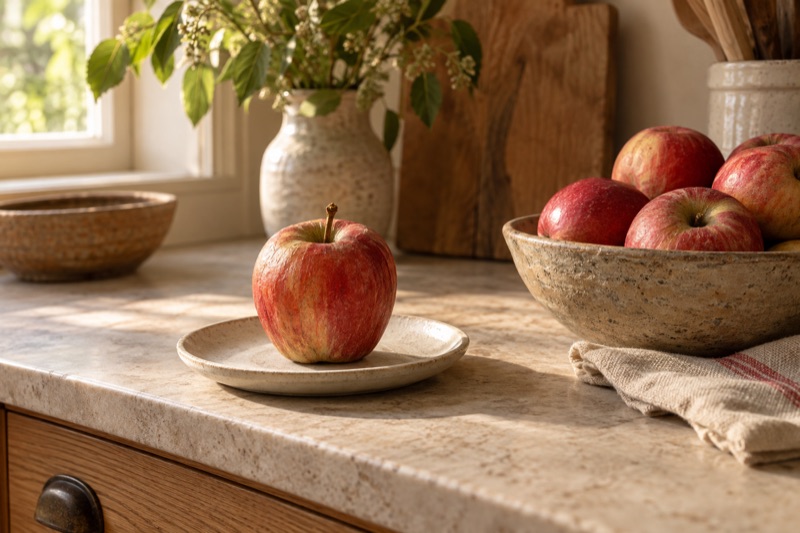
- One apple or pear on a small plate. Set it on the kitchen counter beside real fruit. The plate gives it a stage and the real fruit sets the standard.
- Off-center on a bookshelf. Lay it on a stack of books, not in the middle of a shelf, so it looks put down rather than placed. More in bookshelf styling ideas.
- Under a cloche. Glass keeps dust off and turns a single piece into a display, which the Victorians knew well. See cloche decor ideas. Only unlit pieces go under glass; how to use a candle cloche explains why.
- A shallow bowl, mixed. Two faux pieces among real ones of the same variety, with the stems showing.
- At one end of the mantel. Group three pieces to one side and leave the rest bare. Keep wax well away from any working fireplace; mantel decor ideas has the clearances.
- On a coffee table tray. One ceramic piece, a book and a candle. See coffee table decor ideas.
- On a cake stand. A single piece as the center of a dining table, with nothing else competing. Swap it with the seasons instead of adding to it. For the wider trend, see Fruit Is the New Floral.
A faux apple that smells like one
Fake fruit has always been something to look at. Le Bonne Pomme adds a second job. It's a sculptural apple candle, hand-poured from soy and beeswax, hand-painted one by one and presented under a handblown glass cloche. Displayed under its cloche, it scents a room without being lit, for about 60 days, depending on room size. Its fragrance is by Mane, the French fragrance house founded in 1871, and it opens on crisp apple skin, melon and peach, with rose and red berries at the heart and caramel, musk and wood at the base.
It can be lit, but isn't meant to be: the painted finish will melt and the wax may drip, which is not a defect. Keep it out of direct sunlight and away from heat sources. For what that scent is like, read what an apple candle smells like and apple candles without the cinnamon. For the wider category, see our guide to fruit-shaped candles.
Frequently asked questions
What's the most realistic faux fruit material?
None wins on its own. Wax and hand-painted ceramic tend to do best because they can carry uneven color and small flaws, and because they have some weight. Whatever you choose, look for a matte finish, a believable stem and variation from piece to piece.
How many faux fruits should I display?
Start with one. If you want more, use three at most on a surface, and mix them with real fruit.
How do I stop faux fruit looking cheap?
Avoid shine and sameness. Set it on its own plate or under glass, keep it out of a crowd of matching pieces, and put a real apple or pear nearby.
How do I care for faux fruit?
Keep it out of direct sun and away from heat, and dust it gently. The National Candle Association suggests a soft cloth or a piece of nylon for wax. Painted pieces fade with light, and the damage can't be reversed.