Hand-blown glass is made by gathering molten glass from a furnace onto the end of a hollow blowpipe, inflating it with the glassblower's breath, and shaping it with simple hand tools while reheating it again and again. The finished piece is then cooled slowly in an oven so that it doesn't crack. The technique is more than two thousand years old.
Below are the steps, the signs that tell you a piece was blown by hand, and what that means if you live with a hand-blown cloche.
Hand-blown vs machine-made
Before glassblowing, glass vessels were cast in molds or formed around a removable core. Both methods were slow and labor-intensive, so glass stayed scarce (The Met). Then came the blowpipe. Glassblowing was discovered in the mid-first century B.C., and some of the earliest blown glass comes from Syria and Palestine, with finds from Israel pointing to about 50 B.C. (Corning Museum of Glass).
Hand-blown glass can be free-blown, shaped only by inflation and tools (Corning), or blown by mouth into a mold that gives it its shape (Corning). Machines came much later. Pressing glass was first mechanized in the United States between 1820 and 1830 (Corning). In 1903 Michael J. Owens devised the first commercially successful, fully automatic bottle-making machine (ASME).
A machine repeats itself exactly. A glassblower working by eye never quite does, and that difference is the appeal of hand-blown glass decor.
Regional styles grew on the same basic method. Italian hand-blown glass has a long record: in Venice, cristallo was in use by the fourteenth century for glass that resembled colorless rock crystal (Corning). Glass made elsewhere in the Venetian manner, façon de Venise, was popular in many parts of Europe in the sixteenth and seventeenth centuries (Corning).
The furnace and the gather
Glass starts as batch, a mix of raw materials, often silica, soda or potash, and lime, melted in a pot or tank (Corning). Corning puts the melting temperature of glass at 2,100°F (Corning), and the furnace keeps it molten.
The glassblower dips a blowpipe into the furnace. It is an iron or steel tube, usually four to five feet long, with a mouthpiece at one end (Corning). The mass of molten glass that comes out on its tip is the gather (Corning).
The gather is rolled on the marver, a smooth, flat surface whose name comes from the French marbre, marble (Corning). It may also be rounded in a block, a hollowed piece of wood dipped in water so that a cushion of steam forms between wood and glass (Corning).
Blowing and shaping
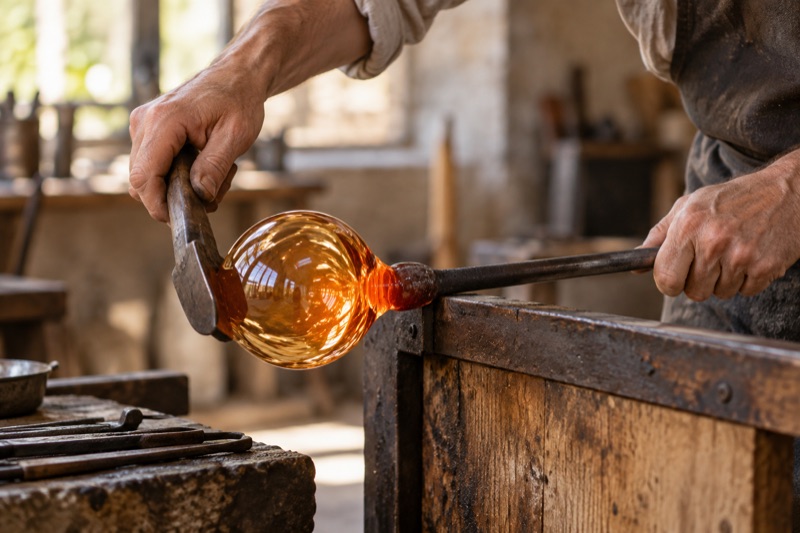
A first breath through the pipe slightly inflates the gather. Once partly inflated, it is called a parison (Corning). From there it is shaped by swinging, rolling on the marver, working with tools or blowing into a mold, then inflated to size (Corning).
In a traditional workshop the master is the gaffer, a corruption of "grandfather" (Corning). The gaffer sits at a wide bench with arms, called the chair, and rolls the blowpipe back and forth along the arms so the glass stays symmetrical. The same word, chair, names the team that assists the gaffer (Corning).
Glass stiffens as it cools, so the piece goes back again and again into the glory hole, an opening in the side of the furnace or a separate chamber for reheating (Corning). Corning's librarians note that no one knows for certain where the name came from. One theory points to the halo-like glow of a 2,100-degree opening in a smoky old factory (Corning).
The hand tools are few:
- Jacks, two metal arms joined by a spring, used for jobs such as forming the mouth of an open vessel (Corning).
- Paddles, including the battledore, a square wooden paddle used to smooth the bottoms of vessels, and the pallet, used to flatten bases (Corning).
- Shears, to trim excess hot glass (Corning).
To finish the open end, the piece moves to a pontil, or punty. This is a solid metal rod tipped with a wad of hot glass and applied to the base of the piece to hold it (Corning). Once the piece is held, it is broken free of the blowpipe, and the end that was attached to the pipe can be opened and finished. A last trip to the glory hole, called fire polishing, melts the surface just enough to smooth small irregularities (Corning).
Annealing
A finished piece can't simply be left to cool. Glass that cools too quickly ends up highly strained, and it may break as it cools or at some later date. So it is annealed, cooled slowly in part of the furnace or in a separate oven (Corning).
That oven is the lehr. Older lehrs were long brick tunnels, and glass was pushed through them over several hours as it was reheated and then cooled evenly. Today lehrs run on conveyor belts (Corning).
Signs of hand-blown glass
Hand-blown glass keeps traces of how it was made. Whether you're looking at a new piece or vintage hand-blown glass, check for these:
- A pontil mark. Removing the pontil often leaves an irregular or ring-shaped scar on the base (Corning). Some glassblowers grind it away, and the absence of a scar can mean either that it was removed or that the piece was mold-blown (Wikipedia). A smooth base proves little either way.
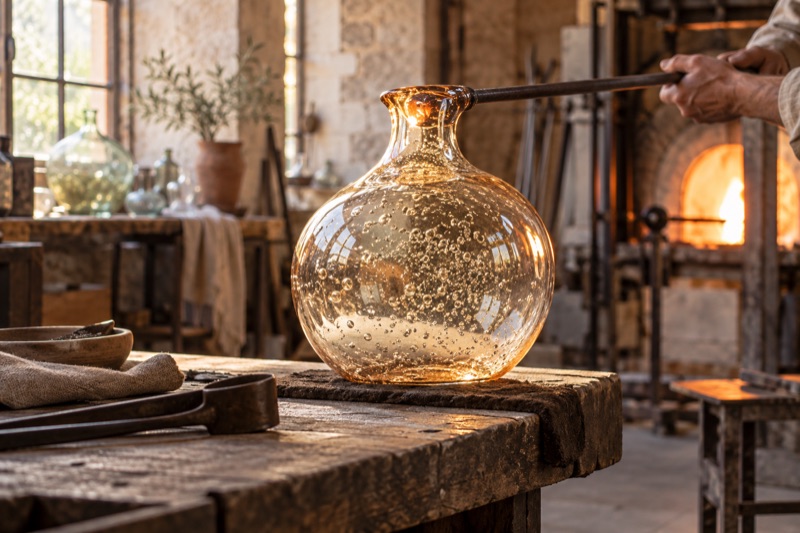
- Seeds. These are minute bubbles of gas, usually in groups (Corning). A seed is a trapped pocket of gas, not a crack (Corning). In the Provençal village of Biot, bubbles are the point: the glassmaker Éloi Monod began trapping them deliberately in the late 1950s (Biot Tourisme). We tell that story in The Glassblowers of Biot.
- Slight variation. Two hand-blown pieces of the same design will differ a little in height, wall thickness or the line of the rim.
- An inside that follows the outside. In blown glass the interior matches the outer form. Pressed glass has an inside shape that is independent of the outside (Corning).
Living with a hand-blown cloche
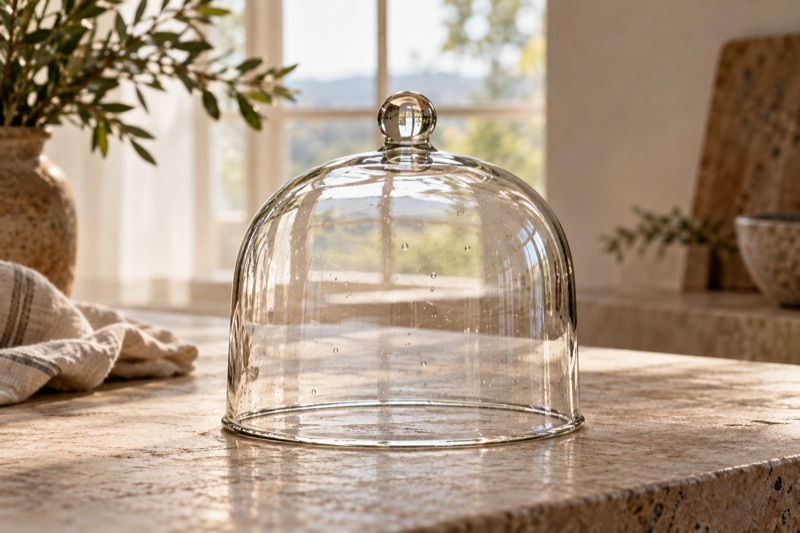
Cloche is French for bell. In English it means a bell- or dome-shaped cover, whether a glass cover that protects small plants from frost or one used indoors to display or protect ornamental objects (Merriam-Webster).
A hand-blown cloche will show its making. Expect a seed or two, a faint wave in the glass, and small differences in height or rim from one cloche to the next. They are marks of the process, and they are expected.
Care is simple: dust with a soft, dry cloth, and avoid sudden swings of temperature.
Pommette's Le Bonne Pomme is presented under a handblown glass cloche. Displayed under its cloche, the hand-painted soy and beeswax apple scents a room without being lit. Keep it out of direct sunlight and away from heat sources. Le Bonne Pomme is designed in France, and our guide to French origin labels explains what that does and doesn't promise.
For the other crafts behind it, see our guide to French savoir-faire and what hand-poured candle labels mean.
FAQ
What is blown glass? Glass formed by inflating a gather of molten glass on the end of a blowpipe, then shaping it by swinging, rolling, tools or a mold (Corning).
How does glassblowing work? Glass is gathered from a furnace, inflated on a blowpipe, shaped with hand tools while it is reheated in the glory hole, moved to a pontil to finish the open end, and then annealed in a lehr.
Is glassblowing hard? It takes practice. The glass has to be kept turning to stay centered and reheated whenever it stiffens, and traditional factory work was done by a team under a master gaffer.
How do you learn glassblowing? Start with a class at a public hot shop. Glassblowing spread beyond factories in the 1960s, after Harvey Littleton and Dominick Labino developed a small furnace and easy-to-melt glass in 1962, which let artists work hot glass in their own studios (Corning). The Studio at the Corning Museum of Glass, for example, offers programs for people of all skill levels (Corning).