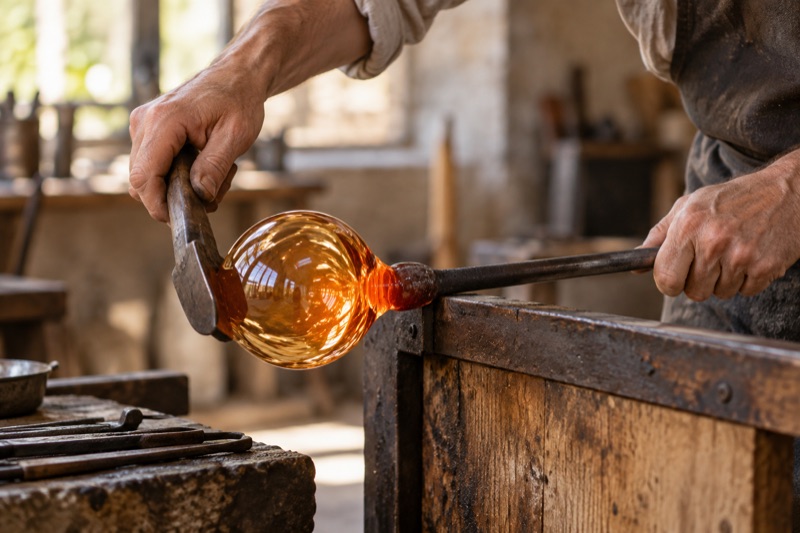
Savoir-faire is French for know-how: the practical skill a person builds by doing a job, usually learned from someone who already has it. Larousse defines it as competence "acquise par l'expérience dans les problèmes pratiques, dans l'exercice d'un métier," gained through experience in the practice of a trade. In English the word has drifted toward social poise. In French it still points to the hands.
That difference matters when you shop. On a label, savoir-faire can describe a real chain of skill passed between people, or it can describe nothing at all. This guide covers what the word means, how French craft knowledge travels, the crafts that go into a scented object, how France recognizes them, and where to watch them at work.
What savoir-faire means
The phrase joins two verbs: savoir, to know, and faire, to do or to make. Larousse's French–English dictionary translates it simply as know-how. It names the knowledge in a practiced hand rather than the knowledge in a book.
English has used the word for more than two centuries, with a different emphasis. As a post on Oxford's modern languages blog explains, the English sense leans toward tact and polish: knowing how to speak and act well in company. French keeps a separate word for that, savoir-vivre. So the meaning of savoir-faire in English depends on context. A diplomat's savoir-faire is social grace. A glassblower's is in their hands.
Fashion uses the word in its French sense. When a couture house talks about savoir-faire, it usually means its specialist workshops. Chanel, for example, has shown a Métiers d'art collection every year since 2002. Eleven of its Maisons d'art, specialist ateliers that include embroiderers, milliners, goldsmiths and shoemakers, work from le19M, a creative hub it set up in Paris in 2021.
A useful test: savoir-faire is something a person has, not something an object has. UNESCO draws the same line for craft heritage, saying its safeguarding work is concerned with the skills and knowledge involved in craftsmanship rather than the finished pieces. A vase can show savoir-faire. Only a maker can hold it.
How French craft knowledge is passed on
Savoir-faire moves from one person to another, slowly, and mostly by doing. Several French institutions are built around that fact.
In the workshop. UNESCO notes that perfume skills in the Pays de Grasse are passed on mostly informally, through a long apprenticeship that still happens largely inside perfume houses, though interest in formal teaching has grown in recent decades.
On the road. Compagnonnage, France's system of journeyman training, sends apprentices on a Tour de France of about five years, moving between towns and workshops. Before they can teach, they must make a masterwork judged by other compagnons. UNESCO inscribed it in 2010 as a network for on-the-job transmission of knowledge. It spans trades in stone, wood, metal, leather, textiles and food.
From master to pupil. Since 1994, France's Ministry of Culture has named Maîtres d'art: craftspeople with rare skills who hold the title for life and commit to three years of training a single pupil. The program was inspired by UNESCO's Living Human Treasures. At least 150 masters have been named, across 100 specialties.
A national institute. The organization that runs the Maître d'art program and coordinates the yearly Journées Européennes des Métiers d'Art was founded in 1889. In 2024 it took a new name: the Institut pour les Savoir-Faire Français. The word now sits in the name of the body that looks after French craft.
The crafts behind a scented object
A candle that sits under glass and scents a room draws on four separate crafts: working wax, blowing glass, composing fragrance and painting by hand.
France keeps an official list of métiers d'art, set by ministerial order in December 2015, with 281 crafts and specialties in 16 fields. The Institut pour les Savoir-Faire Français describes them as work that demands mastery of technique and brings an artistic contribution. Three of the four crafts are on the list. The fourth, perfumery, is recognized another way.
Wax
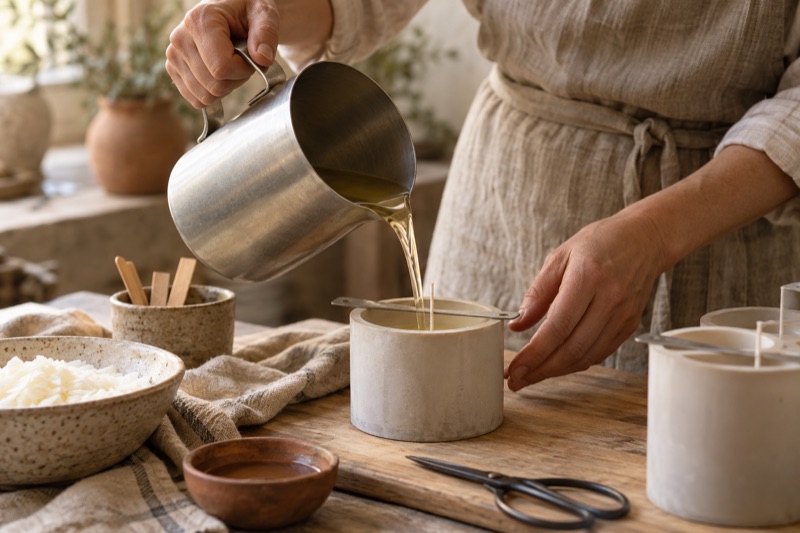
The list names the cirier, the wax worker, under furnishings and decoration. The craft is melting, blending, scenting, pouring and finishing wax, and each step shows in the result.
France has a long record here. Cire Trudon dates its story to 1643, when Claude Trudon took over a Paris shop that sold candles, and it became a royal manufacture in 1719. For more, read our short history of candles in France, the story of wax as a sculptural material, and why the French word for candle is bougie. For the modern process, see how a luxury candle is made.
Glass
Glass has its own field on the list. Under verrier à la main, the hand glassmaker, it names specialties that include the cueilleur, who gathers molten glass from the furnace, and the souffleur à la canne, who blows it on the pipe.
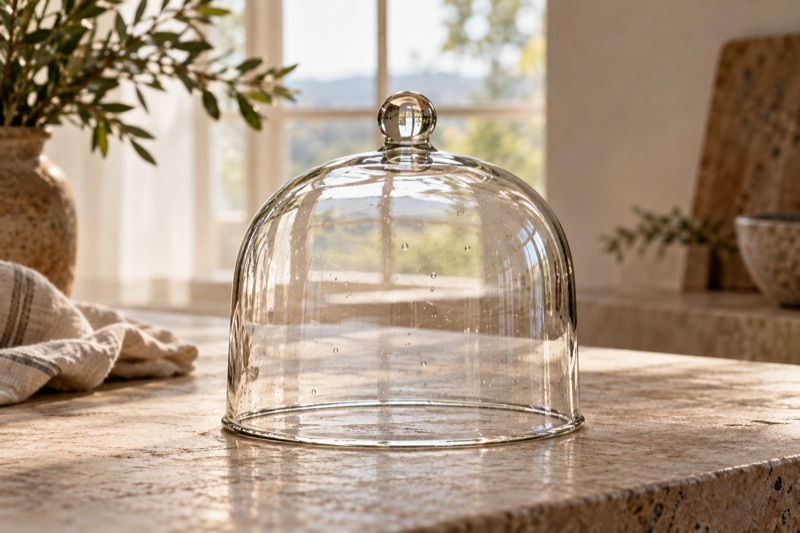
Hand-blown pieces vary slightly from one to the next, and that variation is one way to recognize them. Our guide to how hand-blown glass is made follows the work from the gather to annealing.
Perfume
Perfumery is not one of the sixteen fields on the list. Its recognition came from UNESCO, which in 2018 added the skills related to perfume in the Pays de Grasse to its Representative List of the Intangible Cultural Heritage of Humanity.
The listing covers three linked skills: growing perfume plants, knowing and processing natural raw materials, and composing perfume. Read about the flowers of Grasse, how perfume is made, and what a perfumer does.
Paint
Painting by hand appears in more than one field. Under ceramics, the list names painters on faïence and on porcelain. Under glass, a decorating glassmaker can specialize as a painter.
The skill is the same in each: a steady brush, a trained eye, and the acceptance that no two pieces will match exactly. Faïence is one of the clearest French examples, and our short guide to French faïence covers it.
Four crafts, one object
One small object can carry all four. Le Bonne Pomme, the apple we design in France, is hand-poured soy and beeswax, hand-painted one by one, and set under a handblown glass cloche. Its fragrance is by Mane, the French fragrance house founded in 1871.
How France recognizes and protects its crafts
France doesn't leave savoir-faire to marketing alone. Several public distinctions recognize it, and each has a named issuer and stated criteria.
| Recognition | What it recognizes | Who grants it | Since |
|---|---|---|---|
| Métiers d'art list | 281 crafts and specialties counted as métiers d'art | French ministers, by ministerial order | Current list 2015 |
| Entreprise du Patrimoine Vivant (EPV) | Companies with rare, traditional know-how | The state, through regional prefects, for five years at a time | 2005 |
| Un des Meilleurs Ouvriers de France (MOF) | Individual craftspeople, after a long competition | A state diploma; the competition is run by the COET-MOF | 1924 |
| Maître d'art | Holders of rare skills who train a successor | Ministry of Culture | 1994 |
| UNESCO Intangible Cultural Heritage | Living practices, such as compagnonnage and Grasse's perfume skills | UNESCO, on France's nomination | 2010 (compagnonnage), 2018 (Grasse) |
Entreprise du Patrimoine Vivant. The EPV label, created in 2005, goes to companies, not individuals. Criteria include rare know-how based on traditional techniques, specific economic heritage such as rare equipment, and a long-standing location or reputation. It is granted for five years, and about 1,300 companies hold it. A public dataset lists them. More in What Is an Entreprise du Patrimoine Vivant?
Meilleur Ouvrier de France. Created in 1924, the competition leads to a state diploma and covers nearly a hundred trades in 17 groups. Its qualifying and final rounds take between eighteen months and two years, according to the education ministry's answer to a parliamentary question. Laureates wear a blue, white and red collar. The title belongs to a person, so a company can employ a Meilleur Ouvrier de France but cannot be one. More in What Is a Meilleur Ouvrier de France?
UNESCO. UNESCO's lists recognize practices rather than companies or people. Grasse's perfume skills and compagnonnage are both on its Representative List.
Telling real craft from a marketing word
The word itself costs nothing. Anyone can print savoir-faire on a box, and in English it often arrives as a mood rather than a claim. A few habits help you tell the difference.
- Look for a verb and a person. Real craft copy says who did what: poured, blew, painted, composed. Savoir-faire with no technique attached tells you little.
- Check named distinctions. EPV holders are publicly listed. MOF and Maître d'art are titles held by individuals, so ask which person holds one.
- Separate design from making. "French" can describe where something was designed, where it was made, or where its materials came from. These are different claims, and we explain the labels in designed in France versus made there.
- Read the craft words closely. Hand-poured, handmade, small-batch and artisan each promise something narrower than they sound. Our glossary of candle labels takes them one at a time.
- Expect variation. Hand work leaves traces: a brushstroke, a small bubble in glass. Perfect sameness is not a sign of hand work.
In France, even artisan has edges. The title artisan d'art is reserved for people in a listed craft who hold a vocational diploma or can show at least three years' experience in it, according to France's industrial property office, INPI.
Where to see French savoir-faire
The best way to understand savoir-faire is to watch it. These places and events open the work to visitors.
Grasse, for perfume
The Musée International de la Parfumerie in Grasse, founded in 1989 and renovated in 2008, traces perfume from raw materials and manufacturing through design and trade. Its displays include an olfactory installation of more than a hundred perfumes and flowers.
The museum's gardens in nearby Mouans-Sartoux serve as a conservatory for perfume crops, including centifolia rose, jasmine and tuberose. In Grasse itself, Fragonard runs free guided factory tours of about thirty minutes, led by guides trained by a perfumer.
Biot, for glass
In the village of Biot, on the Côte d'Azur, the Verrerie de Biot has blown glass since 1956, when the engineer and ceramist Éloi Monod started it. Monod developed the bubbled glass now tied to the village, trapping air in the glass on purpose.
Biot's tourist office notes that visitors can watch the glassmakers make a piece from start to finish. More in The Glassblowers of Biot.
Across France, each spring
The Journées Européennes des Métiers d'Art open workshops and training centers to the public for a week each spring, free, across France and in other European countries. Expect demonstrations, discovery workshops and guided visits. The Institut pour les Savoir-Faire Français has coordinated the event since 2002. The next edition runs from March 30 to April 4, 2027.
The heritage houses
Some French houses have practiced the same craft for centuries. We profile several in The Oldest French Houses Still Making Things by Hand.
FAQ
What does savoir-faire mean in English? Literally, knowing how to do. In craft and fashion, it means know-how: practical skill learned through experience. In everyday English it more often means tact and social ease, the sense French expresses with savoir-vivre.
Is savoir-faire the same as know-how? Close. Larousse translates it as know-how. The French word also carries the idea of skill passed along within a trade, which is why it attaches so naturally to crafts.
What are heritage crafts? Crafts whose skills pass from practitioner to practitioner across generations, such as glassblowing, wax work or painting on ceramics. France's official category is the métiers d'art, defined by a list of 281 crafts and specialties. UNESCO recognizes some living practices, such as compagnonnage, as intangible cultural heritage.
Is savoir-faire a label or certification? No. It's an ordinary noun. The claims you can check are the awarded ones: the EPV label, the Meilleur Ouvrier de France title, the Maître d'art title and the reserved title artisan d'art.