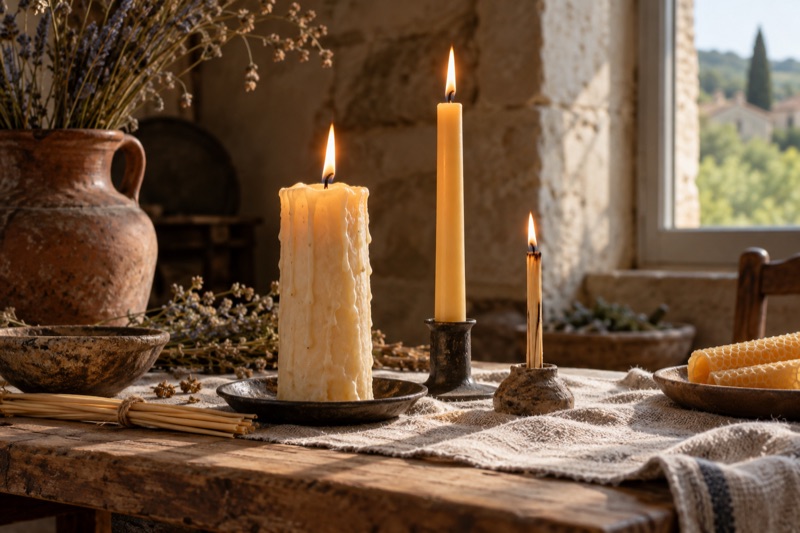
The history of candles in France turns on two materials. Tallow, rendered animal fat, was cheap, smoky and rank, and it lit ordinary homes. Beeswax burned cleanly and smelled sweet, so it went to churches, the court and anyone who could afford it (Britannica). In the 1820s French chemists found a better candle inside fat itself, and in 1963 a Paris shop turned the candle into a vessel for scent.
Before wax: tallow and rushlights
The candle's oldest ancestor is the rushlight. Britannica describes ancient Egyptians soaking the pith of reeds in melted animal fat, and credits the Romans with the first true wicked candles, made by dipping rolled papyrus in tallow or beeswax.
By the Middle Ages tallow candles were common across Europe. They were cheap, and they smoked and smelled.
French kept the difference in its vocabulary. In 1835 the Académie française defined a chandelle as a small torch of tallow, wax or other fat, but said the word was used more commonly for the tallow candle (Académie française, 6th edition). The finer word, bougie, entered French in the fourteenth century to mean the fine wax candles were made from. It is named after Bougie, the Algerian town now called Béjaïa, from which that wax was imported (Académie française, 9th edition).
The chandlers of medieval Paris
Étienne Boileau became provost of Paris in 1261 and had the rules of the city's trades written down in the Livre des métiers (Universalis). Its nineteenth-century editors date the compilation to 1268. Title LXIV belongs to the chandeliers de suif, the tallow chandlers (Lespinasse and Bonnardot edition, 1879).
The statute is mostly about honest fat. A newcomer had to prove six years at the trade, and a master could keep one apprentice besides his own children. Journeymen were barred from making candles at the regrattiers, the resellers, because, the text says, they added tripe fat and leftover grease. Adulterated tallow candles, it explains, were trop domacheuse chose au povre et au riche: too harmful to poor and rich alike.
Candles were also made in people's houses. When a Paris burgher had candles made at home, the master had to stay with his apprentice until the work was underway, or pay a fine of five sous.
Wax was a different trade. In the same register's list of market dues, the ciriers, makers and sellers of wax, appear beside the pepperers and apothecaries, paying their dues at the king's weights. Wax was weighed and sold like spice.
The English word chandler shares the root: Old French chandelier, from chandelle (Merriam-Webster).
Beeswax for church and court
The Church was the great buyer of wax. The 1908 Catholic Encyclopedia says liturgical candles should be beeswax, probably for its symbolic link to the flesh of Christ. A 1904 decree required the paschal candle and the candles at Mass to be beeswax in maxima parte, read as at least 75 percent (Catholic Encyclopedia). White was the rule, unbleached yellow wax was kept for funerals and Holy Week, and "gilded and painted candles" were allowed under certain restrictions.
Candles also marked the French year. The feast of February 2, la Chandeleur (Candlemas), takes its name from the Latin for a feast of candles, and on that day the priest blesses the church candles (Académie française). In the twelfth and thirteenth centuries, the encyclopedia notes, people in northern France and England often "measured to" a saint: they offered candles equal to the height of the person they were praying for.
White wax took work, because natural beeswax is yellow. Trudon's history records a manufactory founded at Antony, south of Paris, in 1702 to whiten wax and make candles (Trudon). France's national heritage register dates its building to 1714 and has listed the beehive carved into its wall since 1929 (Mérimée).
Lighting Versailles
Versailles used three kinds of light: lamps, tallow candles and beeswax candles. The historian Stéphane Castelluccio describes Louis XIV using lighting to set royal residences apart from private houses. Three separate services placed, lit and maintained the candles, and how brightly a room was lit depended on its use and on whether the king was there (Société des Amis de Versailles).
In his history of daily life at the palace, Derrière la façade (Perrin, 2008), William Ritchey Newton records two grades of wax candle: white for tables and interiors, and yellow, made from lesser wax. The quoted prices were 50 sols a pound for white candles and 10 for tallow ones, a fivefold difference (Bibliothèque municipale de Lyon, quoting Newton). In the king's household, lighting was supplied by the Fruiterie, and the king's officers received carefully measured amounts. Outside balls and festivities, Newton concludes, the royal family and the court were hardly better lit than a shopkeeper.
The exception was the Hall of Mirrors, built between 1678 and 1684, where 357 mirrors fill seventeen arcades facing seventeen windows. According to the palace, thousands of candles lit the glass during the rare grand balls held there, particularly for the weddings of the Dauphins. The Menus Plaisirs, the office in charge of court festivities, took the lighting down immediately afterward (Château de Versailles).
One supplier's name is still on candles today. Trudon, the Paris house long known as Cire Trudon, dates itself to 1643. By its own account, Claude Trudon then owned a shop on rue Saint-Honoré selling spices and candles, and in 1737 Jérôme Trudon bought the manufactory at Antony (Trudon). Newton's research places "Trudon et fils" at Versailles independently. They held a contract for white and yellow wax at 50 sols a pound and asked for four more sols the next year. In 1749 they gave up the contract in exchange for the post of cireur du château.
From tallow to stearin: the chemists' candle
The candle that ended tallow's reign came from a Paris laboratory. In 1823 the chemist Michel-Eugène Chevreul published Recherches chimiques sur les corps gras d'origine animale, showing that fats combine glycerol with fatty acids (L'Actualité Chimique). One of those acids, stearic acid, made a superior candle (Britannica). By 1825 Chevreul and Joseph-Louis Gay-Lussac had patented its use in lighting (AOCS).
Industry still needed a cheap process. Adolphe de Milly and his partner Motard broke down tallow with lime, purified the stearic acid by pressing, and paired it with cotton wicks treated with boric acid, so the wicks no longer had to be trimmed to stop them smoking. Stearin works multiplied. At France's 1839 industrial exhibition, nine exhibitors were already showing stearic candles (L'Actualité Chimique).
Then came paraffin. In Scotland, James Young's works were selling paraffin wax from 1856, and in quantity for candles from 1859 (Grace's Guide). Refined from petroleum and blended with stearic acid, paraffin became the basic candle stock (Britannica). The French dictionary kept pace. The Académie now defines a bougie as a candle of wax, stearin or paraffin molded around a cotton wick.
From light to scent
Once candles were no longer the main source of light, people chose them for other reasons. Britannica dates the shift in consumer interest toward decorative and aromatic candles to the mid-1980s.
In Paris, the scented candle arrived two decades earlier. Rigaud, a Paris perfume house founded in 1852, says it created "the world's first scented candle" in the late 1950s (Rigaud). Diptyque was founded at 34 boulevard Saint-Germain by three friends, Yves Coueslant, Christiane Gautrot and Desmond Knox-Leet (Diptyque). In 1963 they made its first three scented candles: Aubépine (hawthorn), Cannelle (cinnamon) and Thé (tea) (Diptyque). The house now counts more than fifty candle scents.
Older wax houses moved into scent too. Trudon, by its own timeline, created its scented candles in 2007.
The candle as object today
Candles today are used mostly for decoration, ambience and ceremony (Britannica). New waxes arrived in the 1990s, including soy wax developed in the United States, and beeswax, once the wax of church and court, still appears in blends.
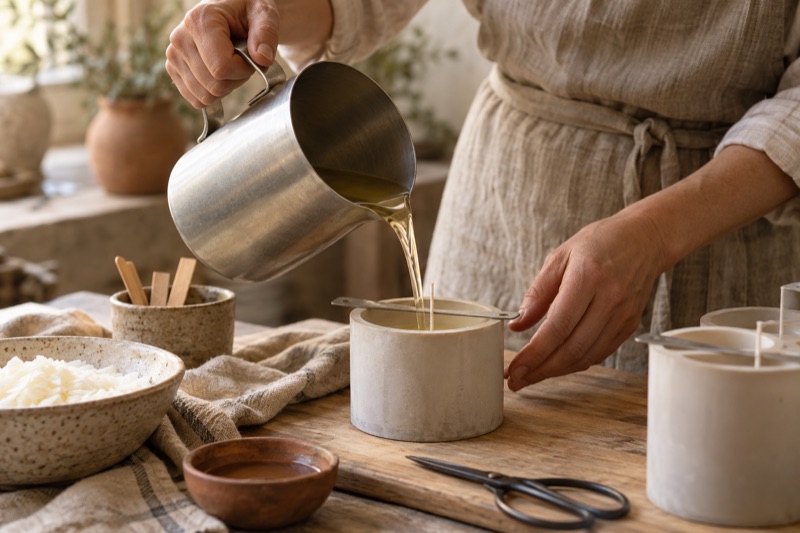
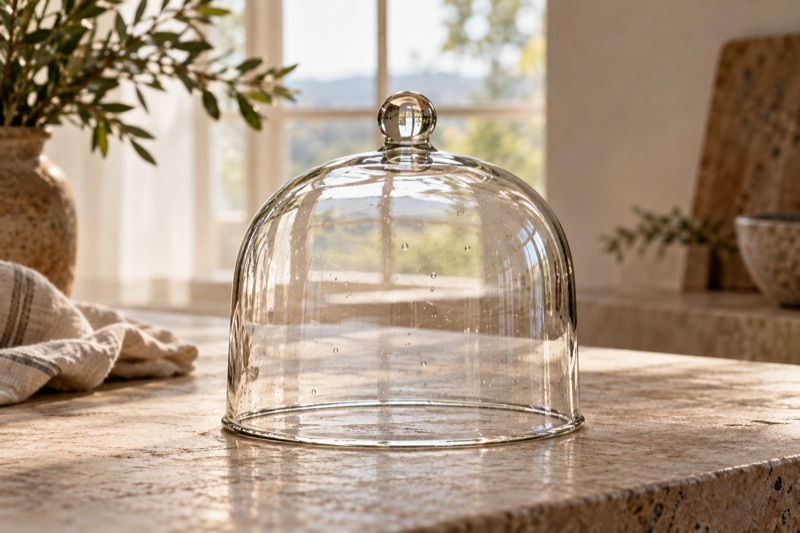
Some candles are made to be looked at as much as burned, and painted candles are nothing new: the Church allowed them, within limits. Pommette's Le Bonne Pomme is one. Designed in France, it is an apple of hand-poured soy and beeswax, hand-painted one by one and presented under a handblown glass cloche. It is meant to scent a room without being lit, with a fragrance by Mane, the French fragrance house founded in 1871. It can be lit, but the painted finish will melt.
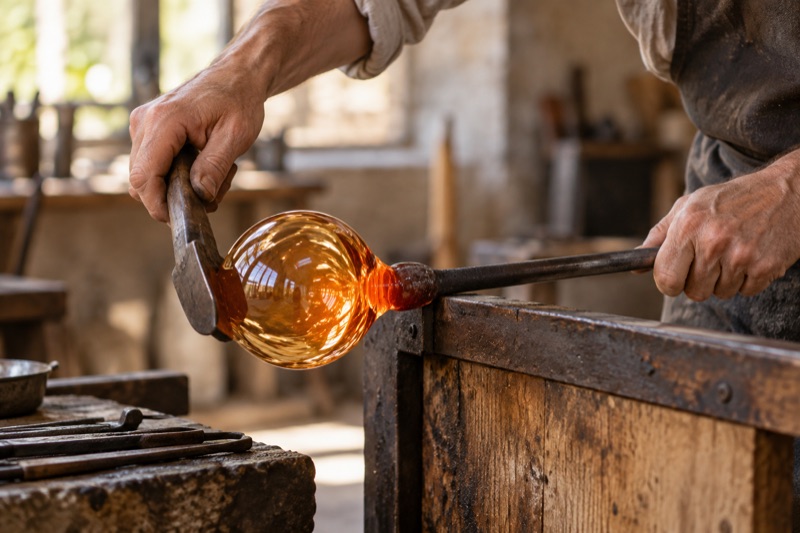
For the crafts behind objects like this, see our guide to French savoir-faire, what labels such as hand-poured and small-batch really mean, and how hand-blown glass is made.
A short timeline
| Year | What happened |
|---|---|
| c. 1268 | The Livre des métiers records the statutes of the Paris tallow chandlers |
| 1643 | Trudon dates its founding to Claude Trudon's Paris shop (company account) |
| 1678–1684 | The Hall of Mirrors is built at Versailles |
| 1702 | A wax-whitening and candle manufactory is founded at Antony |
| 1737 | Jérôme Trudon buys the Antony manufactory (company account) |
| 1749 | The Trudons give up the Versailles wax contract (Newton) |
| 1823 | Chevreul publishes his research on animal fats |
| 1824–25 | Chevreul and Gay-Lussac patent stearic acid for lighting |
| 1839 | Nine exhibitors show stearic candles at France's industrial exhibition |
| 1859 | Scottish paraffin wax is sold in quantity for candles |
| Late 1950s | Rigaud makes its first scented candle (company account) |
| 1963 | Diptyque makes its first three scented candles |
| 2007 | Trudon launches scented candles (company account) |
FAQ
What is a chandler? A chandler is a maker or seller of candles, and often of soap. In English the word later came to mean a dealer in supplies too, as in a ship chandler (Merriam-Webster).
What did a chandler originally make? Candles, and in medieval Paris specifically tallow candles. The chandeliers de suif made those, while wax was the business of the ciriers.
What were candles made of before paraffin? Mostly tallow and beeswax. From the 1820s, stearin made from fatty acids joined them, and spermaceti from sperm whales was another nineteenth-century source (Britannica).
Did Versailles use beeswax candles? Yes. White wax lit the royal tables and interiors, and yellow wax, tallow and lamps served elsewhere, as described above.