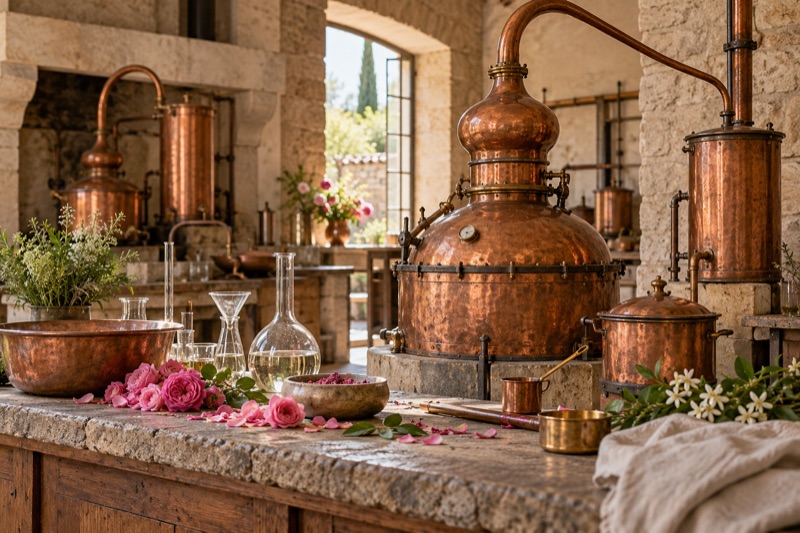
Perfume is made by drawing scent out of raw materials, blending those extracts and synthetic materials into a concentrate to a perfumer's formula, mixing the concentrate with alcohol, and leaving it to rest for weeks before it's chilled, filtered and bottled. The first step has several routes: distillation, solvent extraction, enfleurage and CO2 extraction. This guide takes them in order, then follows the blend to the bottle.
Raw materials
The International Fragrance Association (IFRA), the industry's trade body, says natural materials such as flowers, woods, resins, spices and citrus peels are harvested around the world, then distilled or extracted on site to capture their scent. Galimard, a Grasse perfumer, says Grasse's industry also imports materials in their raw natural state, among them roots such as iris and vetiver and seeds such as ambrette.
A perfume can contain from twenty to more than a hundred different components, says Fragonard, another Grasse house. Some come from plants and some from synthetic chemistry. Grasse's flowers are the classic plant example, covered in The Flowers of Grasse.
Distillation
Steam distillation is a very old process. Fragonard, which displays its stills, says it has been in use since antiquity and remains a major technique in traditional perfume making.
Galimard describes how it works. A steam generator produces vapor that carries the plant's odor particles through a curved neck into a cooling coil, where the vapor turns back into liquid. In a collecting vessel, the oil separates from the water by density. It suits lavender, patchouli, vetiver and geranium, which Galimard says hold their oils in a natural state, and it can't capture the aroma of delicate petals.
Heat is the problem. Steam distillation runs at around 100 °C for hours, Wikipedia notes, conditions that can degrade fragile compounds.
Solvent extraction and absolutes
Delicate flowers like jasmine are better served by solvents. The process, as Wikipedia describes it), has two stages. The plant material is first extracted with a hydrocarbon solvent such as hexane, giving a waxy concrete. The concrete is then extracted with ethanol, cooled to solidify the waxes and cold-filtered. When the ethanol evaporates, what's left is the absolute.
Absolutes are more concentrated and less volatile than essential oils, and rose, jasmine and tuberose are among those in demand. In Grasse, a flower grower such as Domaine de Manon says its jasmine is delivered immediately to be made into absolute, to keep the flower's scent.
The International Perfume Museum credits François Coty, whom it calls the father of modern perfumery, with using natural absolutes, made by solvent extraction, together with new synthetic materials.
Enfleurage
Enfleurage (the French is roughly "ahn-fluh-RAHZH") is a method closely tied to Grasse's history, and one now rarely used. Larousse defines it as capturing the scent of flowers by contact with a fat or oil.
Fragonard describes two kinds. In hot enfleurage, flowers are infused in heated fat. Cold enfleurage was developed for the most fragile flowers, such as jasmine, which wouldn't survive heat: a layer of odorless grease is spread on a glass frame, which is then covered with flowers. Galimard says the petals are renewed every two or three days through the season. At the end, the scented fat, called a pomade, is treated with alcohol to lift out the aroma.
Fragonard says cold enfleurage was widely used in the Grasse region until the late 1950s and has since been replaced by solvent extraction and supercritical CO2. Galimard calls it almost forgotten today. Strictly, enfleurage doesn't yield an essential oil: Wikipedia notes that essential oils come from distillation or pressing, while absolutes come from solvent extraction or, traditionally, enfleurage.
CO2 extraction
A newer method uses carbon dioxide held above its critical point, 31 °C and 74 bar, where it behaves like a solvent, Wikipedia explains. Volatile oils can be extracted at about 100 bar, and low-pressure extraction avoids the fats that liquid solvents also pull out. The cost is equipment: high pressure raises the price compared with conventional extraction. Wikipedia's perfume article adds that CO2 extracts tend to stay close to the raw material's own scent.
Synthetics
Not every note can come from a plant. IFRA says chemists create synthetic fragrance materials that extend naturals or replicate rare notes with fewer resources. Fragonard lists the benefits as a wider range of odors, consistency, and a response to ecological and allergen requirements.
According to the International Perfume Museum, modern perfumery began in the late 19th century with the first use of synthetic products. It names Guerlain's Jicky of 1889, which celebrated vanillin, as considered the first modern perfume. The Globe and Mail says Ernest Beaux layered rich flowers with a large dose of aldehydes, synthetic molecules seldom used before, in Chanel N°5 in 1921.
Some notes can only be built. The fragrance encyclopedia Osmoz says essential oil can't be extracted from apples, so an apple note is made by combining other ingredients. What an apple candle smells like shows what that means in practice.
Blending and maceration
The perfumer composes the formula. Galimard and Fragonard both describe the perfumer's "organ," a stand with every material laid out, and Fragonard says a fragrance can take several years to compose. IFRA says fewer than a thousand fully qualified perfumers work worldwide, each training for seven to ten years. How a brief becomes a scent has the rest of that story.
In a factory, the raw materials are weighed with great precision and blended into a concentrate, Fragonard says. IFRA adds that automated systems reproduce the formula to parts-per-million precision, and that each formula is screened against IFRA's safety standards.
Then the concentrate rests. At Fragonard it's mixed with alcohol in large stainless steel vats and left to macerate for several weeks. Some vegetable waxes from the natural materials may solidify, so the mixture is chilled to −5 °C and filtered until it's perfectly clear. Molinard says the concentrate stays in its vats for a time that varies by fragrance. Fragonard's bottling line is semi-automatic, and each product is tested at several stages.
From perfume to home fragrance
A candle borrows the same raw materials and the same houses. The National Candle Association says candle makers work closely with fragrance companies, that scented candles usually blend natural and synthetic fragrances, and that makers can choose from more than 2,000 aroma chemicals and essential oils. The vehicle is different: a candle's scent evaporates from wax rather than from alcohol on skin.
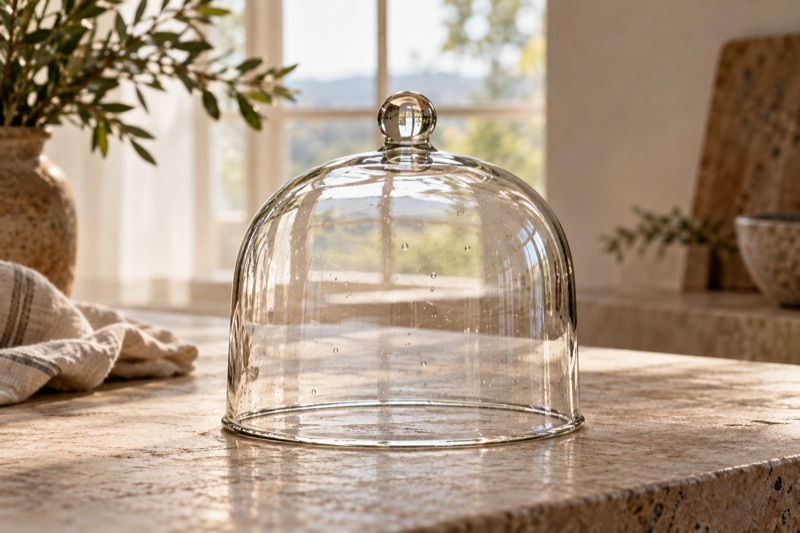
Le Bonne Pomme is a hand-poured soy and beeswax apple, hand-painted one by one and presented under a handblown glass cloche. Its fragrance is by Mane, the French fragrance house founded in 1871, and it's written in three tiers: crisp apple skin, melon and peach at the top, rose and red berries at the heart, and caramel, musk and wood at the base.
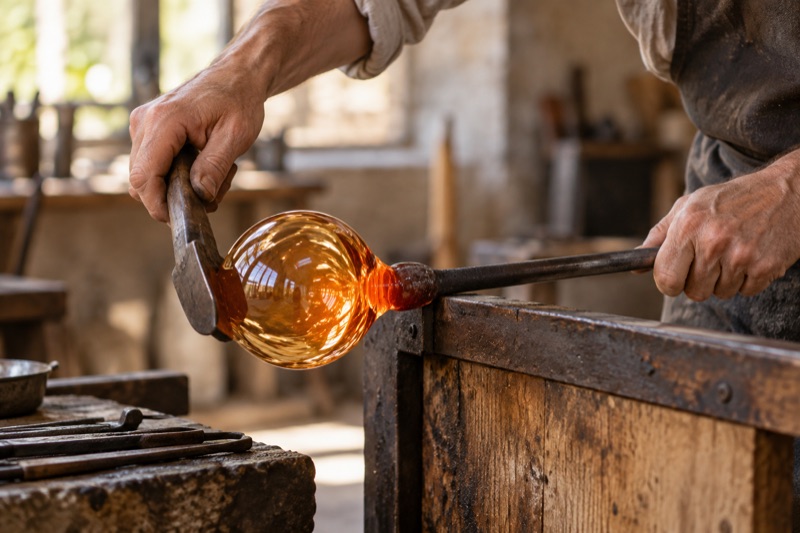
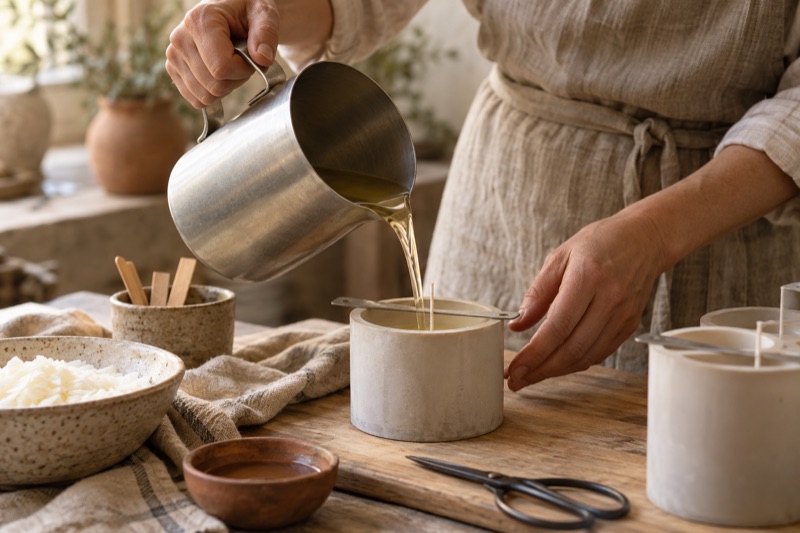
It's designed for cold diffusion. Displayed under its cloche, it scents a room without being lit, for about 60 days, depending on room size. It can be lit, but isn't meant to be: the painted finish will melt and the wax may drip, which is not a defect. For the other crafts in the object, see what "hand-poured" means, how hand-blown glass is made and the hub, French Savoir-Faire: What It Means, and Where to Find It.
FAQ
How is perfume made step by step? Natural materials are distilled or extracted, and synthetic ones are made in a lab. A perfumer blends them into a concentrate, which is mixed with alcohol, left to macerate for several weeks, chilled, filtered and bottled.
How is perfume made in a factory? At Fragonard, the lab weighs and blends the materials into a concentrate, which macerates with alcohol in steel vats, is chilled and filtered, and then goes to a bottling line.
What is enfleurage, and how do you pronounce it? A historic method that uses a layer of odorless fat to absorb the scent of fragile flowers such as jasmine. In French it's roughly "ahn-fluh-RAHZH"; Wiktionary gives the IPA as /ɑ̃.flœ.ʁaʒ/. It's rarely used now, having been replaced by solvent and CO2 extraction.
Where can you see perfume being made? Grasse houses run free factory tours with stills and workshops, covered in What Perfumes Are Made in Grasse? The history behind them is in Why Is Grasse the Perfume Capital of the World?