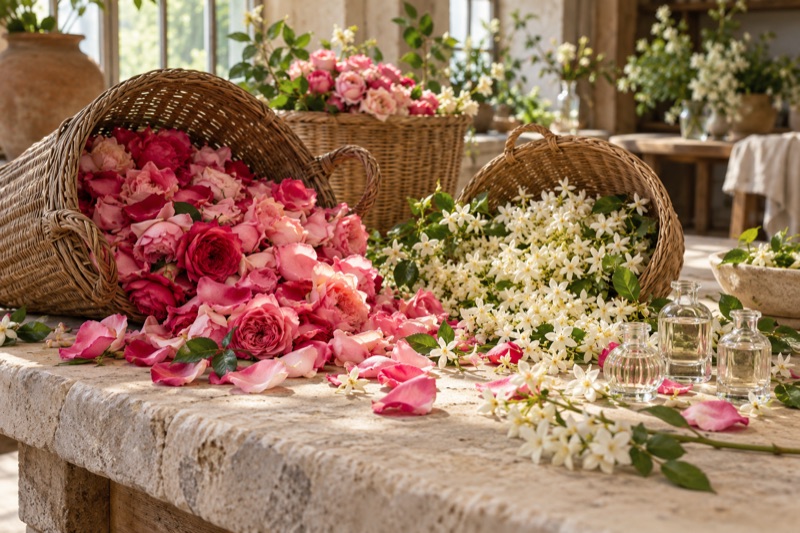
Three of Grasse's best-known houses, Galimard, Molinard and Fragonard, make their own perfumes in and around the town. Larger fragrance and raw-material companies there compose and supply the ingredients other brands use, and some famous perfumes use flowers grown in the Grasse area, most visibly Chanel's jasmine. This guide sorts those three groups, then explains how to visit.
Perfumeries in Grasse
Three family houses make perfume for sale under their own names. Each date below is the house's own account.
Galimard
Galimard calls itself a perfumer since 1747. It says all its perfumes are made in its laboratory in Grasse, which visitors see on the free guided tour. It also runs a factory-museum in Èze-Village, and its site sells women's and men's fragrances, bath products and home scents.
Molinard
Molinard describes itself as a perfumer in Grasse since 1849, now in its fifth generation. It says every step from formulation to bottling takes place at its production site in Grasse. Its Habanita collection centers on a perfume the house dates to 1921. Molinard also sells scented candles and ambient perfumes, and it runs perfume-making workshops in Grasse, Paris, Nice and Cannes.
Fragonard
Fragonard says it has made perfume in Grasse since 1926 and manufactures its products in three factories on the Côte d'Azur. Two are in Grasse, the Historical Factory and La Fabrique des Fleurs, and one is in Èze-Village. The Historical Factory also houses a perfume museum that opened in 1975. Fragonard's own site lists women's and men's perfumes, candles and diffusers.
The companies behind other brands' scents
Many perfumes sold under a brand's name are composed by a fragrance house, a company that employs perfumers and creates scents to order for other businesses. Several large ones work in Grasse. Robertet says it moved its head office to Grasse in 1883. AFP reports that dsm-firmenich has a natural-ingredients development facility employing about 250 people, that IFF has nearly doubled its Grasse headquarters, and that Givaudan has announced a multi-hectare innovation center there.
Those companies are rarely the name on the bottle. Fragrance Houses, Explained covers who they are and how a brief becomes a scent.
Grasse materials in famous perfumes
A famous perfume can use Grasse ingredients without being composed there. AFP notes that dsm-firmenich's Villa Botanica in Grasse hosts perfumers based in Paris, New York, São Paulo and Dubai, who come for ideas and inspiration.
Chanel N°5
Chanel is the clearest case. Reuters described the harvest at the Mul family's fields in Pégomas, near Grasse, in 2021, and called jasmine the key ingredient of N°5. Chanel's own sustainability page says it has sourced flowers from fields managed by the Mul family in the Pays de Grasse for over four decades.
The Globe and Mail reported that the Mul family grows jasmine, May rose, tuberose, iris and rose geranium on 50 acres at Pégomas exclusively for Chanel, under a partnership signed in 1987. Chanel's perfumer Olivier Polge told the paper that Grasse jasmine is fresher and a little greener than jasmine of the same species grown in Egypt, which he uses in another Chanel perfume.
N°5 isn't only flowers. According to the same article, its perfumer Ernest Beaux combined rich flowers with a heavy dose of aldehydes, synthetic molecules rarely used in perfume before then. How Perfume Is Made explains where synthetics fit.
Dior
One Grasse grower that supplies Dior is a family estate, Domaine de Manon. Its tourist-office listing says its centifolia rose flowers go straight to be made into absolute for Dior perfumes, and that its jasmine harvest is reserved exclusively for the house. AFP says Dior and Chanel use centifolia in their historic perfumes.
Houses with Grasse estates
AFP lists further investments: Louis Vuitton opened a creative center in Grasse in 2016, and Lancôme created a seven-hectare rose estate, its Domaine de la Rose, in 2023. A house's presence in Grasse doesn't mean every perfume it sells uses Grasse flowers, so it's worth asking which ingredient, lab or flower field a label means.
Visiting
Getting there. Grasse is about 35 kilometers from Nice and 17 from Cannes, Galimard says. From Nice airport, the Pays de Grasse tourist office suggests taking the tram to Grand Arénas and then bus 650 to Grasse, about every 30 minutes, or the TER train from Nice Saint-Augustin. Grasse station is about 2 kilometers from the center, with a shuttle and a bus line between them. France's official tourism site also suggests visiting outside summer, when the town is quieter and the weather can still be good.
The International Perfume Museum. The museum, founded in 1989, sits at 2 boulevard du Jeu de Ballon and traces perfume from raw materials and manufacturing to design and trade. The tourist office lists it as open daily from 10 a.m., closing at 6 p.m. (7 p.m. in July and August), with a €6 adult ticket in October 2026. The museum's own practical-information page lists extra closing days and a €2 discount with a same-day TER ticket, so check it before you go.
The museum's gardens. The gardens in Mouans-Sartoux are a conservatory of perfume plants, including centifolia rose, jasmine, tuberose, lavender, geranium and orange blossom. The museum lists them as open from March to November.
Factory tours. All three houses offer free tours:
- Fragonard's guided tour leaves every 30 minutes and lasts about 30 minutes, with a guide trained by a perfumer.
- Molinard's Bastide visit is about 25 minutes, with a departure every 20 minutes at set hours.
- Galimard says free guided tours run seven days a week without booking for individuals.
For something hands-on, Galimard lists its Studio des Fragrances workshop in Grasse from €69 on its site in October 2026, and Molinard runs creation workshops in Grasse, Paris, Nice and Cannes.
In flower season. Roses are picked in May and jasmine from August to October. The tourist office lists an Expo Rose in May and a Fête du Jasmin in August, and two growers, Domaine de Manon and Terre de Jasmin, list visits or picking sessions during bloom. Both ask you to get in touch first, and the dates change each year. For what is in bloom when, see The Flowers of Grasse.
Grasse at home
Grasse's perfumers sell home fragrance as well, by their own sites: Fragonard lists candles and diffusers, Molinard scented candles and ambient perfumes, and Galimard a home-scents range. French Candle Brands Worth Knowing covers other French houses that began as perfumers. The history behind all of them is in our hub, Why Is Grasse the Perfume Capital of the World?
Le Bonne Pomme is a hand-poured soy and beeswax apple, hand-painted one by one and presented under a handblown glass cloche. It's designed in France, and its fragrance is by Mane, the French fragrance house founded in 1871. Who Is Mane? tells that house's story.
Displayed under its cloche, it scents a room without being lit, for about 60 days, depending on room size. It can be lit, but isn't meant to be: the painted finish will melt and the wax may drip, which is not a defect.
FAQ
What is Grasse perfume? There's no single product. It usually means perfume made by a house in Grasse, or a perfume that uses Grasse-grown ingredients such as jasmine or centifolia rose.
How much is Grasse perfume? It depends on the house and the product. Factory tours are free, and a workshop at Galimard starts at €69 on its site in October 2026.
Is there Grasse perfume for men and for women? Yes. Galimard and Fragonard both list women's and men's fragrances on their sites. Grasse isn't a style category.
Can you visit Grasse from Nice? Yes. It's about 35 kilometers away, and the tourist office describes a bus and a train link. Molinard also runs workshops in Nice itself.