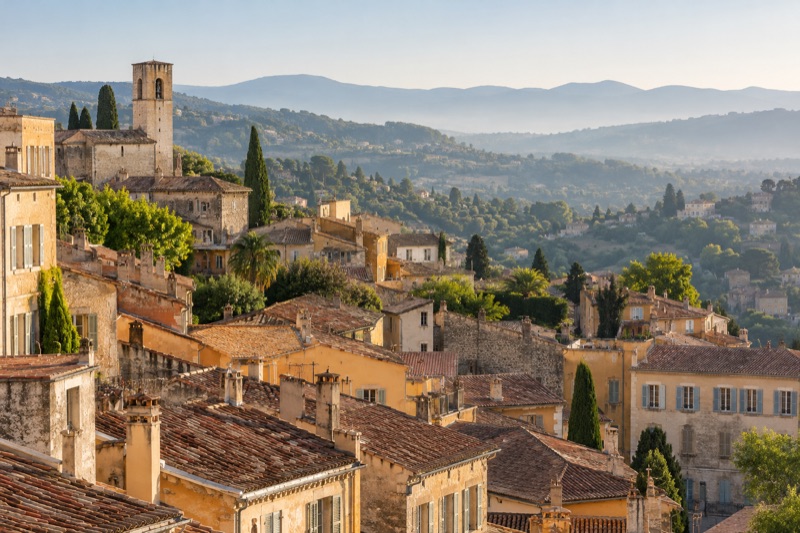
Grasse became the perfume capital of the world because a tanning town learned to scent its gloves, and its hills proved good at growing the flowers to do it. Perfumed gloves led to perfumes, then to flower fields, factories and a trade in raw materials. By the early 20th century, the International Perfume Museum says, Grasse was the world's largest center of natural perfume raw materials, and in 2018 UNESCO recognized the skills behind it.
This guide follows the story in order: the tanners and their gloves, the flowers, the houses, the UNESCO listing, what Grasse is now, and how it connects to a scented object at home.
From tanners to perfumers
In the 15th century Grasse had a large tanning industry, and its leather had a European reputation, according to the Fragonard perfume museum. The leather was known for its quality and a greenish tint from steeping in myrtle. Galimard, a Grasse perfumer, adds that the town had flocks of sheep and spring water for treating hides.
Tanned leather smelled, and perfumed gloves were the fashion at court. The usual story says a Grasse tanner, Galimard, gave a pair to Catherine de' Medici and that orders followed. It's a good story with thin support. The Fragonard museum notes that nothing documents the queen ever visiting Grasse, and it calls a rival tale, about an Italian named Tombarelli, questionable as well.
What is documented is the guild. In 1614 Louis XIII created the guild of maîtres gantiers parfumeurs, master glovers and perfumers, and in 1724 it received statutes specific to Grasse, the Fragonard museum says. Perfumery gradually became the only business of Grasse's workshops. The International Perfume Museum gives taxes a role: in its account, high taxes after the French Revolution caused tanning to recede in favor of perfumery, which then branched into powders and soaps.
UNESCO states the long view in one sentence. The practices of growing and processing perfume plants and creating fragrant blends have developed in the Pays de Grasse since at least the 16th century, in a craft industry long dominated by leather tanning.
The flowers
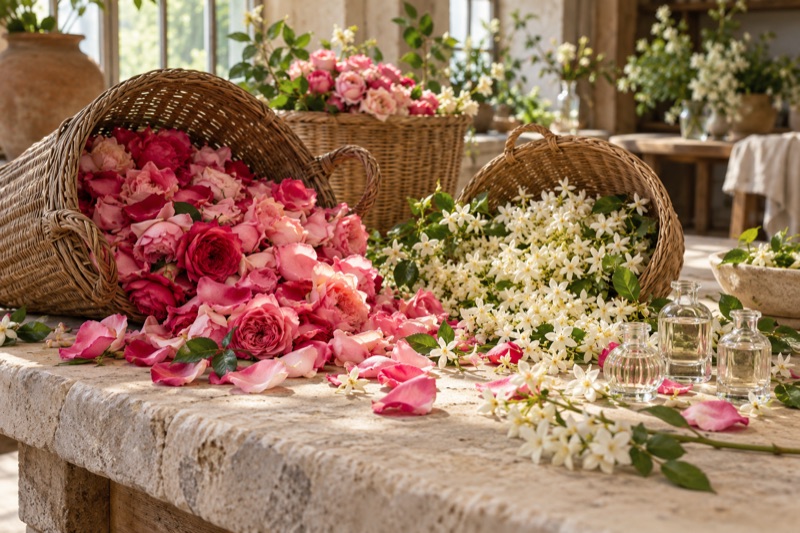
Perfumed gloves needed perfume, and perfume needed flowers. The Fragonard museum says jasmine was planted successfully in large fields around 1560, and that rose de mai (Rosa centifolia), tuberose and lavender gradually filled the surrounding landscape.
Why there? Perfumers give a consistent answer. The Fragonard museum cites southern sun, Mediterranean mildness, cool nights from the altitude and plentiful watercourses. Galimard's overview of the town adds long sunshine, short rainy periods and fertile alluvial soil. These are the trade's own explanations, not an agronomic study, but they agree.
The Pays de Grasse tourist office calls jasmine, rose and tuberose the three queen flowers of perfumery and lists the area's flowers by season, from mimosa in January and February to centifolia rose in May and June and jasmine from August to October. Our guide to the flowers of Grasse has the full harvest calendar. Lavender, the flower most people picture in Provence, is a July crop that the tourist office says is mainly grown on the Valensole plateau. Lavender Season in Haute-Provence covers it.
Visitors hoping for endless flower fields should adjust their expectations. Galimard says perfume plants are grown in small family plots, often for very short seasons.
The houses
Several of Grasse's best-known houses grew out of the glove-and-tannery trade or the family firms of the 19th century. The dates below are each house's own account.
| House | Its own account | Detail |
|---|---|---|
| Galimard | Perfumer since 1747 | Says Jean de Galimard, a glover-perfumer, turned to perfume as the leather trade waned |
| Molinard | Perfumer in Grasse since 1849, now in its fifth generation | Has used its Bastide since 1900; its distillery room has a metal structure designed by Gustave Eiffel, it says |
| Fragonard | Founded in 1926 by Eugène Fuchs, who bought two existing Grasse perfumeries | Says it is named for the painter Jean-Honoré Fragonard, son of a Grasse perfumer and glove maker; its Historical Factory is a former tannery, it says |
| Robertet | Dates itself to 1850 | Moved its head office from Paris to Grasse in 1883 |
| Givaudan | Founded in 1895 in Zürich | Dates its historic roots to 1768 and Antoine Chiris, and says they lie in Grasse |
Grasse did not only make finished perfume. The Fragonard museum says the town's factories became essential suppliers of raw materials, such as essential oils sold to other houses for blending. (Our guide to how perfume is made explains how those materials are drawn from plants.) The museum adds that Grasse did not become the center of synthetic aroma chemistry, and that mass-market perfumery settled in Switzerland, the United States and Germany.
The International Perfume Museum describes a harder turn from the 1960s, when large international groups bought Grasse factories. Their synthetic scents gave perfumers a wider palette, but their low prices often came at the expense of natural products.
UNESCO recognition
In 2018, at its 13th session, UNESCO's intangible heritage committee inscribed the skills related to perfume in Pays de Grasse on the Representative List of the Intangible Cultural Heritage of Humanity. The listing covers three linked skills: cultivating perfume plants, knowing and processing natural raw materials, and composing perfume. Communities and groups involved are brought together under the Association du Patrimoine Vivant du Pays de Grasse.
Two details are worth knowing. First, UNESCO says this knowledge is mostly passed on informally, through a long learning process that still takes place mainly in perfumeries, though interest in formal teaching has grown in recent decades. Second, the listing recognizes living skills, not buildings. UNESCO's 2003 convention is mainly concerned with the skills and knowledge involved in craftsmanship rather than the craft products themselves. You'll sometimes see Grasse called a World Heritage site. What UNESCO listed is the intangible kind.
How this listing sits among France's other craft recognitions is covered in French Savoir-Faire: What It Means, and Where to Find It.
Grasse today
Today Grasse is more a center of know-how than of farming. An AFP report from May 2026 puts the town's perfume workforce at 4,600, citing Prodarom, the French trade body for makers of aromatic raw materials.
The fields are the harder story. For decades, AFP reports, pressure on land along the Riviera, the rise of synthetics and competition from other growing regions weakened the local industry. Production of centifolia roses fell from about 3,000 metric tons a year in the early 20th century to a record low of 59 metric tons in 2011. It has since recovered to about 120 metric tons a year, which AFP still calls a niche production, and in 2018 the city set aside 70 more hectares for perfume plants such as rose, jasmine, tuberose and mimosa.
The International Perfume Museum's account of jasmine is blunter. It says property development between 1970 and 1980 took farmland, and jasmine growing moved to the Nile Delta in Egypt, then to southern India, which it says supply 90 percent of the world's jasmine.
What keeps Grasse central is a mix of faithful customers and new investment. AFP says Chanel and Dior use centifolia in their historic perfumes, so swapping in Damask rose was never an option. Chanel says it has sourced flowers for more than four decades from fields managed by the Mul family in the Pays de Grasse. Reuters reported in 2021 that Chanel added 10 hectares to the 20 it already worked with the family. The Globe and Mail described those fields at Pégomas, a few kilometers from Grasse, where jasmine, May rose, tuberose, iris and rose geranium are grown exclusively for Chanel.
Fragrance companies have followed with estates and labs, AFP says: Louis Vuitton's creative center in 2016, dsm-firmenich's Villa Botanica in 2020 and Lancôme's seven-hectare rose estate in 2023. The head of Symrise's SFA-Neroli unit says the group has plantations in Madagascar but finds its production techniques in Grasse.
Perfume isn't the whole industry, either. Galimard's overview says food flavorings account for about a third of the sector's revenue.
Many of the main sights are free or inexpensive. Our guide to what perfumes are made in Grasse covers the houses, the famous names and a visiting plan.
Grasse and home fragrance
Grasse's perfumers sell more than perfume. By their own sites, Fragonard offers candles and diffusers, Molinard lists scented candles and ambient perfumes, and Galimard has a home-scents range. That overlap is natural. The National Candle Association says candle makers work closely with fragrance companies to develop their scents, and a candle's fragrance is often described with the same top, heart and base notes as a perfume. Our guides to how fragrance notes work and who makes candle fragrances take that further, and French Candle Brands Worth Knowing covers the houses that began as perfumers.
For the wider idea of living well at home that scent belongs to, see The French Art of Living: What 'Art de Vivre' Means at Home.
Our own scented object is Le Bonne Pomme, a hand-poured soy and beeswax apple, hand-painted one by one and presented under a handblown glass cloche. It's designed in France, and its fragrance is by Mane, the French fragrance house founded in 1871. Who Is Mane? tells that house's story.
It's designed for cold diffusion: displayed under its cloche, it scents a room without being lit, for about 60 days, depending on room size. It can be lit, but isn't meant to be: the painted finish will melt and the wax may drip, which is not a defect. The published notes are crisp apple skin, melon and peach at the top, rose and red berries at the heart, and caramel, musk and wood at the base. A note describes what you smell, not which flower or field supplied it.
FAQ
Why is Grasse called the perfume capital of the world? The title is a reputation built on history: tanners who scented gloves, a flower-growing climate, family houses and a raw-materials trade that, by the early 20th century, made Grasse the world's largest center of natural perfume materials, per the International Perfume Museum.
Is Grasse famous for perfume? Yes. France's official tourism site calls it the world capital of perfume and says many famous fragrances were created there, and UNESCO listed the area's perfume skills in 2018.
What is Grasse jasmine? It's Jasminum grandiflorum, grown in Grasse and picked by hand at dawn from about August to October, by the accounts of local growers. Chanel's perfumer Olivier Polge told the Globe and Mail that Grasse jasmine is fresher and a little greener than Egyptian jasmine of the same species. Local growers such as Terre de Jasmin say its flowers open at night and are picked at first light. See The Flowers of Grasse for more.
What perfumes are made in Grasse? Houses such as Galimard, Molinard and Fragonard make their own perfumes there, and raw-material and fragrance companies make extracts and compositions that other brands use. The list is in What Perfumes Are Made in Grasse?
Is Grasse worth visiting? For anyone curious about perfume, yes: there's a perfume museum, a plant garden and free factory tours. France's official tourism site suggests going outside summer, when the weather is often still good and the town is quieter.
How much is Grasse perfume? Grasse isn't a price tier. Houses there sell everything from small bottles to bespoke blends. Factory tours at Fragonard, Molinard and Galimard are free, and a perfume-making workshop at Galimard starts at €69, as listed on its site in October 2026.