Fragrance notes describe what you smell as a scent unfolds over time. Here's how fragrance notes work: perfumers sort the materials in a blend into top, heart and base notes by how quickly they evaporate, so the top notes reach you first, the heart follows and the base lasts longest. A notes list is a map of that sequence, written in words you can picture. It isn't an ingredient list.
This guide walks through each tier with one apple, explains why a candle you don't light leans toward the top of its pyramid, and shows how to read and describe the notes on any label.
What notes are
Notes are descriptors of the scents) you can perceive in a fragrance, not a formula. "Apple" on a label doesn't mean an apple went into the bottle or the wax. The fragrance encyclopedia Osmoz notes that no essential oil can be drawn from apples, so perfumers build the note from other materials. Our piece on what an apple candle smells like shows how.
The three tiers are usually drawn as a pyramid. A chemical-engineering review in Molecules calls it Carles's pyramid, after the perfumer Jean Carles, who described a perfume as top notes for the first impact, middle notes for its main character and base notes for staying power. "Middle" and "heart" are two names for the same tier. The International Fragrance Association compares the perfumer's work to composing a musical score, with each layer doing a different job.
Top notes
Top notes are made of small, light molecules) that evaporate quickly. They make the first impression and fade first. The Molecules review describes them as typically citrus and green notes, lasting 15 to 30 minutes on the skin.
Heart notes
Heart notes give a fragrance its body and character. They arrive as the top notes thin out and hold the center of the scent. The same review describes them as typically floral, spicy or leathery, lasting three to four hours on the skin.
Base notes
Base notes are the large, heavy molecules) that evaporate slowly. They anchor the blend and stay longest. The review gives amber and musk as typical base notes, lasting more than four hours on the skin.
| Tier | Also called | What it does | Typical families | On skin |
|---|---|---|---|---|
| Top | Head | First impression, fades first | Citrus, green | 15–30 minutes |
| Heart | Middle | Body and character | Floral, spicy, leather | 3–4 hours |
| Base | Soul | Depth and staying power | Amber, musk | More than 4 hours |
Those timings describe perfume on skin. A candle works differently. The National Candle Association explains that a candle's scent is released by evaporation from the hot wax pool and from the solid candle itself, so the wax, the temperature and whether the candle is lit all change the balance.
One apple, three layers
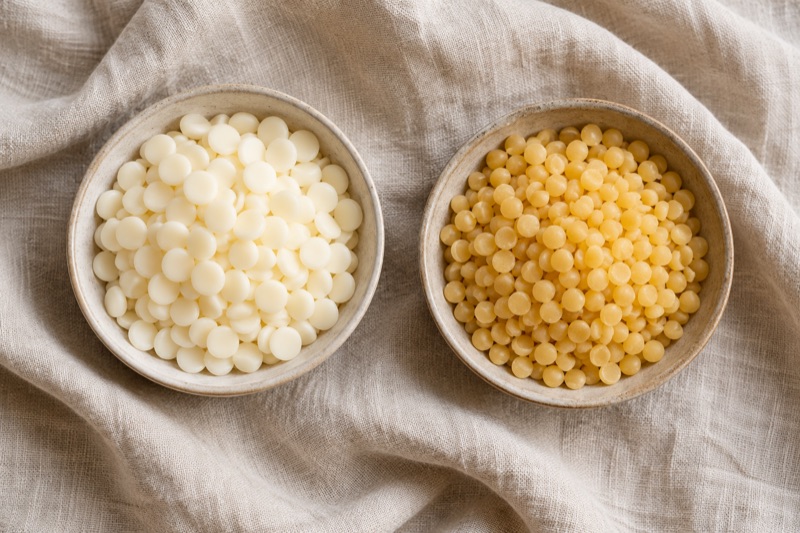
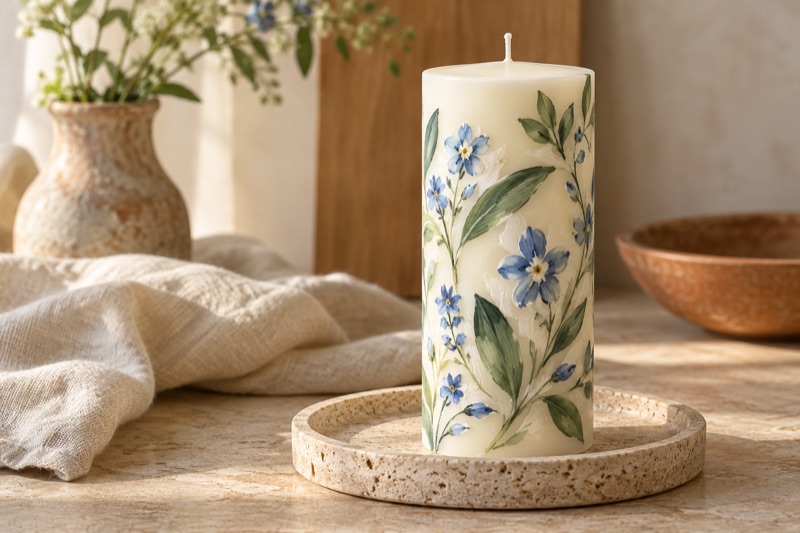
Our own candle makes the pyramid easy to see. Le Bonne Pomme is a hand-painted apple of hand-poured soy and beeswax, presented under a handblown glass cloche. Its fragrance is by Mane, the French fragrance house founded in 1871, and it's written in three tiers.
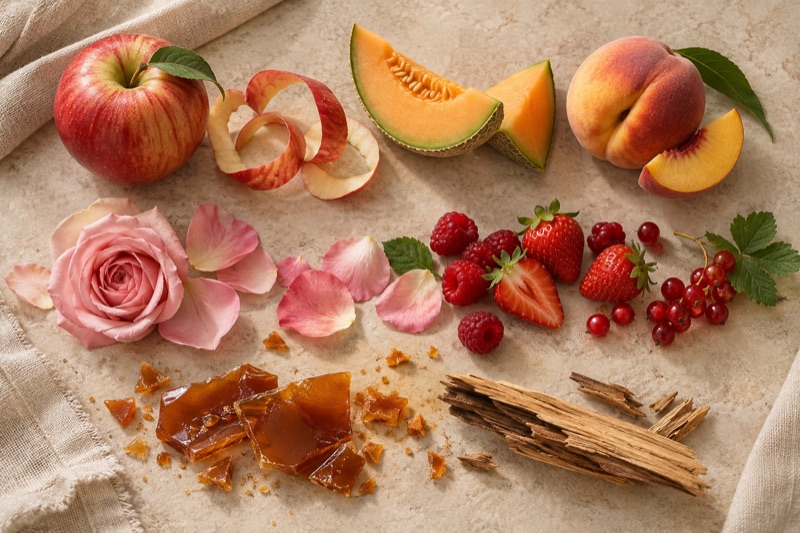
Top: crisp apple skin, melon, peach. The first impression. "Skin" points to the tart peel rather than the sweet flesh, melon adds a cool, watery note, and peach rounds the edges with riper fruit.
Heart: rose, red berries. The body. Rose turns the apple floral, and red berries add a tart, jammy brightness.
Base: caramel, musk, wood. The anchor. Caramel brings warmth without spice, musk softens, and wood keeps the finish dry.
Read top to bottom, the list tells a short story: a crisp apple, then something floral and fruity, then a warm, dry base.
Why unlit scent favors the top
Heat speeds evaporation. As a liquid warms, a greater share of its molecules have enough energy to escape into the air. A burning candle's melt pool lifts every tier, including the heavy base materials. Unlit, a candle gives off only what evaporates from solid wax at room temperature.
From that, it follows that an unlit candle should lean toward its most volatile materials, which are the top notes. That's an inference from how volatility works, not a measurement of any particular candle, ours included. Volatility isn't the whole story either. The Molecules review's simplest measure of how strongly we smell a material is its concentration in the air divided by its odor detection threshold, so a slow-evaporating material that people can detect at very low levels can still register.
Displayed under its cloche, Le Bonne Pomme is designed to scent a room without being lit, for about 60 days, depending on room size. In principle, that leaves the crisp apple skin, melon and peach to do most of the traveling, with the heart and base filling in closer to the apple. Our guide to cold throw vs hot throw covers the difference between a candle's unlit and lit scent. Le Bonne Pomme can be lit, but isn't meant to be: the painted finish will melt and the wax may drip, which is not a defect. Can you burn a painted candle? explains why.
Reading a notes list
- Read a three-part list as a timeline. Top, heart and base tell you what you'll notice first, what settles in and what lingers.
- Treat notes as impressions. "Rain," "cashmere" and "clean linen" can't be distilled. They're accords, small blends built to suggest something.
- Look at the families. Citrus, fruit and green notes read fresh. Florals usually sit in the heart. Woods, musk, amber, vanilla and caramel read warm and heavy.
- Notice qualifiers. "Apple skin" is crisper than "apple," "fig leaf" greener than "fig," "orange blossom" floral rather than citrus.
- Ask how it's meant to be used. A candle made to burn can count on heat to carry its base notes. One made to be smelled unlit relies more on its top.
The wax plays a part as well. Our guide to soy vs beeswax candles compares how each holds fragrance.
How to learn and describe notes
Professionals take years. According to the International Fragrance Association, fewer than a thousand fully qualified perfumers work worldwide, each training for seven to ten years. You can make a start at home.
- Smell the real thing. Before you judge an "apple skin" note, smell a fresh apple's peel. Do the same with a peach, a rose, a slice of melon.
- Come back to it. With a perfume, smell again after 15 minutes and after an hour. With a candle, leave the room and notice your first breath when you return.
- Rest your nose. People habituate to odors they're repeatedly exposed to and notice them less (Pellegrino et al., Physiology & Behavior, 2017). Fresh air between samples helps.
- Borrow words. Naming smells is hard in English. In one study, Jahai speakers of the Malay Peninsula named odors as easily as colors, while English speakers struggled (Majid and Burenhult, Cognition, 2014). Name a source ("like apple peel"), a quality (sharp, creamy, powdery, dry) and a weight (light or heavy, cool or warm).
Every note on a list was chosen by someone. Who that someone is, and who they work for, is the subject of Fragrance Houses, Explained.
FAQ
What are fragrance notes? They're descriptions of what you can smell in a fragrance, grouped by when you notice them: top notes first, heart notes next and base notes last.
What is a fragrance pyramid? A diagram of a fragrance's notes in three tiers, with the fast-evaporating top notes at the peak and the slow, heavy base notes at the bottom.
How do you learn fragrance notes? Smell the real materials a note names, revisit a scent over time, rest your nose between samples, and describe what you smell in your own words.
Do notes smell the same in a candle as on skin? Not quite. Heat, wax and whether the candle is lit change which tiers come forward. In principle, an unlit candle shows more of its top notes, though that's inferred from volatility rather than measured.
What do the notes in a candle tell you? How the scent is meant to open, settle and finish. They don't disclose the formula.