
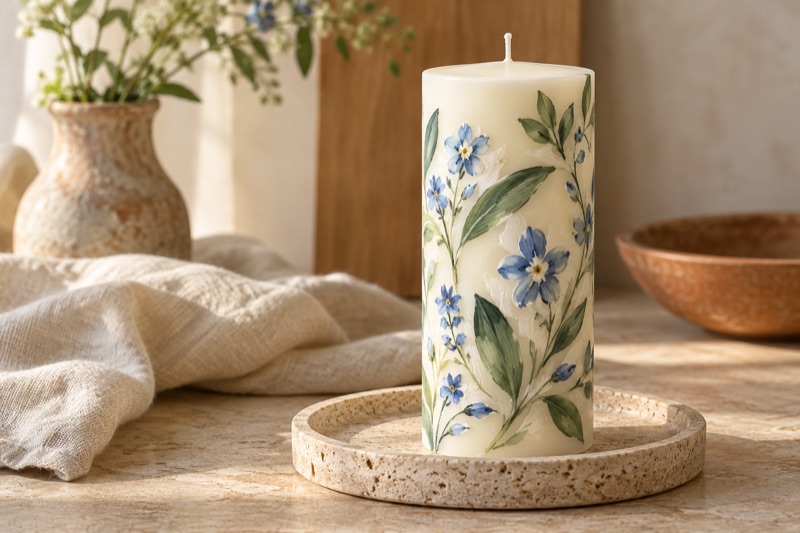
You can burn some painted candles, but a flame is hard on paint, and some painted finishes can catch fire. A small design on the side of a plain dinner candle may burn down without trouble. A candle painted all over, especially a sculpted one, will lose its finish as the wax softens. The best guide is the maker: a painted candle with burn instructions was made to be lit, and one without them is safer treated as an object.
Here is how hand-painting works, what happens when a painted candle meets a flame, and how to look after one you keep.
How candles are hand-painted
Wax takes color in two ways. Britannica notes that beeswax mixes with any coloring matter and takes surface tints well. Candlemakers use both routes. According to the National Candle Association, dyes generally color a candle all the way through, while pigments, which form a solid wall of color "similar to paint," are generally used to coat the outside.
Painting is the surface route, done by hand. The methods vary:
- Paint on a plain candle. This is the home-craft version. The Women's Institute's guide to painted candles has you wipe plain dinner candles clean, then draw the design in water-based acrylic paint pens, in two coats with drying time between. Stylist's version cleans the candle with rubbing alcohol first and applies acrylic with a brush or sponge.
- Wax on wax. Some makers paint with melted, colored wax instead of paint, brushing it on so the decoration is the same material as the candle.
- Coatings. Commercial decorative candles have also been finished with metallic paint, gold coatings and glitter, as the recall notices below show.
- Hand-finished sculpture. A molded or sculpted candle that's hand-painted gets its color after the form is made, by hand and one piece at a time, so small differences from piece to piece are part of the work.
For ideas, the Women's Institute suggests painting names on small votives to use as place cards. Dots, stripes and small botanical sprigs suit the curve of a dinner candle, and a design kept low on the side stays away from the flame.
What happens when you light one
A burning candle consumes its wax, not its surface. The flame melts a pool of wax around the wick, and that pool is the fuel. Paint sits on top of the wax and isn't part of that fuel. Three things can follow.
The finish loses its footing. As the wax beneath softens, the paint film slumps, wrinkles, smears or slides into the pool. On a sculpted form the wax isn't spread evenly around the wick, so thin edges and raised details melt first and the wax may run down one side.
The color gets in the flame's way. The NCA says pigments usually do not burn well and will clog a wick if burned. Flakes of paint in the pool are also debris, and the NCA's advice for minimizing soot includes keeping the wax pool free of debris. That's one reason a painted candle can smoke.
Some finishes catch fire. A search of the US Consumer Product Safety Commission's recall database turns up more than a dozen candle recalls, most between 1999 and 2014, in which paint, glitter or another coating on a candle or its container could ignite. In one, a duck-shaped novelty candle, the pooling wax could ignite the paint on the duck. Others involved holiday candles with painted scenes, round and egg-shaped candles with gold paint and metallic tapers.
Le Bonne Pomme is a painted candle made to be kept rather than burned. It is a sculptural apple of hand-poured soy and beeswax, hand-painted one by one and presented under a handblown glass cloche. It's designed for cold diffusion: displayed under its cloche, it scents a room without being lit. It can be lit, but isn't meant to be: the painted finish will melt and the wax may drip, which is not a defect. For the wider question, see Should Decorative Candles Be Lit?
Is it safe to paint candles?
Painting a candle is ordinary craft work. The real question is whether to light it afterward, and the guidance differs. The Women's Institute says to keep paint off the top of the candle near the wick, to use water-based paint, and to treat candles painted with other acrylics as decorative only. Stylist says small designs in water-based acrylic can be burned once dry, provided the candle is never left unattended, and notes that the amount of paint can affect burn time.
Neither is a safety standard. The industry's fire-safety specification for candles is ASTM F2417, which sets minimum safety requirements, and the NCA advises choosing candles with a cautionary label. A candle you've painted yourself hasn't been through that, so the cautious course is the Women's Institute's: keep the top clear and the design small, or keep the candle for display.
If you do light one, follow the NCA's usual rules. Trim the wick to ¼ inch, set the candle on a stable, heat-resistant surface at least 12 inches from anything flammable, and never leave it burning unattended. Put it out if paint near the flame starts to bubble, blacken or smoke.
Caring for a painted finish
A painted candle you don't burn still needs some care.
- Keep it cool and out of the sun. Heat softens wax, and the NCA notes that light and heat can slowly alter the color of dyed wax. Le Bonne Pomme's care note is to keep it out of direct sunlight and away from heat sources.
- Handle it by the base. Both craft guides warn that paint on wax can chip or scratch.
- Dust it dry. A soft, dry brush is enough. Skip water and household cleaners on a painted surface.
- Skip the hair dryer. Natural waxes can develop a whitish bloom over time. Don't try to warm it away on a painted piece, because the paint moves with the wax. Our guide to soy and beeswax explains why blends behave as they do.
- Cover it. A glass cloche or lid keeps dust off a painted surface, which is harder to clean than plain wax.
A painted candle you keep is still a scented one. To understand what it gives off unlit, read How to Read Fragrance Notes, and for who composes a candle's scent, see Fragrance Houses, Explained.
FAQ
Can you burn hand-painted candles? Some, with care. If the maker gives burn instructions, follow them. If the candle is painted all over, sculpted, or sold for display, leave it unlit.
How do you hand paint candles? Wipe a plain candle clean, paint a design on the sides in water-based acrylic or paint pens, let the first coat dry, then add a second. Keep paint off the top and away from the wick.
Can you paint candle jars? You can decorate the outside of a container, but keep paint well below the rim and check the paint maker's guidance on heat. In 2001 the CPSC announced a recall of candles whose silver-painted containers could be ignited by the flame.
Why is my painted candle smoking? Paint or flakes of the finish may have reached the wax pool or the wick. Put it out and let it cool. If the paint runs close to the top, it's better kept as decor.
Can a painted candle without a wick still scent a room? If it's scented, yes. Some painted wax pieces have no wick and are purely decorative, but the NCA notes that fragrance is released from the solid candle itself as well as from a melted pool.