
Most candle fragrances aren't made by the brand on the label. They're composed by a fragrance house: a company that employs perfumers and creates scents to order for other businesses, from perfume and shampoo to laundry and home fragrance. The National Candle Association says candle makers work closely with fragrance companies to develop their scents.
Here is how brands and houses divide the job, who the major houses are, how a brief becomes a scent, and why it's worth knowing who made yours.
Brands and houses
A brand decides what a product is: its concept, name, vessel, wax and price. A fragrance house creates the scent itself. Givaudan, which describes itself as an industry leader, says it works in the business-to-business market, supplying food, consumer goods, fragrance and cosmetics companies.
That's where the perfumers are. According to Wikipedia's entry on the profession, most perfumers are employed by large fragrance corporations, and the International Fragrance Association (IFRA), the industry's trade body, counts fewer than a thousand fully qualified perfumers worldwide.
The vocabulary muddies things, since perfume brands are often called houses too. In this article, a fragrance house means the company that composes the scent.
Scent is central to candles. The NCA estimates that 75 to 80 percent of candles sold in the US are scented, and says candle makers can choose from more than 2,000 aroma chemicals and essential oils.
The big houses
Givaudan names Symrise, dsm-firmenich and IFF as its main competitors. Alongside those four are other long-established houses, among them Mane, Robertet and Japan's Takasago. Each fact below comes from the house's own site.
| House | Roots | By its own account |
|---|---|---|
| Givaudan | Founded in 1895 in Zürich by Léon and Xavier Givaudan; traces its roots to Antoine Chiris in Grasse, 1768 | More than 17,500 employees and 2025 sales of CHF 7.47 billion |
| dsm-firmenich | Firmenich began in 1895 as a perfumery start-up in Geneva; it merged with DSM in 2023 | Perfumery & Beauty is one of its businesses |
| IFF | Began in 1889 as a Dutch flavor and essence business, later merged with the US firm Van Ameringen-Haebler | Says A.L. van Ameringen, later its chairman, persuaded American soap makers to add fragrance in the 1920s; merged with DuPont's Nutrition & Biosciences business in 2021 |
| Symrise | Formed in 2003 from Haarmann & Reimer, whose roots go back to 1874, and Dragoco, founded in 1919 | Headquartered in Holzminden, Germany; was the fourth-largest flavor and fragrance company at its formation |
| Mane | The French fragrance house founded in 1871, as V. Mane Fils, by Victor Mane | Works across fragrances, flavors and ingredients; fragrances were 40% of its 2025 business |
| Robertet | Dates itself to 1850; moved its head office from Paris to Grasse in 1883 | Calls itself a world leader in natural raw materials |
| Takasago | Founded February 9, 1920, in Tokyo | Makes flavors, fragrances, aroma ingredients and fine chemicals |
How many fragrance houses are there?
There's no single count. IFRA lists seven Regular members, which it describes as multinational fragrance houses active in all its regions: dsm-firmenich, BASF, Symrise, Givaudan, IFF, Robertet and Takasago. Its national associations represent companies in 24 countries, and IFRA says its members produce around 80 percent of the world's fragrance by volume. Beyond them are many smaller houses and suppliers.
How a brief becomes a scent
The brief. A project usually starts with a brief from the client. Wikipedia describes it as setting out the specifications for the fragrance, often in poetic terms about what it should smell like or evoke, along with a maximum price per liter of the concentrate. A candle brief also has to describe the product the fragrance will live in.
Composition. A perfumer blends trial versions and adjusts them toward the brief. IFRA says labs support the work with gas chromatography, trend data and even AI tools, but every finished formula is still judged by the perfumer's own nose.
Performance. IFRA notes that brand owners and houses work to match a scent's performance to the product, from laundry to home care. For candles, the NCA says the amount of fragrance should be carefully monitored so the candle burns cleanly and properly, using fragrance materials approved for candle use.
Safety. The formula is screened against the IFRA Standards, which set the maximum dose of an ingredient in finished products, with limits that vary by product type. IFRA says the Standards are compulsory for its members.
Production. Once the brief is approved, IFRA says, automated systems reproduce the formula to parts-per-million precision.
Then the candle maker takes over: the wax, the wick and how much fragrance goes in all shape how the finished candle smells. Our guide to soy vs beeswax candles covers the wax side.
Why it matters
For a long time, Wikipedia notes, perfumes were known by the brand name on the bottle and the perfumers behind them went unnamed. In 2000 Frédéric Malle began printing perfumers' names on his bottles. Candle labels raise the same question of who composed the scent.
A house name tells you something real. The scent was composed by professional perfumers, and IFRA's members are bound by its Standards. It doesn't tell you whether you'll like the scent, or how well a particular candle carries it. That depends on the candle maker's wax, wick and fragrance load.
A supplier's catalog oil isn't automatically worse. Suppliers such as CandleScience sell ready-made candle fragrance oils to independent makers and explain how to read the IFRA certificate that sets a fragrance's maximum use level for each product type.
If you want to know more about a candle's scent, ask the brand:
- Who made the fragrance?
- Was it composed for this product, or chosen from a catalog?
- Was it developed for candle use, and in which wax?
- Is the candle meant to be burned, or smelled unlit?
Those answers say more than any adjective on the label. For the notes themselves, see How to Read Fragrance Notes.
Our house
The fragrance in Le Bonne Pomme is by Mane, the French fragrance house founded in 1871. It began as V. Mane Fils, founded by Victor Mane. Its timeline names members of the Mane family across generations, and Samantha Mane is the Group CEO. Today it works across fragrances, flavors and ingredients, and says it draws on 150 years of experience producing natural ingredients.
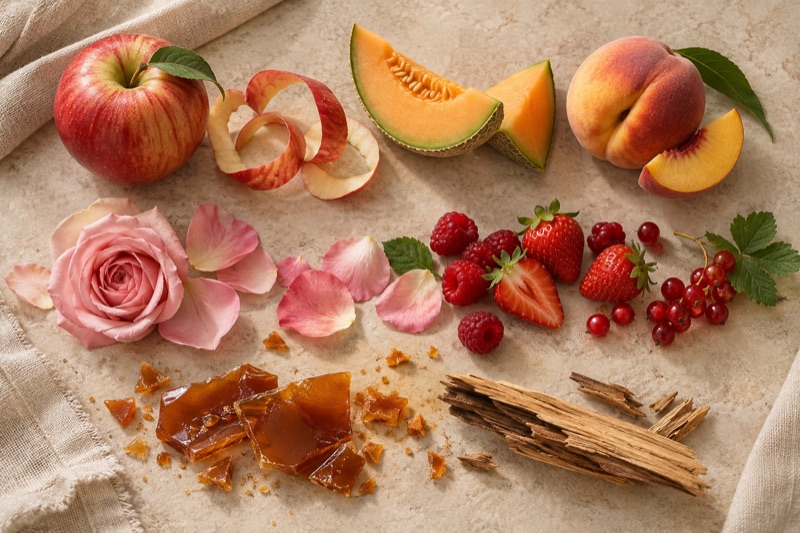
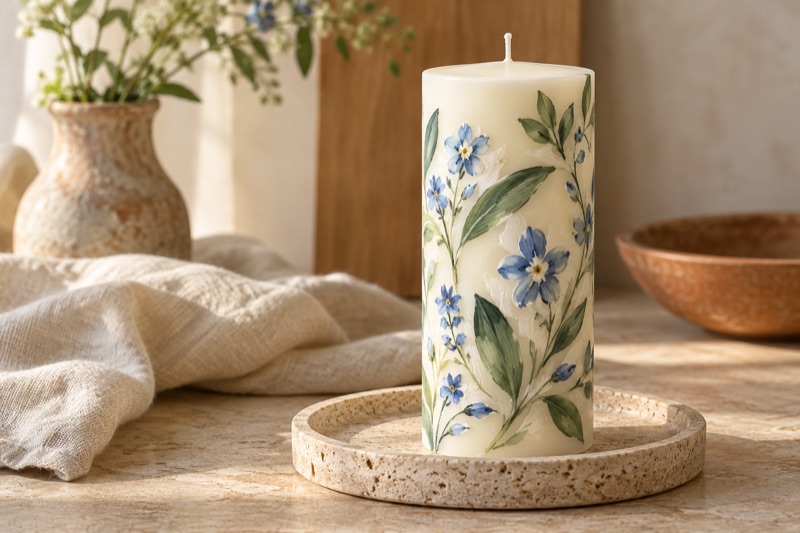
The fragrance is written in three tiers: crisp apple skin, melon and peach at the top, rose and red berries at the heart, and caramel, musk and wood at the base. It's designed for cold diffusion: displayed under its handblown glass cloche, the hand-painted apple scents a room without being lit. It can be lit, but isn't meant to be: the painted finish will melt and the wax may drip, which is not a defect. Can You Burn a Painted Candle? explains why. There's more on the house itself in Who Is Mane?
FAQ
What is a fragrance house? A company that employs perfumers and creates fragrances to order for other businesses, including perfume, beauty, household and candle brands.
How many fragrance houses are there? There's no official count. IFRA lists seven multinational houses as Regular members, and its national associations represent companies in 24 countries. Many smaller houses work outside that core.
Who makes candle fragrances? Usually a fragrance house working to a brief from the candle brand, or a supplier selling ready-made fragrance oils. The candle maker then decides the wax, wick and how much fragrance goes in.
Is a fragrance house the same as a perfume brand? No. A perfume brand sells the finished product under its name. A fragrance house composes the scent, often for many brands at once.
Is Mane a fragrance house? Yes. Mane, the French fragrance house founded in 1871, creates fragrances, flavors and ingredients, and it's the house behind Le Bonne Pomme's fragrance.