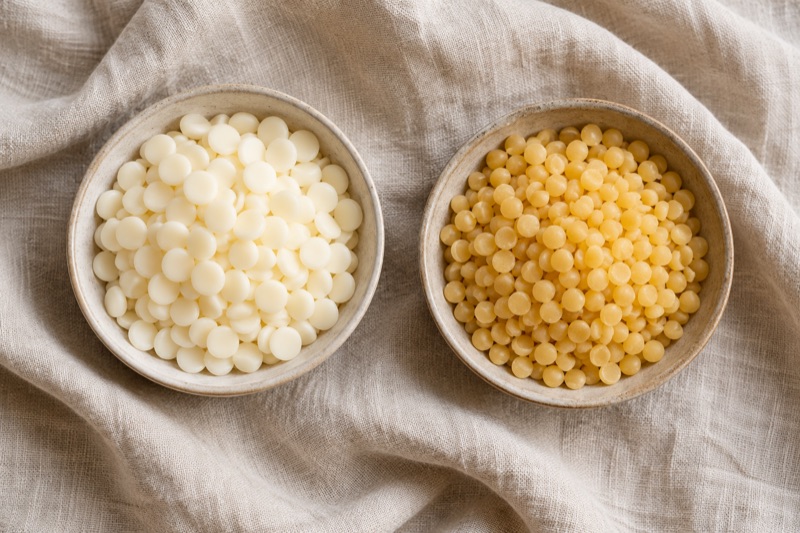
Soy vs beeswax candles: neither wax is better across the board. Soy wax is soft, inexpensive and holds plenty of fragrance, which is why it fills so many container candles. Beeswax is firmer, melts at a higher temperature, burns slowly and brings its own honey scent and golden color, at about three times the price. A blend takes something from each, and it's what we use for Le Bonne Pomme.
Soy versus beeswax comes down to what the candle has to do. Below, each wax on its own, then the two side by side, then what blending does and why it matters most for a candle made to be kept rather than burned. One thing first: neither wax turns a candle into a health product. Both give off soot when they burn.
Soy wax
Where it comes from
Soy wax is soybean oil made solid. Most of the fats in liquid soybean oil are unsaturated. Hydrogenation, a high-temperature process with a nickel catalyst, converts them to saturated fats, which raises the melting point until the oil sets as wax, as materials researchers explain. It is a young candle wax. The National Candle Association dates its commercial use in candles to the late 1990s.
How it behaves
Soy is soft and melts at a low temperature. Golden Brands 464, a common container soy, melts at 113°F (45°C), and its supplier, CandleScience, warns that it "can be a little too soft for the summer heat." Container waxes are designed to cling to the glass as they cool, which is why they go into jars and tins.
Pillar waxes are formulated to be harder and to pull away from a mold. CandleScience's pillar soys melt at 131°F (55°C) for EcoSoya PB and 135°F (57°C) for BW-921. The researchers above describe pure soy wax at room temperature as greasy and brittle.
Fragrance and finish
Soft soy holds a lot of fragrance. CandleScience rates 464 at a 10% fragrance load in containers, meaning fragrance oil equal to 10% of the wax's weight. Its pillar soys are rated at 6%. CandleScience also says soy is known for an "impressive cold throw", the scent a candle gives off before it is lit.
The finish is opaque, semi-matte and creamy white. Soy is prone to frosting, a white, chalky film of tiny crystals on the top and sides. CandleScience calls it "solely an aesthetic issue": it doesn't change how a candle burns or smells. Bumpy tops after cooling are common too.
Cost
Soy is the cheaper wax. In October 2026, a 1-lb bag of 464 cost $3.96 at CandleScience, and less in bulk.
Beeswax
Where it comes from
Young worker honeybees make beeswax. They secrete it as small platelets from eight glands on the underside of the abdomen and use it to build comb. The Food and Agriculture Organization of the UN notes that new wax is white and darkens in the hive as pollen and debris are worked into it. Rendered beeswax is yellow, and white beeswax has been bleached or filtered.
This is the old prestige wax. The NCA notes that beeswax reached Europe in the Middle Ages and was rarely used in homes because of its great expense.
How it behaves
Beeswax is firmer than container soy and melts higher. The FAO notes that pharmacopoeias most often list 62–65°C (144–149°F), and CandleScience rates its white beeswax at 144°F (62°C). According to the FAO, beeswax candles with a correctly sized wick stay straight in warm rooms and are less likely to drip.
Beeswax is also plastic. It turns pliable at around 32°C (90°F), below body temperature, and Candlewic, a long-running US candle supplier, notes that its tackiness can make it hard to release from molds. Melted beeswax is viscous, so it is usually paired with square-braided wicks, which the NCA says are preferred for beeswax and help prevent clogging.
Fragrance and finish
Beeswax has a scent of its own: Candlewic describes beeswax candles giving off "the sweet aroma of honey." CandleScience notes that its filtered white beeswax smells less than yellow. Beeswax is also rated for less added fragrance than container soy: 6% for CandleScience's white beeswax, the same as its pillar soys. Any fragrance you add sits on top of the honey.
Over time, beeswax can develop bloom, a whitish film on the surface. The FAO identifies it as small wax crystals and says the process is reversible without damage.
Cost
Beeswax is expensive. CandleScience's white beeswax cost $12.20 for a 1-lb bag in October 2026, about three times the price of its container soy. That price makes it a target for dilution: the FAO notes that beeswax cut with cheap paraffin is hard to detect without chemical analysis.
Soy vs beeswax, side by side
Here are the main differences between soy and beeswax candles at a glance. Figures are for specific waxes at one US supplier, CandleScience, unless noted. Grades vary, so read them as typical, not universal.
| Soy wax | Beeswax | |
|---|---|---|
| Source | Hydrogenated soybean oil | Secreted by worker honeybees |
| In candles since | Late 1990s | Centuries; in Europe since the Middle Ages |
| Melt point | 113°F (45°C) container; 131–135°F (55–57°C) pillar | 144°F (62°C); 62–65°C in pharmacopoeias (FAO) |
| Firmness at room temperature | Soft in container grades, harder in pillar grades; greasy and brittle when pure | Firm; pliable and tacky when warm |
| Rated fragrance load | 10% container; 6% pillar | 6% |
| Color and scent | Opaque, semi-matte, creamy white | Yellow, with a honey scent; white grades are bleached or filtered and milder |
| Surface crystals | Frosting, which is cosmetic | Bloom, which is cosmetic and reversible |
| Price, 1-lb bag (Oct 2026) | $3.96 | $12.20 |
| Typical uses | Container candles, tealights; pillars in harder grades | Pillars, tapers, molded shapes; containers too |
Soy vs beeswax candles and health: is either cleaner?
Not in any absolute sense. The National Candle Association, the US industry group, says any candle will soot if its flame is disturbed, and that "wick length and flame disturbance are the primary factors that impact sooting."
A chemical-safety consultant interviewed by National Geographic in 2023 made the same point from outside the industry: candles of every wax, beeswax and soy included, give off soot and volatile organic compounds when they burn. Two public-health researchers writing in The Conversation warn that "natural" isn't automatically safer, because natural ingredients can release pollutants when burned too.
You may also read that burning beeswax releases negative ions that clean the air. We found no published research that shows it. Beeswax is a wax, not an air purifier.
How you burn a candle matters more than which of the two waxes it's made of. Trim the wick, keep the flame out of drafts, ventilate the room, and follow the basic candle rules. To find out what a specific candle has been tested for, ask for its lab report. Here's how to read an SGS candle test.
Why blend the two
Blends are routine in candlemaking. The NCA counts "a variety of wax blends" among the waxes in use and says no single wax or blend is considered the best. A soy-beeswax blend tries to keep the strengths of each wax and lose the awkward parts. In general, it does four things.
- It firms up soy. Adding beeswax makes soy wax harder and raises its melting temperature. In a 2023 study, researchers at the International Islamic University Malaysia found that adding beeswax raised the peak melting temperature of soy blends and increased their compression strength by about 150%. They were testing waxes for batik rather than candles, so read the numbers as a direction, not a candle spec. That firmness is what lets a soy-based wax hold a freestanding, sculpted shape. Candlewic's staff advise that soy on its own won't work for freestanding candles.
- It brings the cost down. At the prices above, every pound of soy used in place of beeswax costs about a third as much.
- It turns down the honey. Less beeswax means less of its honey note under the fragrance, which matters when the scent is meant to read as fruit or flowers.
- It can lengthen the burn. Candlewic says beeswax can be blended into soy to improve candle quality and "increase the burn time."
The proportions are up to each maker. A jar candle can get by with a little beeswax or none at all, while a freestanding piece needs much more.
What it means for an unlit, painted candle
For a candle designed to be kept rather than burned, the usual measures of hot throw and burn time hardly apply. Three others take over.
It has to hold its shape. A sculpted piece sits at room temperature for months. Container soy, made to cling to a jar, can't stand up on its own. The firmness beeswax adds is what lets a soy blend be molded, handled and displayed without slumping. Heat still softens any wax, so keep a wax object out of direct sunlight and away from heat sources.
Its surface has to keep a finish. Paint sits on top of the wax, so anything that softens the wax disturbs the paint. Natural waxes can also frost or bloom over time. On a plain candle the usual fix is gentle warmth, but on a painted piece you should skip the heat; see how to care for a hand-painted wax object. If you're wondering whether a painted candle can be burned at all, this explains how hand-painting works.
Its scent has to travel without a flame. An unlit candle works on cold throw alone, so the fragrance does more of the work, and more depends on the perfumer. Read who makes the scent in your candle and how to read top, heart and base notes. For how quickly scent fills a room, see how long it takes a candle to scent a room. If a candle seems to have gone quiet, here's why you can't smell your candle.
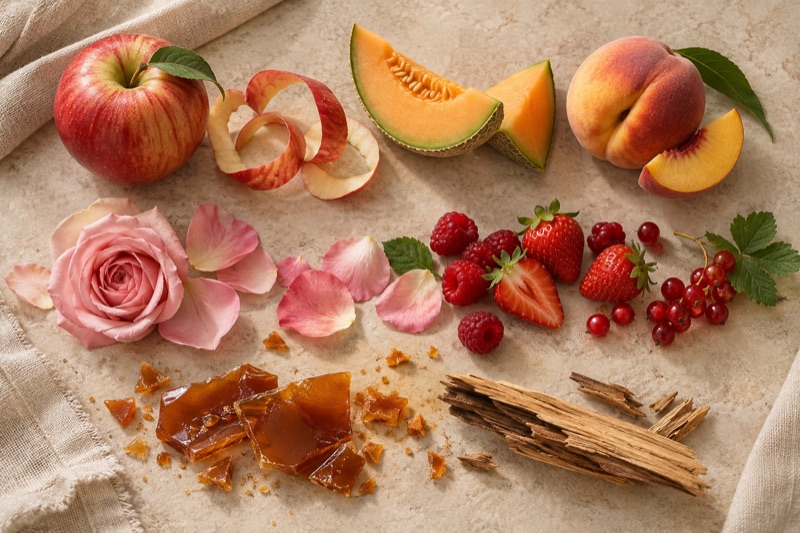
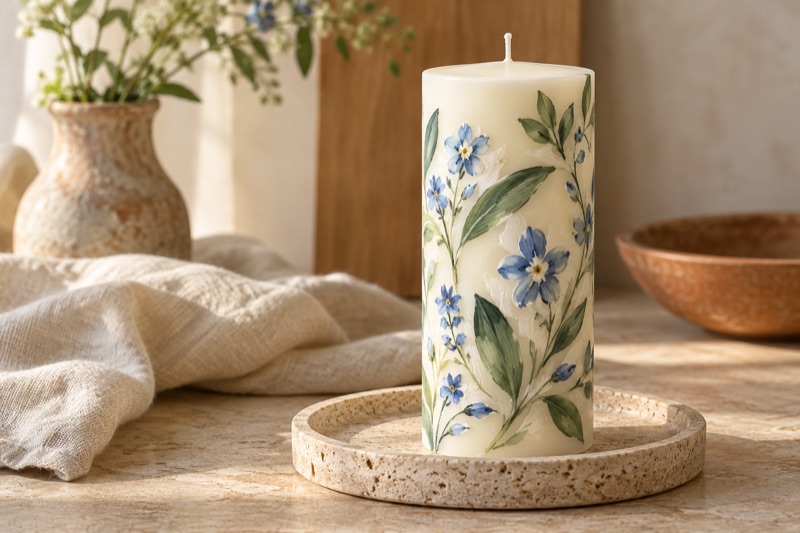
Le Bonne Pomme is one example. The 50 g (1.76 oz) apple is hand-poured from soy and beeswax, hand-painted one by one and presented under a handblown glass cloche. It is designed for cold diffusion: displayed under its cloche, it scents a room without being lit for about 60 days, depending on room size. The fragrance is by Mane, the French fragrance house founded in 1871. It opens on crisp apple skin, melon and peach, with rose and red berries at the heart and caramel, musk and wood at the base. It can be lit, but it isn't meant to be: the painted finish will melt and the wax may drip, which is not a defect.
FAQ
Which is better, soy or beeswax candles? Neither wins outright. Soy suits container candles with a strong scent at a lower price. Beeswax suits pillars and tapers that should burn slowly and hold their shape, and anyone who likes a honey note. A blend sits between the two.
Are soy or beeswax candles cheaper? Soy, by a wide margin. At one US supplier in October 2026, beeswax cost about three times as much per pound. Wax is only part of a candle's price, though, and what makes a candle luxury covers the rest.
Do soy or beeswax candles last longer? Size for size, beeswax usually does, because its higher melting point means the flame melts it more slowly. Wick size, diameter and drafts matter as much as the wax, and a candle that tunnels wastes wax whatever it's made of.
Are soy or beeswax candles safer? Neither is a health product, and both give off soot and other emissions when burned. How you burn them matters more: trim the wick to 1/4 inch, keep the flame out of drafts, ventilate the room and never leave a candle unattended, as the National Candle Association advises.
Do soy or beeswax candles work with essential oils? Both can carry essential oils or fragrance oils. Beeswax adds its own honey note to whatever you use, and firmer waxes are rated for less fragrance than container soy. Essential oils don't make a candle burn any cleaner, since natural ingredients release pollutants when burned too.