The French art of living, art de vivre, is the skill of living well: running your days with care and taking pleasure in them. The Académie française's dictionary defines it as a way of conducting one's life well and the way a person enjoys life's pleasures. At home it comes down to a few habits, and none of them requires buying anything French: keep fewer and better things, set the table, keep a ritual, choose one scent, and stay in on purpose.
What "art de vivre" means
In the Académie's entry for vivre, art de vivre is defined as manière de bien conduire sa vie, and as the way one has of tasting life's pleasures. Its first example is Montaigne's Essays, which it says propose an art de vivre. Its second is a phrase you may already know: l'art de vivre à la française.
Larousse explains why the word art fits. Its first sense is the body of methods, knowledge and rules involved in practicing an activity. Its second is any activity or conduct treated as a set of methods to observe, and its example is Bien vivre, aimer, penser est un art: to live well, to love, to think is an art. A fourth sense is a way of doing something that shows taste. An art, in these senses, is a practiced skill, like the savoir-faire of a craftsperson. Living well is practiced the same way, through small choices, repeated.
That makes the idea less aspirational than the marketing around it suggests. There is nothing to buy and nothing to join. What follows are habits, and where a source applies, it is named. The rest is our advice.
Fewer, better things
In Livingetc's piece on French design rules, the designer Lichelle Silvestry says that Parisians prize quality above sheer volume, along with craftsmanship and attention to detail. Houzz's guide to French country style makes a related point about time: a good room looks collected over time, not bought all at once.
In practice:
- Start with what you touch every day. The knife, the chair, the glass, the pan. Upgrade those first and leave the rest.
- Buy things that can be kept up. Solid wood that can be refinished, glass and ceramic that last, fabrics that wash well.
- One in, one out. When something new comes into the house, something leaves.
The test works in the bath and the bed as well. A few good towels and a set of sheets you like beat a cupboard full of ones you don't.
The table
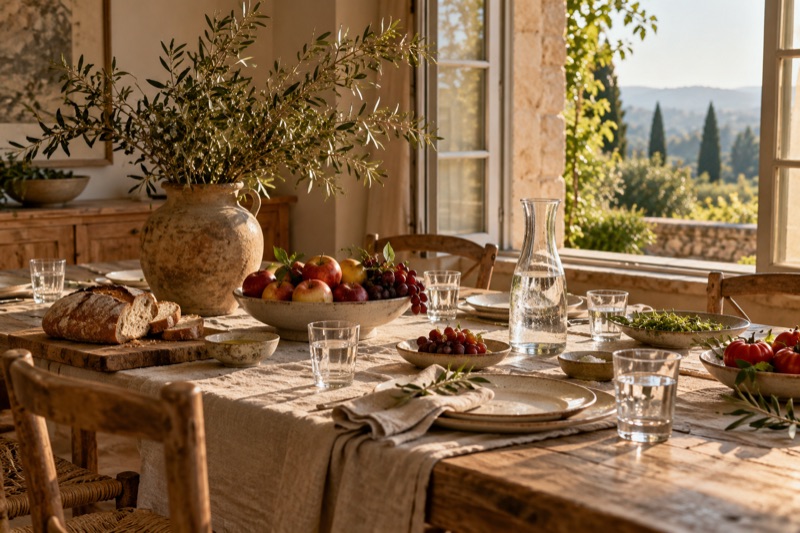
UNESCO's listing of the gastronomic meal of the French, inscribed in 2010, is a useful picture of what a table can mean. It describes a customary social practice for celebrating important moments. Its key elements include choosing dishes with care, buying good and preferably local products, pairing food with wine, setting a beautiful table, and smelling and tasting at the table. The full meal follows a fixed order: it begins with an apéritif, runs to at least four courses and ends with liqueurs.
Few of us will cook four courses on a Tuesday. The part that carries over is smaller, and these habits are ours, not UNESCO's:
- Set the table, even for one. A cloth napkin, a real glass, a plate that isn't also the pan.
- Eat at it, with screens and phones elsewhere.
- Cook less, and choose it. One good ingredient bought for a reason does more than a full basket.
- Give the meal a start and an end. Something to drink before, coffee after.
Ritual
A ritual is a small act, repeated, that marks a change. The apéritif is one: in UNESCO's description it opens the meal and liqueurs close it. The same idea works at home on a smaller scale.
- Arrive. Shoes off, bag in the same place, a window open for a few minutes.
- Mark the evening. A drink poured into a proper glass before you cook.
- Close the day. Clear the table, switch off the overhead light and use lamps only.
Pick one. A ritual only works if it is short enough to repeat.
Scent
Scent is the quietest object in a home, and making it is a recognized craft. In 2018 UNESCO added the skills related to perfume in the Pays de Grasse to its Representative List of the Intangible Cultural Heritage of Humanity. The listing covers growing perfume plants, processing natural raw materials and composing perfume, and notes that the knowledge is passed on mainly informally, through a long learning process that still happens largely in perfumeries. Our guide to why Grasse is the perfume capital of the world covers the town and its history.
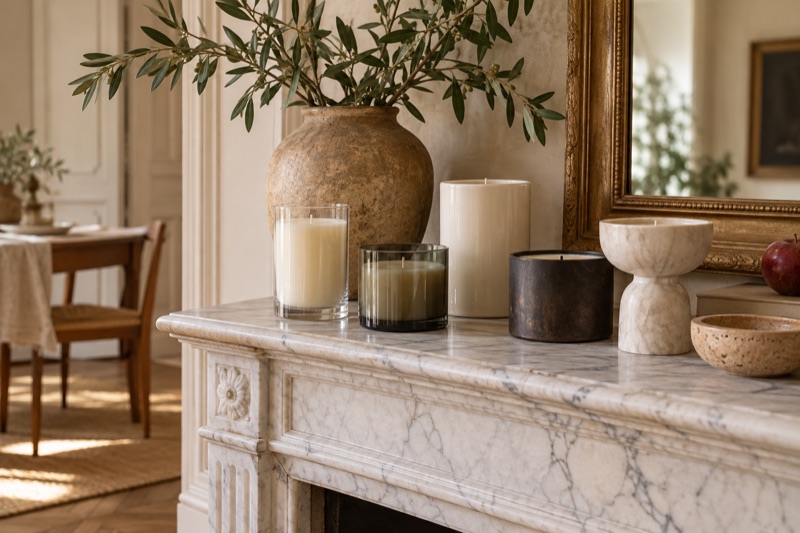
At home, the habit is restraint. Choose one scent, put it where you pass slowly, such as an entry table or the end of a hallway, and leave the rest of the house neutral.
Le Bonne Pomme is how we apply that idea. It is a hand-poured soy and beeswax apple, hand-painted one by one and presented under a handblown glass cloche, and we design it in France. Displayed under its cloche, it scents a room without being lit. The fragrance is by Mane, the French fragrance house founded in 1871. It lasts about 60 days, depending on room size. The published notes run from crisp apple skin, melon and peach through rose and red berries to caramel, musk and wood.
It can be lit, but isn't meant to be: the painted finish will melt and the wax may drip, which is not a defect. Keep it out of direct sunlight and away from heat sources. To learn more about the fragrance house, read Who Is Mane?, and for other French houses, French Candle Brands Worth Knowing.
Staying in
French labor law names Sunday as the default weekly rest day for employees, with listed exceptions that include bakeries and seasonal hotels and restaurants, according to Service-Public, the government's information site. The law doesn't say what anyone does with that day. It does show what the habit needs: a day the week has already agreed to leave alone.
You don't need a statute to borrow it.
- Protect one evening and one half day. Put them in the calendar like an appointment, with nothing scheduled.
- Invite two people to dinner at home instead of booking a restaurant.
- Make the house worth staying in. One chair with a lamp, a table that's set, something you have been meaning to read.
Staying in is where the other habits meet: the things you kept, the table you set, the ritual that starts the evening and the scent in the hall.
FAQ
What is the French art of living? Art de vivre is the skill of living well. The Académie française defines it as the way of conducting one's life well and enjoying its pleasures, and cites Montaigne's Essays as an example. At home it shows up as habits: fewer and better things, a set table, small rituals, one scent, and time spent in.
How do you live a French lifestyle, or live more French? Copy the habits, not the costume. Pick one: set the table every night for a week, replace one thing you use daily with a better one, or protect one evening. Add another when the first has held.
Is art of living free? The French expression is a way of living, so there is nothing to pay for or join. Art of Living is also the name of a separate international nonprofit, founded in 1981 by Sri Sri Ravi Shankar. Its own site is the place to check its programs and any fees.