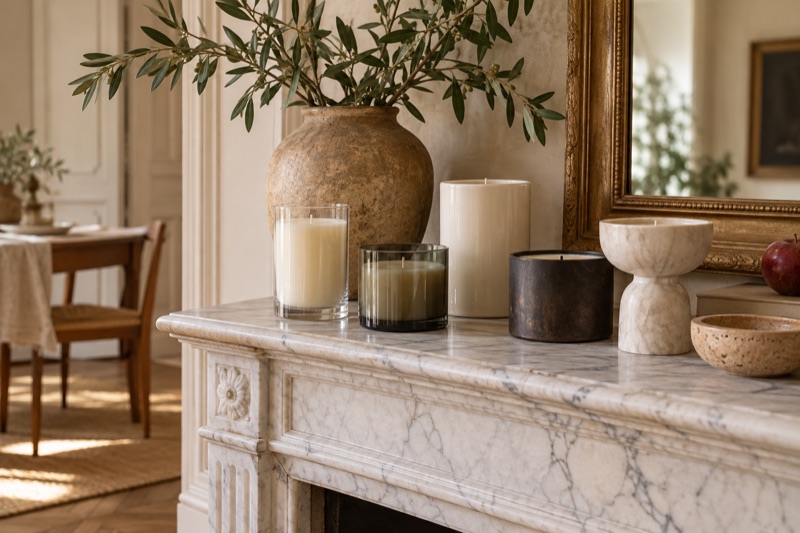
The French candle brands worth knowing run from Trudon, which traces its story to a Paris shop in 1643, to Rigaud, Diptyque, Astier de Villatte, Maison Francis Kurkdjian, Mad et Len and Buly 1803. Each has a clear signature: a scent, a vessel or a way of working. Below, you'll find when each house began, what it's known for and a candle to start with, with each history told as the house tells it.
The houses are grouped by type, not ranked. Our own, Pommette, comes last and is labeled as ours.
| House | Since | Known for | Start with |
|---|---|---|---|
| Trudon | 1643 | Royal wax manufacture, wax busts | Abd El Kader |
| Rigaud | 1852 | Paris perfumery, soft-wax candles | Cyprès |
| Diptyque | 1961 | Scented candles since 1963 | Baies |
| Astier de Villatte | 1996 | Paris ceramics, place-named candles | A city you know |
| Maison Francis Kurkdjian | 2009 | Perfume, Limoges porcelain jars | Baccarat Rouge 540 |
| Mad et Len | – | Hammered iron, mineral potpourri | Apothecary candle |
| Buly 1803 | 2014 | Marble vessels under glass | Campagne d'Italie |
| Pommette (ours) | – | An unlit apple under a cloche | Le Bonne Pomme |
What makes a candle French
Most of these houses share three things, though not every candle has all of them.
A wax tradition. France made candles for its kings. By Trudon's account, its wax manufacture at Antony, south of Paris, was named a Royal Manufacture in 1719. Our short history of candles in France covers the rest.
Perfumery. Several of these houses began as perfumers, or still are. For why so much French perfume traces back to one town in Provence, read why Grasse is the perfume capital of the world.
The vessel as an object. A French candle is often meant to outlive its wax, in porcelain, ceramic, iron or marble. That habit of treating a household thing as worth keeping is part of what the French call art de vivre.
"French" doesn't always mean every part comes from France. Trudon says its glasses are handcrafted in Tuscany. Astier de Villatte pours into blown-glass tumblers from Tuscany. Read the label, and see our guide to French origin labels for what each phrase promises.
The heritage houses
Trudon
Trudon, long known as Cire Trudon, dates its story to 1643, when Claude Trudon owned a shop on rue Saint-Honoré selling spices and candles. By its own account, the wax manufacture later bought by the Trudon family became a Royal Manufacture in 1719, "the one and only candle manufacture" to hold the title. Its scented candles came in 2007.
The classic candle sits in a glass the house says is hand-crafted in Tuscany, shaped after a champagne bucket. Trudon also makes wax busts of Napoléon, Marie-Antoinette and Louis XIV.
Start with: Abd El Kader, a mint tea scent the house lists among its icons.
Rigaud
Rigaud began as a perfumery. By its own account, Jean-Baptiste Rigaud left the Auvergne for Paris in 1852 and built a perfume house. After the Second World War, the third generation, Mario and Viviane Rigaud, turned to wax. Rigaud says that in the late 1950s they created "the world's first scented candle," with a fragrance inspired by Mediterranean pine forests and a soft wax that Mario patented.
Start with: Cyprès, cedarwood with bergamot and lavender, the candle the house leads with.
Diptyque
Diptyque's story begins in 1961 with three friends: the painter Desmond Knox-Leet, the interior architect Christiane Montadre-Gautrot and Yves Coueslant, at 34 boulevard Saint-Germain in Paris. In 1963, the house says, they made their first three scented candles, Aubépine (hawthorn), Cannelle (cinnamon) and Thé (tea), and turned the candle into "a decorative and sensory object."
Start with: Baies, blackcurrant and rose, which the house marks as a best-seller. It also comes as a scented wax oval, a tablet of wax rather than a candle.
The designers and perfumers
Astier de Villatte
Benoît Astier de Villatte and Ivan Pericoli founded the company in 1996, with family and friends from the École des Beaux-Arts. It is best known for ceramics made in its own Paris workshop. Its candles follow what it calls "an olfactory world tour," with scents named for places such as Alger, Buenos Aires and Tanger.
By the house's account, the wax is plant-based with a touch of beeswax, poured into handcrafted blown-glass tumblers from Tuscany. Refills can go into its Paris-made ceramic tumblers.
Start with: the city you know best, then keep the tumbler.
Maison Francis Kurkdjian
The perfumer Francis Kurkdjian and Marc Chaya created the house in 2009, by its account. Its candles come in Limoges biscuit-porcelain jars with hand-painted interiors, some named for places, such as Rue des Groseilliers.
Start with: the Baccarat Rouge 540 candle, which carries the name of the house's perfume.
Mad et Len
Mad et Len describes itself as an artisanal perfumery, with a workshop in the south of France and objects made from steel by its own artisans. Its apothecary candles, the house says, are hand-poured one by one in France in vegetable wax and set in hand-hammered black iron pots that stay useful after the wax is gone.
Start with: an apothecary candle, or its mineral potpourri, lava or amber stones that release fragrance "without combustion."
The newcomers
Buly 1803
Officine Universelle Buly takes its name from Jean-Vincent Bully, whose Paris perfumery on rue Saint-Honoré opened in 1803, according to Buly's history. Victoire de Taillac and Ramdane Touhami revived it at 6 rue Bonaparte in 2014. By Buly's account, the same pair orchestrated Trudon's relaunch in 2006.
Start with: Campagne d'Italie, bergamot and grapefruit over cedar, sandalwood and patchouli, in a carved marble vessel crowned with a glass dome.
Pommette (our own)
This one is ours, so read it with that in mind. Le Bonne Pomme is a sculptural apple of hand-poured soy and beeswax, hand-painted one by one, designed in France and presented under a handblown glass cloche. Displayed under its cloche, it scents a room without being lit, for about 60 days, depending on room size.
The fragrance is by Mane, the French fragrance house founded in 1871: crisp apple skin, melon and peach, then rose and red berries, then caramel, musk and wood. It can be lit, but isn't meant to be: the painted finish will melt and the wax may drip, which is not a defect.
How to choose
Start with how you'll use the candle, then the scent, then the vessel.
| If you want | Look at |
|---|---|
| A piece of French history | Trudon, Rigaud, Diptyque |
| Flowers | Diptyque's Roses and Baies; Rigaud's Gardenia, Spring Jasmine and Rose Couture |
| A vessel to keep | Kurkdjian's porcelain, Astier de Villatte's ceramics, Mad et Len's iron, Buly's marble |
| Scent without a flame | Diptyque's wax ovals, Mad et Len's mineral potpourri, Le Bonne Pomme |
| Refills | Diptyque and Astier de Villatte, which both sell candle refills |
Read the notes, not the name: a candle called after a place can smell of anything. Check the size and burn time on the product page, since most houses sell the same scent in several formats. And if the vessel matters to you, find out what it's made of and where.
FAQ
What is the oldest French candle brand? Trudon dates its story to 1643 and says it is the only candle manufacture ever named a Royal Manufacture, in 1719. Both are the house's own account.
What are the best French candle brands? It depends on what you want from a candle. Each house above does something different, from royal history to ceramics, perfume, iron and marble. The how-to-choose table matches them to what you're after.
Which French candles smell of flowers? Diptyque's Roses collection and Baies, which pairs blackcurrant with rose. Rigaud makes Gardenia, Spring Jasmine and Rose Couture. Le Bonne Pomme has rose at its heart.
Is every French candle poured in France? Not every part of it, necessarily. Mad et Len says its candles are hand-poured in France, while Trudon and Astier de Villatte say their glass comes from Tuscany. Check each product's label.