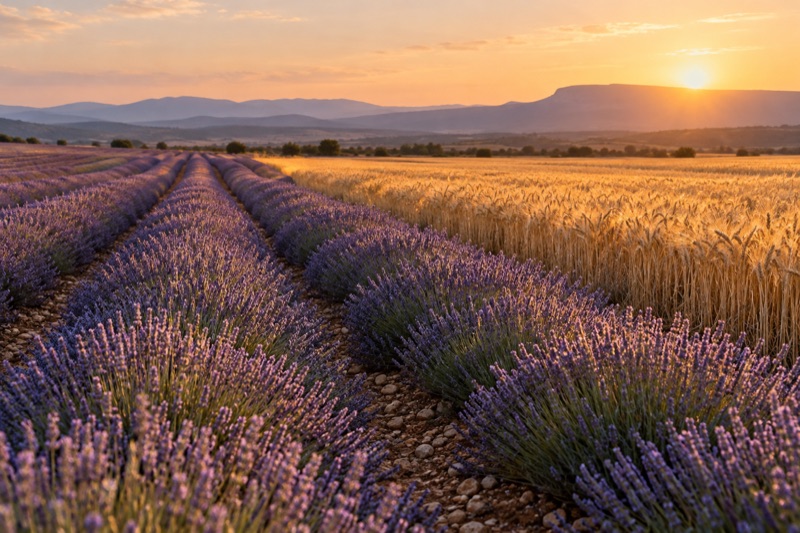
Lavender fields in Provence bloom in summer, and the best period to see them runs from June to early August, according to Vaucluse's tourism agency. July is the month to aim for. Valensole, a town on a plateau in Haute-Provence, describes its fields as shades of blue in July, alternating with the gold of wheat. This guide covers when and where to go, how lavender differs from lavandin, what lavender does in perfumery, and how to bring some home.
When lavender blooms
Vaucluse Provence Attractivité, which calls itself the official guide for the Vaucluse, says the best period for seeing and photographing the fields is June to early August. Elsewhere on the same page it says lavender flowers from July to August.
The producers' association for AOP lavender oil, APAL, says flowering is in July and that the harvest is around July 14, varying by altitude and year. On Haute-Provence's hillsides, by its account, the lavender blooms in early July. Lavandin, the hybrid, flowers later than ordinary English lavender, according to Wikipedia, which can stretch the season.
If you want fields in full color, early July is the safer bet, since harvest begins around mid-July in some places. That is our reading of the dates, not a rule, and the timing moves from one year to the next. The Vaucluse guide adds that the fields look especially striking at sunset.
What you see took years to grow. APAL says lavender is a perennial, grown on a field for about ten years, so a plot in bloom this July was planted well before.
Where to go
The places below are the ones the tourism and producer sources name. Local festivals fall in July and August and shift from year to year, so check each one.
| Place | What it offers | Usual timing |
|---|---|---|
| Valensole plateau, Haute-Provence | Fields of lavender and wheat; Fête de la Lavande | Fields in July; festival on the third Sunday of July |
| Sault, Vaucluse | A lavender hike and two distilleries, per the Vaucluse guide | June to early August |
| Coustellet, Luberon | The Musée de la Lavande: copper stills, a film on the harvest, a distillation workshop | Open daily from April; distillation and sachet-making in July and August |
| Apt | Fête de la lavande en pays d'Apt | Second Sunday of July |
| Digne-les-Bains | Lavender fair | Third week of August |
Visiting Valensole
Valensole's town site gives travel times rather than distances. Marseille-Provence airport is about 1 hour 30 minutes away and Manosque's train station about 20 minutes. By car, take the A51 and exit at Manosque. Its tourist office is open every day in June and July.
The town also has a request for photographers. It asks visitors not to park just anywhere to shoot the fields, and to follow the Highway Code. The D6 is busy at that time of year, so it suggests stopping at a rest area, photographing away from the road, and using the country tracks. The Vaucluse guide asks visitors to avoid trampling the plants, to protect the landscape and respect the growers' work.
Lavender or lavandin?
Not every blue field is lavender. The Vaucluse guide separates three types: fine lavender, the most delicate and the most expensive; aspic lavender, a tall plant that reaches about 80 cm; and lavandin, a cross of the first two with a more camphor-like scent. Valensole's tourism page notes that lavandin appeared in the 1920s, with a higher yield and up to ten times the oil of traditional lavender.
APAL's comparison adds more, by the producers' own account:
| Fine (true) lavender | Lavandin | |
|---|---|---|
| What it is | Lavandula angustifolia | A hybrid of true lavender and spike lavender, Lavandula × intermedia |
| Where it grows | 600 to 1,200 m | 200 to 700 m, up to 1,000 m |
| Oil per hectare | About 15 kg | About 100 kg |
| Scent | Finer and richer | Greener, more camphor-like |
| Propagation | Grown from seed, so each plant differs | A sterile hybrid, propagated by cuttings |
| Typical uses | Fine perfumery and cosmetics | Soaps, detergents, household products, room fragrance and some perfumes |
Altitude is a clue to what you are looking at. So is the look of the field. Because fine lavender is grown from seed and each plant is genetically different, APAL says a field of it looks uneven. Lavandin plants are clones.
Lavender and perfume
Lavender oil is a classic perfumery material. APAL describes fine lavender oil as floral, green, fresh and diffusive, usually a note between the top and the heart, and finer and richer than lavandin's. Valensole's tourism page says that Grasse perfumeries use fine lavender essential oil.
The same association calls lavender the signature of the fougère family of perfumes. Guerlain's Jicky, introduced in 1889, has lavender among its top notes. For the town at the center of French perfumery, see Why Is Grasse the Perfume Capital of the World?
Bringing it home
These are working farms, so buy what you take home from a grower, a distillery or a market, not from the edge of a field.
- Essential oil. Look for the name Huile essentielle de lavande de Haute-Provence AOP. The producers say the AOP covers only Lavandula angustifolia, also called true or fine lavender, from a delimited zone at 800 m or higher, and excludes clones. They add that the AOC was created by a decree of December 14, 1981. If a label gives a botanical name, Lavandula angustifolia is true lavender and Lavandula × intermedia is lavandin.
- Dried lavender. The Vaucluse guide lists sachets to scent linen, and handmade lavender wands called fuseaux. A sachet in a drawer is the simplest way to take it home.
- Honey. Valensole's tourism page lists lavender honey, and says it is based on lavandin nectar, with beekeepers placing hives near the flowering plants.
- A visit. Distilleries stay open year-round even though the plants flower in summer, the Vaucluse guide notes, so the season for a visit is longer than the bloom. APAL counts 120 distilleries in its area, 30 of them open to visitors.
Le Bonne Pomme, the apple we design in France, is not a lavender fragrance. Its published notes run from crisp apple skin, melon and peach through rose and red berries to caramel, musk and wood. What it shares with a sachet in a drawer is that it scents a room quietly: displayed under its cloche, it does so without being lit. It is a hand-poured soy and beeswax apple, hand-painted one by one and presented under a handblown glass cloche. The fragrance is by Mane, the French fragrance house founded in 1871, and lasts about 60 days, depending on room size. Keep it out of direct sunlight and away from heat sources.
To learn more about the fragrance house, read Who Is Mane?, and for other French houses, French Candle Brands Worth Knowing.
FAQ
When is lavender in bloom in Provence? The best period for seeing the fields runs from June to early August, according to Vaucluse's tourism agency. Valensole describes its fields in July, and the producers place the harvest around July 14, depending on altitude and year.
Where are the lavender fields in Provence? The official tourism sources name the Valensole plateau in Haute-Provence, the area around Sault in the Vaucluse and the Luberon, where the Musée de la Lavande is in Coustellet.
Is lavender the same as lavandin? No. Lavandin is a hybrid of fine lavender and spike lavender. It has a more camphor-like scent and a much higher oil yield, and it grows at lower altitudes.