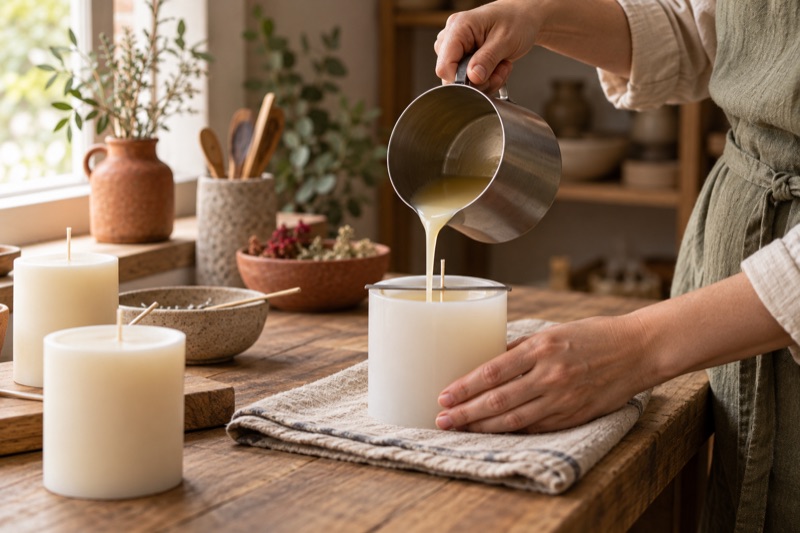
Candles are made by melting wax, blending in fragrance, pouring or molding the wax around a wick, letting it set and cure, finishing the surface and testing the result. A luxury candle follows the same sequence as a factory one. What changes is the decision inside each step: who composes the scent, which wax carries it, how much fragrance goes in, how long the candle rests, how much finishing is done by hand and how it is tested.
Here is the sequence, drawn from trade sources and a few makers' own accounts, with one example we can speak to: Le Bonne Pomme.
The brief
A scented candle starts as a description. In perfumery, a brief sets out what the scent should smell like or evoke, often in poetic or abstract terms, and puts a price ceiling on the concentrate, according to Wikipedia's entry on the perfumer. For a candle, the brief can also say how the candle will be used. A scent that must fill a room from a flame has a different job from one that must carry unlit.
Composing the fragrance
The perfumer takes the brief and blends trial versions. If the customer approves one, the perfumer "wins" the brief, and revisions follow. Wikipedia says this can take months or years.
The craft is scarce. The International Fragrance Association (IFRA) says fewer than a thousand fully qualified perfumers work worldwide, each trained for seven to ten years, and that every formula is judged by the perfumer's own nose. For candles, the National Candle Association (NCA) says fragrance formulas are reviewed against IFRA's safety standards.
The result is usually described as a pyramid of notes. Le Bonne Pomme's published pyramid opens on crisp apple skin, melon and peach, moves to rose and red berries, and rests on caramel, musk and wood. The fragrance is by Mane, the French fragrance house founded in 1871. Our guides explain how to read notes and who makes the scent in a candle.
Choosing the wax
Paraffin is the most widely used candle wax in the world, the NCA says, with beeswax used in much smaller quantities. Soy and palm waxes were developed for candles in the late 1990s by hydrogenating the oils. The NCA says no one wax or blend is best.
The choice follows the form. CandleScience, a candle-supply company, says container waxes are formulated to adhere to the vessel as they cool, while pillar waxes are harder and designed to pull away from a mold. Melting points show the range:
- Golden Brands 464, a container soy, melts at 113°F and is rated at a 10% fragrance load.
- White beeswax melts at 144°F and is rated at 6%.
Beeswax has a second quirk: Candlewic says its tackiness can make it hard to release from molds. Le Bonne Pomme is hand-poured soy and beeswax; our guide to soy versus beeswax covers what each wax does.
Pouring or molding
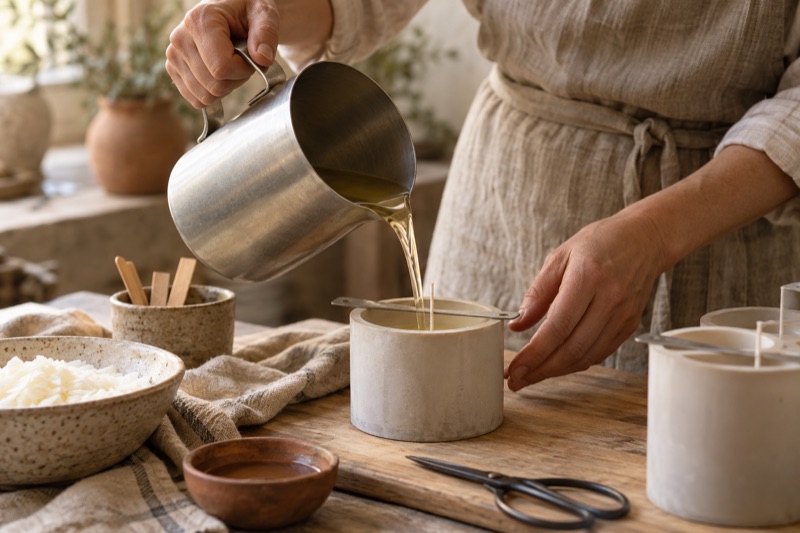
Fragrance goes into melted wax, so temperature matters. For the soy above, CandleScience says to heat the wax to 185°F, add the fragrance, stir, then pour at 135°F. The white beeswax pours hotter, at 175°F. Fragrance load is the fragrance's weight as a percentage of the wax's, and an ounce per pound is about 6%. The NCA warns there is a maximum beyond which a candle no longer burns cleanly or properly, so more is not better.
The NCA lists many ways to shape the wax around a wick: molding, dipping, extruding, pressing, rolling and filling. A container candle is poured into its vessel. A sculpted one is poured into a mold.
How candles are made in factories
One standard reference, Encyclopedia.com's entry on candles, describes the factory route for ordinary paraffin-based candles. Wax is melted in large kettles without direct flame and filtered, and perfume and dye are added. Continuous molding machines then turn out 50 to 500 candles per load in about 30 minutes. Wicks run through tapered, polished tin molds, cooled by a water jacket, and the finished candles are pulled out and trimmed. Extrusion is the alternative: crushed paraffin is forced through a heated die around the wick.
How scented candles are made by hand
By hand, the same steps are slower. Trudon, the Paris house, describes its own sequence on its Know How page: perfume formulas tested in a laboratory before they go into the wax, wicks set at the base of each glass, hot perfumed wax poured by hand, and wicks straightened by hand as the wax cools. Hand-poured, as our glossary of candle labels explains, means only that a person poured the wax.
Curing
After the pour, the wax sets and the candle rests. CandleScience says soy candles should cure at least a week and up to two for the best scent. It doesn't explain what changes in the wax during that time, and we won't guess.
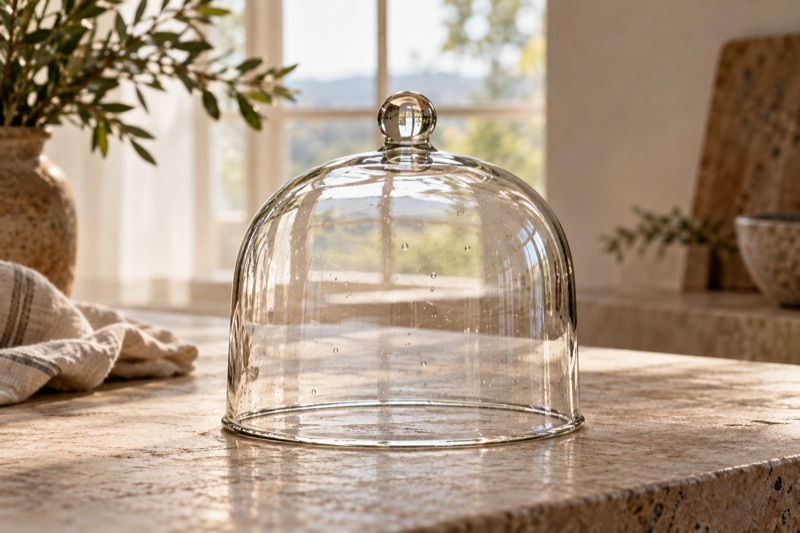
For a candle meant to sit unlit, the wait matters more. Cold throw, the scent before burning, is usually judged within 24 to 48 hours of making. Le Bonne Pomme is designed for cold diffusion: displayed under its cloche, it scents a room without being lit, for about 60 days depending on room size. See cold throw versus hot throw.
Finishing by hand
Finishing is where hand work shows. Sink holes in the surface can be filled with a second pour or smoothed with a heat gun, CandleScience's troubleshooting guide says. Wicks are trimmed to height. Trudon says it slightly melts candle tops to smooth them, and applies labels by hand.
A painted candle adds a step. Le Bonne Pomme is hand-painted one by one, so expect small differences from one apple to the next. It can be lit, but isn't meant to be: the painted finish will melt and the wax may drip, which is not a defect.
Testing
- The burn test. CandleScience's basic burn test runs about four hours of burning, then at least five hours of cooling, repeated until about a quarter inch of wax remains. The tester watches the melt pool, soot, flame height and wick.
- Standards. The NCA says all its members adhere to ASTM candle standards, including F2058 for warning labels, F2179 for glass candle containers and F2417 for fire safety. The CPSC lists several of them as voluntary standards.
- A lab report. A public SGS report is available for Le Bonne Pomme. Our guide to reading a candle safety report explains what such reports cover.
What luxury changes at each step
A luxury label doesn't change the order of the steps. It can change the care put into each one, and you can ask about each.
| Step | What can change | What to ask |
|---|---|---|
| Brief and fragrance | Whether the scent is composed for the candle or chosen from a catalog | Which fragrance house; whether the notes are published |
| Wax | The wax or blend, matched to the form | What the wax is, and in what blend |
| Fragrance load | How close to the wax's limit | Whether the load was set for this candle |
| Pouring | By machine or by hand | What "hand-poured" covers |
| Curing | A rest of days or weeks | How long |
| Finishing | Trimming, smoothing, painting, labeling | Which of it is done by hand |
| Testing | Burn tests, standards, public lab reports | Whether a report is published |
A catalog fragrance is not automatically worse than a bespoke one. What matters is that the brand can answer. More in what makes a candle luxury.
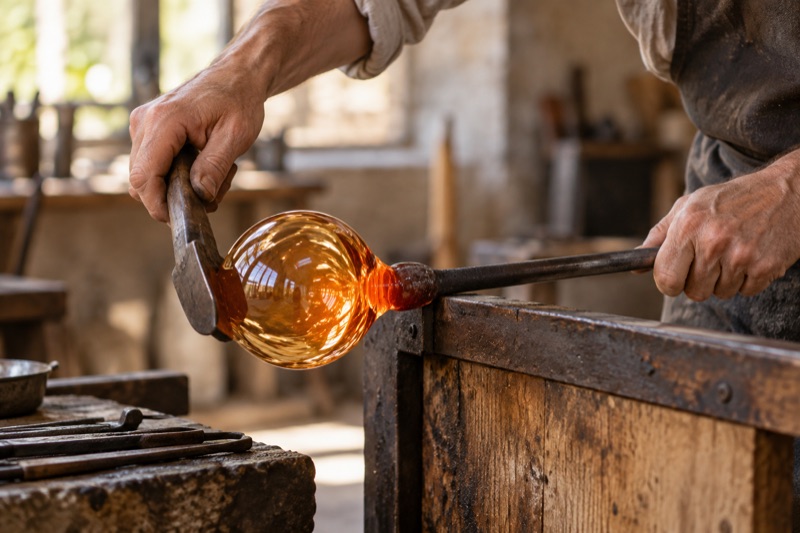
Le Bonne Pomme, designed in France, is handcrafted one at a time, in small runs, and presented under a handblown glass cloche. For that craft, see how hand-blown glass is made; for the wider picture, French savoir-faire.
FAQ
How are candles made in factories? Wax is melted and filtered, fragrance and dye are added, and the wax is poured into tapered molds or extruded around the wick. One reference puts a continuous molding machine at 50 to 500 candles per load in about 30 minutes.
How are scented candles made? Fragrance is added to melted wax at a set temperature, up to the wax's maximum load. The wax is poured around a wick, left to set, cured and trimmed.
How long should a candle cure? For soy wax, CandleScience says at least a week and up to two. Other waxes differ.
What is fragrance load? The weight of fragrance as a percentage of the weight of wax. An ounce in a pound is about 6%.