Bougie means candle in French, and in English it also means something else entirely. The French word comes from a place name: the Algerian town of Bougie, now Béjaïa, from which fine wax was once imported. The English slang, as in "that's a bit bougie," is short for bourgeois. Same spelling, two unrelated sources. That is the whole of the bougie meaning, and the rest is detail.
Bougie, the candle
The Académie française gives the history of the word. Bougie appears in the fourteenth century in the sense of "fine wax from which candles were made." It takes its name from Bougie, in Arabic Bugaya, the Algerian town the wax was imported from, and began as shorthand for chandelles de bougie, candles made of Bougie wax. The town is now called Béjaïa.
The modern French meaning is broader. The Académie defines a bougie as a candle of wax, stearin or paraffin, molded around a cotton wick. For how the word, and the candles, moved through French life, read our short history of candles in France.
French has kept other jobs for the word. The Académie and Larousse both list a bougie as a surgical rod, an old unit of light intensity (since replaced by the candela) and the spark plug of an engine, the bougie d'allumage.
Bougie, the slang
In English, bougie (also spelled boujee) is an adjective for a person or thing with expensive or upwardly mobile tastes. Dictionary.com calls it an Americanism dating to 1965–70, a shortening and alteration of bourgeois. Its usage note says it began as slang in the African American community, used disparagingly of wealthier or upwardly mobile people seen as socially pretentious, and is now also a mild criticism of anyone with costly tastes.
The Cambridge Dictionary labels it US informal and disapproving. It defines the word as typical of the middle class, especially in giving great weight to money, education and social class, or in liking expensive and unusual things. It lists a noun use too, for a person.
French has its own edge here. In French, bourgeois was originally a well-off town dweller of the Middle Ages and the Ancien Régime, a commoner with certain privileges. Larousse also lists a pejorative adjective sense: preoccupied only with material security and comfort. The English slang is a shortening of that word.
Dictionary.com lists the candle word and the slang word as separate entries with separate origins, so one didn't grow out of the other. What they share is the spelling.
Dictionary.com adds that bougie is often used with disparaging intent and can be perceived as insulting, depending on the social or cultural context. Who says it, and about whom, matters.
How to spell and say it
Dictionary.com says bougie is the most common spelling, with boujee, boujie and boojie also in use, and that boogie is a different word. It gives the pronunciation as BOO-zhee or BOO-jee. Cambridge gives BOO-zhee for the US and BOO-jee for the UK.
A short candle vocabulary
Here are the French words a candle lover meets most often. The definitions are Larousse's unless noted.
| French | Meaning | Note |
|---|---|---|
| bougie | A candle: a stick of wax, stearic acid or paraffin around a wick | The everyday word |
| bougie parfumée | A scented candle | Our gloss: bougie plus parfumée, scented |
| chandelle | Formerly a stick of tallow, resin or other fat around a wick | The older word; see the idioms below |
| cierge | A long wax candle burned in churches | Larousse's second sense is a tall cactus |
| mèche | The cord or braid at the center of a candle, the wick | Also a lock of hair |
| cire | Wax; in the first sense, the substance bees secrete | Cire d'abeille is beeswax |
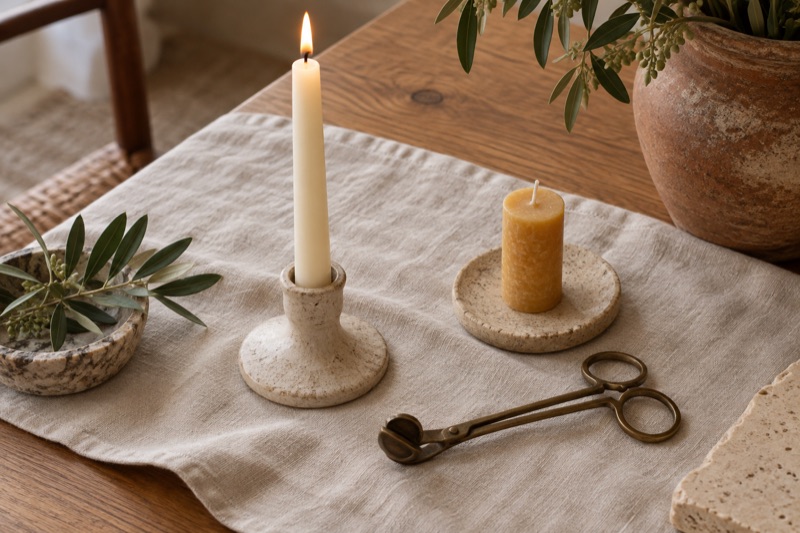
| bougeoir | A small candlestick with no foot, with a ring or handle | A candle holder with a ring or handle |
| chandelier | A stand for candles, including bougies, cierges and chandelles | Larousse gives bougeoir and candélabre as synonyms |
The two old words survive in sayings. Le jeu n'en vaut pas la chandelle means the result isn't worth the trouble it takes. Économies de bouts de chandelle are savings on things too small to matter. Voir trente-six chandelles means to see stars after a blow. Larousse lists all three under chandelle, the older word.
Why the French take candles seriously
The country keeps a candle calendar. The Académie describes the Chandeleur, on February 2, as a Catholic feast of the presentation of Jesus in the Temple, when the priest blesses the church candles. Its name comes from a Latin phrase for the feast of candles.
In Lyon, the city's official Festival of Lights traces itself to December 8, 1852. That evening, the festival says, residents placed candles in colored glasses on their windowsills when a statue of the Virgin Mary was installed on Fourvière Hill, and the custom stuck.
The word also lives in the language of the table and the auction. Larousse lists dîner aux chandelles for a candlelit dinner and vente à la chandelle, an auction that stays open for bids as long as a lit candle burns.
And the trade is old. Trudon, the Paris house, dates itself to 1643, when Claude Trudon owned a shop on rue Saint-Honoré selling spices and candles, and says its manufacture became a royal one in 1719, according to its own history. Wax also has a life outside the candle, as the material of sculptors and votive offerings. Our guide to the history of wax sculpture follows it.
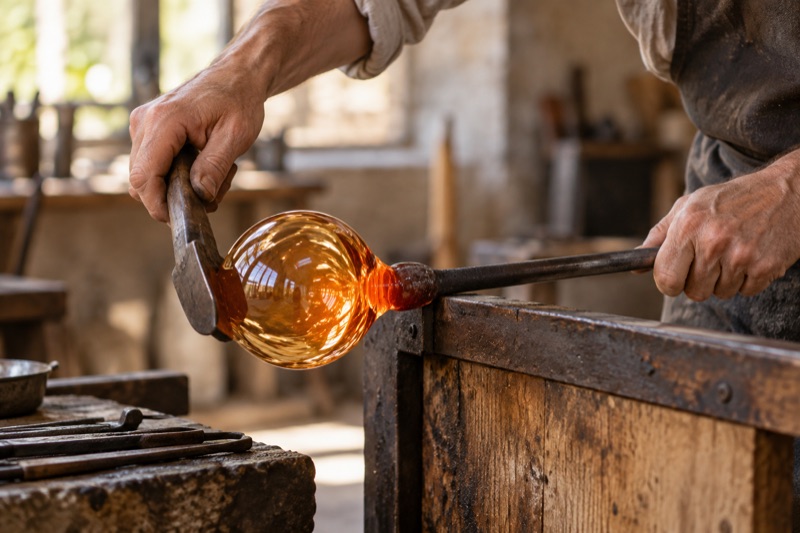
For the crafts that sit behind a French candle, see our guide to French savoir-faire, what labels such as hand-poured really mean, and how hand-blown glass is made.
A bougie parfumée you don't light
Le Bonne Pomme is a scented candle, a bougie parfumée, in the shape of an apple. It is hand-poured soy and beeswax, hand-painted one by one and presented under a handblown glass cloche. Its fragrance is by Mane, the French fragrance house founded in 1871, with crisp apple skin, melon and peach at the top, rose and red berries at the heart, and caramel, musk and wood at the base. It is designed for cold diffusion: displayed under its cloche, it scents a room without being lit. It can be lit, but isn't meant to be: the painted finish will melt and the wax may drip, which is not a defect. For more on that idea, see sculptural candles.
FAQ
What does bougie mean? In French, a candle. In English slang, an adjective for something or someone with expensive, upwardly mobile or status-conscious tastes, from bourgeois.
What does bougie mean in slang? Dictionary.com defines it as relating to a person who indulges in some of the luxuries of a fancy lifestyle, or who aspires to the upper middle class. Cambridge adds the sense of valuing money, education and social class.
Is it bougie or boujee? Both are used. Dictionary.com calls bougie the most common spelling and lists boujee, boujie and boojie as variants.
How do you spell bougie correctly? B-O-U-G-I-E. It is easy to confuse with boogie, which is a different word.
What does bougie parfumée mean? A scented candle. Bougie is candle and parfumée is scented.
Is bougie an insult? It can be. Dictionary.com says it is often used with disparaging intent and can be perceived as insulting, depending on the social or cultural context.
Where does the word bougie come from? The candle word comes from the Algerian port of Bougie (Béjaïa), a source of wax, according to the Académie française. The slang word is a shortening of bourgeois.