Meilleur Ouvrier de France (MOF) is a French state diploma that tradespeople earn through a multi-year exam, ending in a masterpiece judged by a jury of experts. Its full title is Un des Meilleurs Ouvriers de France, "one of" the best. The exam covers nearly a hundred trades, from glassmaking and leatherwork to pastry, and the people who pass it wear a tricolor collar.
Here is what the title means, how the exam works, what the collar signifies and which crafts for the home are on the list.
What MOF means
The organizer, the COET-MOF, stresses the wording in its 2020 press kit: a laureate is "one of" the best workers in France, not "the" best. A literal English rendering is "one of the best workers in France," though ouvrier here covers craft, trade and service professionals. The COET-MOF publishes in French only, and we found no official English name.
It is a state diploma. The official exam site says it was created in 1924, is written into the Code de l'éducation and sits at level 5 of the national qualifications framework, equivalent to a two-year degree after the baccalauréat. The first titles were awarded on January 31, 1925, at the Sorbonne, the press kit says.
The exam is run by the Comité d'Organisation des Expositions du Travail, the COET-MOF, founded in February 1923. It has been a nonprofit association since 1961. Since 1925, 9,347 people have received the diploma, and about 2,000 are active at any time, according to its April 2025 dossier.
How the competition works
Sessions run about every three years, and 27 have been held. Anyone aged at least 23 on the registration deadline can enter, and the press kit says French nationality isn't required. In the dossier, candidates average 37 years old with about 11 years' experience.
A candidate enters a class, which is one profession within a group of trades. The exam site counts nearly a hundred trades in 17 groups, and the 28th session lists 93 professions.
The path has three stages.
- Registration, after information meetings.
- Qualifying tests. Depending on the trade, an oral defense of a dossier, a written multiple-choice test, or a professional test in a work situation.
- The final test. A practical test in person, a work made with a dossier, or a real job site. Each candidate produces a masterpiece, judged by a jury of experts and MOFs.
Class juries are made up of teachers, trainers and professionals, and holders of the title can be no more than half of each jury. A general jury, mainly education and agriculture inspectors and teachers, oversees every class.
There is no fixed number of winners. The press kit says that in some years some classes name no one, and others name as many winners as candidates. For scale, the 26th session (2016 to 2018) drew 2,950 registrations, about 1,000 finalists and 198 laureates in 80 trades.
The 28th session is under way:
| Stage | Date |
|---|---|
| Session opens | March 27, 2025 |
| Registration closes | June 30, 2025 |
| Qualifying tests begin | Autumn 2025 |
| Final tests begin | Spring 2026 |
| Titles awarded | Spring 2027 |
So "MOF 2026" points to this session's final tests. Its titles are scheduled for spring 2027.
The collar
The collar is the visible sign. The COET-MOF's press kit says the tricolor collar worn by laureates dates from 1925, and that it attests to technical mastery, manual skill and creative spirit. A collar means the person passed the exam. It belongs to the person, not to the shop or workshop, so a company can employ a Meilleur Ouvrier de France but cannot be one.
The press kit also tells the title's origin. Albert Lebrun, then a senator and later President of the Republic, brought employers and the state together in 1922 behind a national exhibition of work. About 200 masterpieces from across France were shown at the Palais de Marsan and the Paris city hall, and the first titles were awarded at the Sorbonne's grand amphitheater. Today the diploma is delivered by the minister of national education at a ceremony.
MOFs in glass, porcelain and pastry
Which classes run changes from session to session. For the 28th session, the COET-MOF's list of trades shows the following.
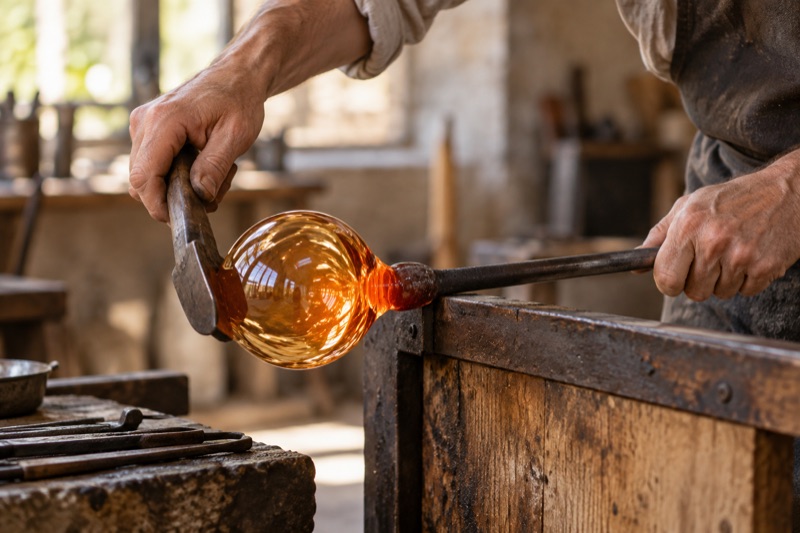
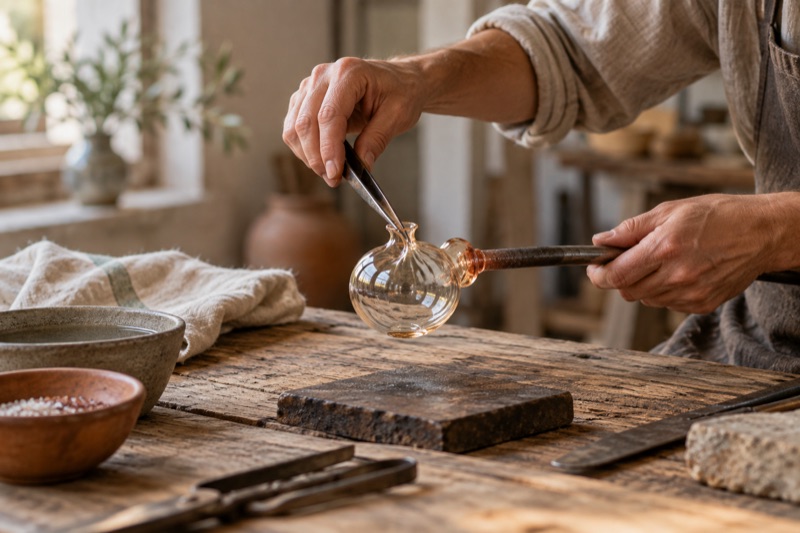
Glass. The group "Métiers de la terre et du verre" has three glass classes. Verrerie, cristallerie has options for tableware, assortments, paperweights, cutting, engraving and sculpture. Vitraux d'art covers stained glass, and Verrerie au chalumeau covers torch work, from scientific glass to art glass and art beads. Decorative mirror work is a separate class under building trades. Our guide to how hand-blown glass is made follows the craft, and The Glassblowers of Biot visits one village.
Porcelain and ceramics. The 28th session's list has no ceramics or porcelain class. They have existed: the COET-MOF's directory of holders offers trade filters for porcelain decoration, porcelain modeling, faïence decoration, pottery and ceramic restoration. The directory lists only holders who ask to appear. On faïence, see our short guide to French faïence.
Pastry. Under Métiers de l'alimentation, the list has Pâtisserie, confiserie, Chocolaterie, confiserie and Glaces, sorbets, crèmes glacées, alongside bakery. Cooking is a separate class under restaurant trades.
To find a particular holder, use the directory, which filters by name, trade and region. We name no individual holders here because we couldn't tie one to a trade and year from an official page.
Reading the title on a label
Because the title belongs to a person, a claim on a product should say who and in which class. A claim of MOF work with no name or trade is a claim you can't check.
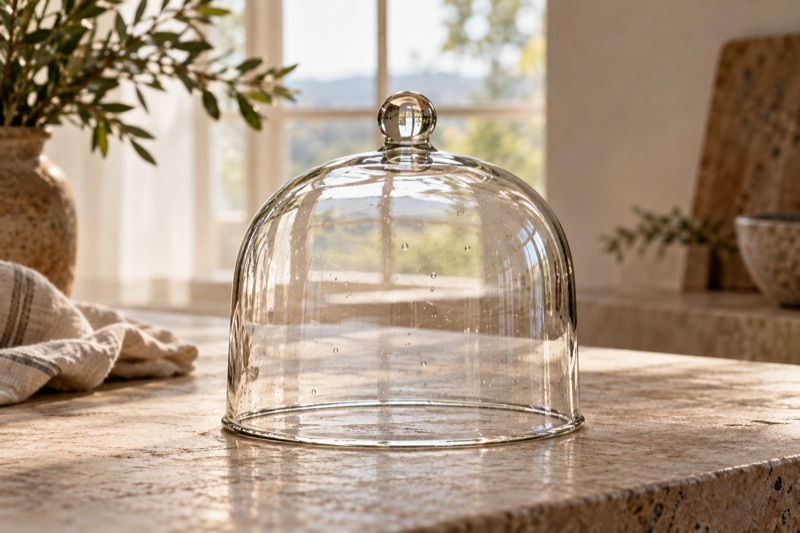
Le Bonne Pomme makes no such claim. It is hand-poured soy and beeswax, hand-painted one by one and presented under a handblown glass cloche, and it is designed in France. Those are descriptions of work, not a title. Our glossary of candle labels explains what each of those phrases does and doesn't promise, and our guide to French savoir-faire covers the other distinctions, including the label for companies, the Entreprise du Patrimoine Vivant.
FAQ
What does MOF stand for? Meilleur Ouvrier de France. The formal title is Un des Meilleurs Ouvriers de France, abbreviated MOF or UMOF.
How do you become a Meilleur Ouvrier de France? Register in a class when a session opens, pass the qualifying tests, then complete a final test whose centerpiece is a masterpiece. The diploma is awarded after the jury's deliberation and the COET-MOF's validation.
How often is the competition held? About every three years. Titles from the 28th session are scheduled for spring 2027.
Does MOF cover chefs, chocolatiers and leather workers? Yes. The 28th session's list includes cooking, chocolate and confectionery, and leather goods (maroquinerie).
Is it a competition or an exam? Both words are used. The diploma is delivered at the end of an exam that the organizer calls the "concours."
Where is the list of MOFs? The COET-MOF keeps an opt-in directory at outils.coet-mof.org. The COET-MOF says 9,347 people have earned the diploma since 1925.