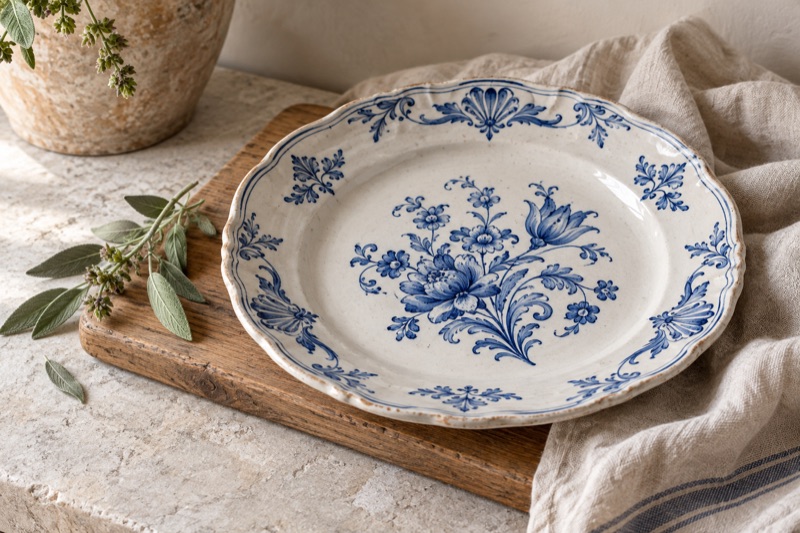
French faïence is tin-glazed earthenware: porous clay covered with an opaque, milky-white glaze made with tin oxide, then painted. It is often written faience in English. The Metropolitan Museum of Art says it first emerged in France in the sixteenth century, and by the eighteenth century the potteries of Rouen, Nevers, Moustiers and Strasbourg each had a style of their own.
Below: what the word means, what set each center apart, the trompe-l'œil pieces it is famous for, how to recognize faïence, and who still makes it.
What faïence is
Sèvres – Cité de la céramique, France's national ceramics museum, defines faïence as a tender, porous clay body covered by an opaque, impermeable glaze. It lists three kinds: lead-glazed, tin-glazed ("stanniferous") and faïence fine, made from clay chosen for its whiteness. French faïence in the sense used here is the tin-glazed kind. The word comes from Faenza, the northern Italian city that was a center of maiolica, the Italian name for the same technique, as the Met explains.
The Met describes two ways of firing. In grand feu, the glaze and metal-oxide colors go on together and are fired once at around 900°C. The palette is limited to blue, yellow, brown-purple and green. In petit feu, the piece is fired, glazed and painted, then fired again at a lower temperature, which allows finer brushwork and more colors. Sèvres puts the lower firing at 650 to 700°C.
A royal order helped faïence reach the best tables. According to the Met, Louis XIV had his own silver furniture sent to the mint in December 1689, and the most loyal courtiers were expected to follow by replacing their silver services with faïence. The duc de Saint-Simon described the rush on the shops. Large faïence vases also stood in the gardens at Versailles, and the Met notes that the Trianon de Porcelaine of 1670 was more likely built of faïence than porcelain, since the clay needed for true porcelain, kaolin, wasn't found in Europe until 1708.
Faïence later lost ground to the new porcelain. The Met ties its decline in the second half of the eighteenth century, in part, to the rising prestige of Sèvres, which began at Vincennes in 1740. Yet when Madame de Pompadour died in 1764, the Met says, she owned more than 350 pieces of faïence.
Rouen, Nevers, Moustiers, Strasbourg
Italian potters brought the technique north. The Met names Gian Francesco de Pesaro, who set up one of France's first workshops in Lyon in the later sixteenth century. Larousse adds that the Conrade family settled at Nevers and Abaquesne worked at Rouen. From there, regional styles diverged.
| Center | How it began | Known for |
|---|---|---|
| Rouen | Masséot Abaquesne opened one of the earliest workshops in 1526, specializing in tiles; Edme Poterat's factory followed in 1656 | Radiating lambrequin patterns in red and blue, then Chinese-inspired and rococo designs |
| Nevers | Italian craftsmen settled after the 1565 marriage of Louis Gonzaga of Mantua to Henriette of Cleves, heiress of Nevers | Strong blues and greens; large ewers and vases of the 1680s |
| Moustiers | Best known through the Olérys-Laugier factory of the eighteenth century | The influence of the court artist Jean Berain, chinoiserie, grotesques and floral garlands |
| Strasbourg | Charles-François Hannong began as a pipe maker in 1709 and started a faïence works in 1721 | Naturalistic flowers in pinks and purples, and vegetable tureens |
Rouen. The Met says Poterat's lambrequins became a "virtual trademark" of the city. Larousse dates the radiating, embroidery-like lambrequin to the late seventeenth and early eighteenth centuries, followed by Chinese decors around 1720 and rococo ones around 1740. The Met also singles out Rouen's ochre niellé, a rich yellow glaze combined with blue and red foliage.
Nevers. The Met says Nevers became a significant production site in the early seventeenth century and developed a regional style by mid-century. In the 1680s it made ewers and vases decorated in blue, white and yellow, and its blue-and-white jassemin vases accentuated the main axes of Le Nôtre's gardens at Versailles.
Moustiers. The Olérys-Laugier factory, the Met says, produced some of the most inventive faïence, with whimsical polychrome grotesques and, for the simpler taste of the eighteenth century, garlands in green, yellow and blue. The Met notes that its painters often signed pieces with personal marks beside the factory's.
Strasbourg. The V&A traces the Hannong dynasty. Charles-François Hannong, of Dutch origin, began in 1709 as a pipe maker and started a faïence works in 1721. By 1737 his son Paul ran the works, and between 1745 and 1748, the V&A says, Paul perfected petit feu decoration, giving the pinks and purples for which Strasbourg is famed today. Larousse dates the technique's appearance to 1748 at Hannong's and at the widow Perrin's in Marseille, and says it favored floral decoration and spread to Niderviller, Sceaux and Lunéville.
Trompe-l'œil pieces
Petit feu colors also painted a tableware joke: tureens shaped like cabbages and lettuces. The Musée Calvet in Avignon describes vegetables, feathered fowl and furred game spreading across tableware, and notes that Strasbourg produced a great many cabbages and lettuces between 1748 and 1754. The V&A holds a Sceaux dish of about 1755–1770 whose border is molded and painted as overlapping leaves in trompe-l'œil fashion. Our guide to trompe-l'œil fruit follows these pieces to the dessert table.
Recognizing faïence
No single test settles it, but a few features narrow the field.
- Glaze and body. Faïence is an opaque glaze over a porous body, so light doesn't pass through it. Sèvres describes porcelain by contrast as generally marked by exceptional translucency and says faïence fine can be hard to tell from it.
- Palette. A narrow palette of blue, yellow, brown-purple and green points to grand feu. Rich pinks, purples and finely drawn flowers point to petit feu.
- Decoration. Red-and-blue lambrequins suggest Rouen, strong blues and greens Nevers, Berain-style grotesques Moustiers, and naturalistic flowers Strasbourg. These are guides, not proofs, because styles traveled: petit feu, for one, spread from Strasbourg to Niderviller, Sceaux and Lunéville, according to Larousse.
- Marks. Many pieces have none. The Musée Calvet's cabbage tureen is unmarked, and the museum says it more likely belongs to Strasbourg than to Saint-Omer, where comparable pieces are known. Where marks exist they help. The V&A says Paul Hannong began using a PH mark in 1754 to protect his wares from inferior copies, and that it stayed in use after his death in 1759. The Frick Collection's catalogue of a Moustiers plate of about 1750 records an interlaced OL on the reverse, for the Olérys and Laugier factory. Henriot-Quimper publishes its own signatures to help date its pieces.
- Fine earthenware. Larousse notes that most industrial faïence, made from the late 1700s at Creil, Montereau, Sarreguemines and Gien among others, is faïence fine, a different material.
For a reference eye, look at museum catalogues. The Met's essay lists objects from Abaquesne's tiles of about 1557–60 to a Rouen plate of about 1725 and a Niderviller potpourri of 1760–65, and the Frick Collection's 2018–19 exhibition of the Sidney R. Knafel collection has online catalogue entries. Sèvres – Cité de la céramique says its collection numbers nearly 50,000 works; check opening before you go.
Faïence at home today
Antique faïence is a collector's field, but the craft isn't extinct. Henriot-Quimper in Brittany says on its site that it was created in 1690 and still makes its faïence by hand, from the forms to freehand decoration, and that it offers workshop visits. Gien says it has been a French earthenware maker since 1821. Its site describes fine earthenware (faïence fine), a different class from tin-glazed faïence in Sèvres's terms. For its hand-painted collections, it says, the outlines are printed by hand from engraved copper plates, using an eighteenth-century technique, before the piece is painted.
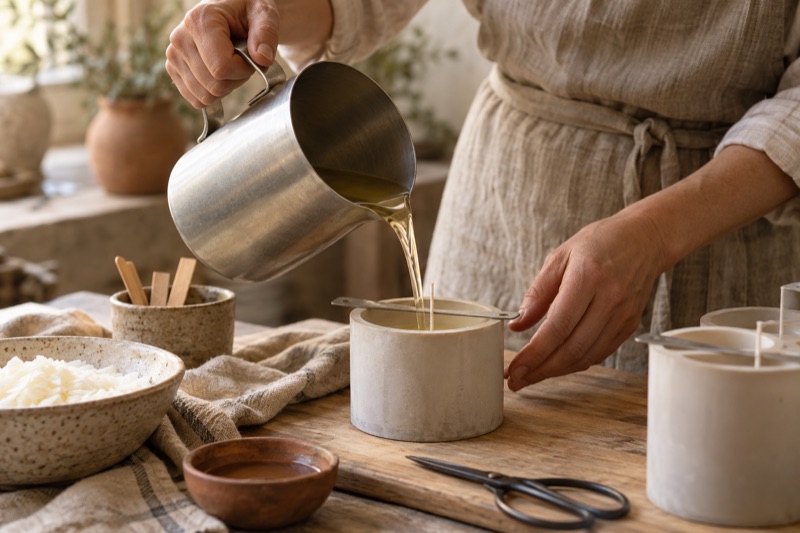
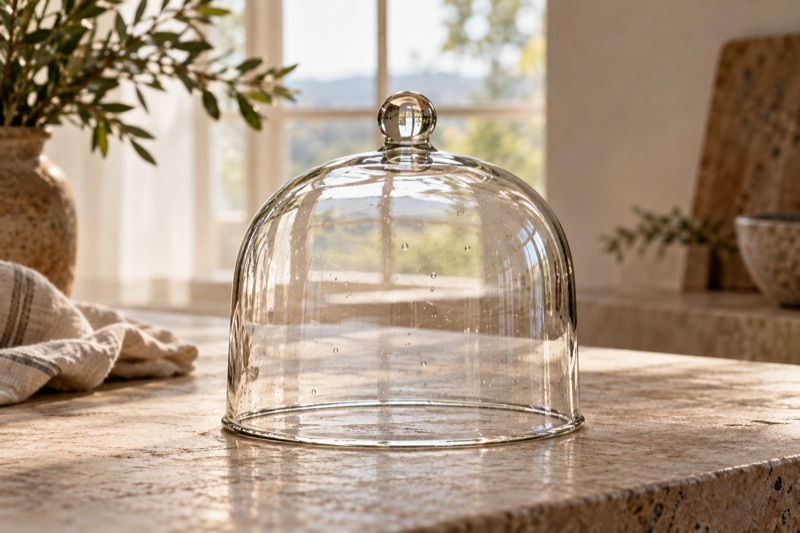
Hand painting is what links faïence to a very different object. Le Bonne Pomme is a candle, not a ceramic, and it makes no claim to this tradition. It is a hand-painted apple of hand-poured soy and beeswax, presented under a handblown glass cloche. Displayed under its cloche, it is designed to scent a room without being lit, with a fragrance by Mane, the French fragrance house founded in 1871. It can be lit, but isn't meant to be: the painted finish will melt and the wax may drip, which is not a defect.
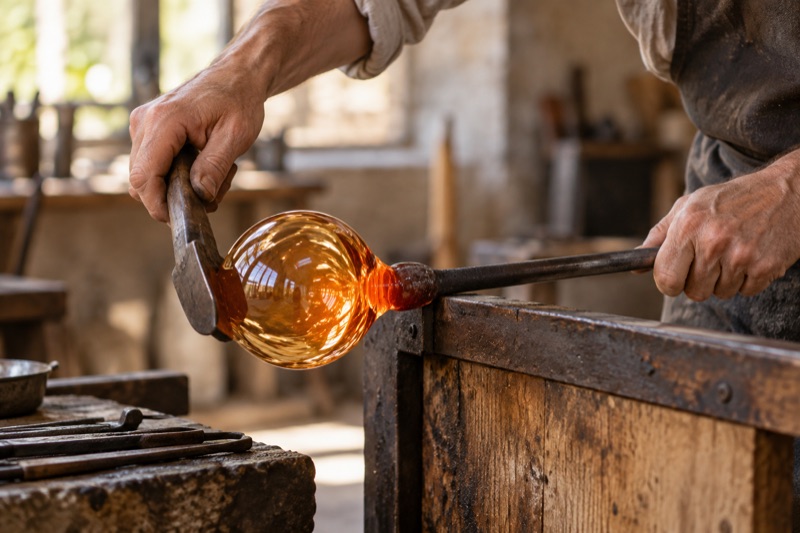
For more on the crafts behind a French object, see our guide to French savoir-faire, what labels such as hand-poured really mean, and how hand-blown glass is made.
FAQ
What is faïence? Earthenware with an opaque white glaze, usually made with tin oxide, and often painted. In English it is also written faience.
Is faïence the same as porcelain? No. Sèvres describes faïence as a porous clay body under an opaque glaze, and porcelain as a fully vitrified body that is generally translucent.
What does faïence mean in French? Larousse defines it as a soft, porous ceramic coated with an impermeable, opaque enamel. The name comes from Faenza in Italy.
What are the main French faïence centers? This guide covers Rouen, Nevers, Moustiers and Strasbourg. The Met also names Lyon and Marseille, and Larousse lists Sinceny, Moulins, Niderviller, Sceaux and others.
What is the difference between grand feu and petit feu? Grand feu is a single high-temperature firing with a narrow range of colors. Petit feu adds a second, lower firing for a wider palette and finer painting.