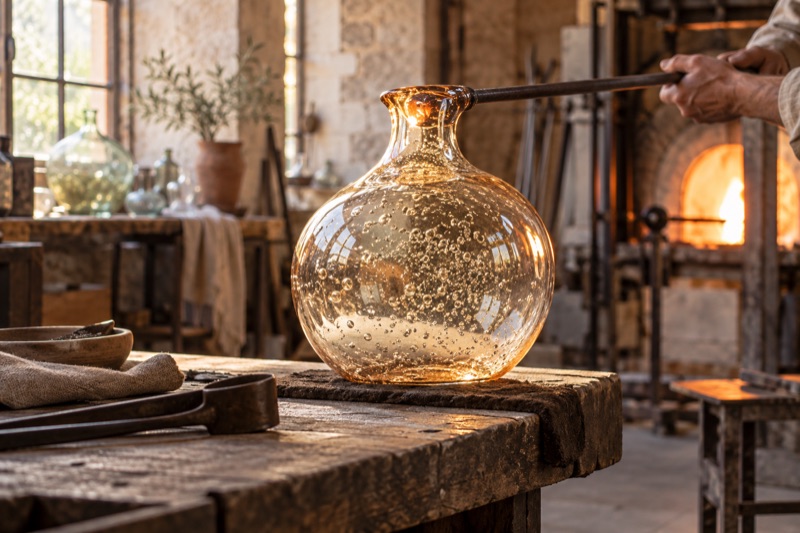
Biot glass is hand-blown glass from Biot, a village on the Côte d'Azur, and it is best known for the small bubbles trapped inside it. The tradition began with the Verrerie de Biot, founded in 1956 by Éloi Monod, and today several workshops blow glass in the village, where visitors can watch.
Below: where Biot is, how its glassmaking began, what makes bubbled glass different from ordinary blown glass, and how to visit the workshops.
Biot, a village between Nice and Cannes
Biot is a village on the Côte d'Azur, between Nice and Cannes, the tourist office says. Its train station is about 4 km from the village, served by a bus of about 10 minutes.
Glass came second. Before it, Biot was a pottery town. The tourist office says the volcanic soil of the Dôme des Aspres supported the industry, that the "Biot vase" was widely exported, and that the trade peaked in the 18th century. The town's own site calls Biot a center of jar production for several centuries, and says pottery declined as industry spread.
A glassmaking tradition
The town's history of glass in Biot starts with Éloi Monod, an engineer who finished first in his class at the Sèvres ceramics school in 1941. In the 1950s he settled at the Poterie Provençale to learn traditional methods for making everyday objects in ceramic and glass. In 1956, with Lucette, the daughter of the Poterie's owner René Augé-Laribé, he founded the Verrerie de Biot at the foot of the village. It opened its workshop to visitors from the start.
The tourist office says Éloi and Luce Monod trained a generation of glassmakers. The town names some of those apprentices, who later set up on their own: Jean-Claude Novaro, Robert Pierini, Daniel and Marcel Saba, Raphaël Farinelli and others. Their names are still on workshops in Biot.
| Year | What happened |
|---|---|
| 1956 | The Verrerie de Biot is founded (town, tourist office) |
| 1985 | The Verrerie opens a gallery opposite its workshop, now the Galerie Internationale du Verre Serge Lechaczynski |
| 1997 | Biot receives the Villes et Métiers d'Art label for glass |
| 2018 | The Biot International Glass Festival is created |
| 2025 | The Verrerie de Biot is listed as an Entreprise du Patrimoine Vivant (see below) |
Bubbled glass
In most glass a bubble is a flaw. The Corning Museum of Glass defines seeds as minute bubbles of gas, and a bubble as a trapped pocket of gas, not a crack. Biot made the bubble a signature.
The accounts differ by a few years. The town says Monod made a bubble in one of his pieces, turned it into a feature, and so bubbled glass (verre bullé) was born. The Verrerie dates its bubbled glass to 1956. The tourist office says Monod began trapping bubbles deliberately in the late 1950s. All agree on the arc: an accident, then a choice.
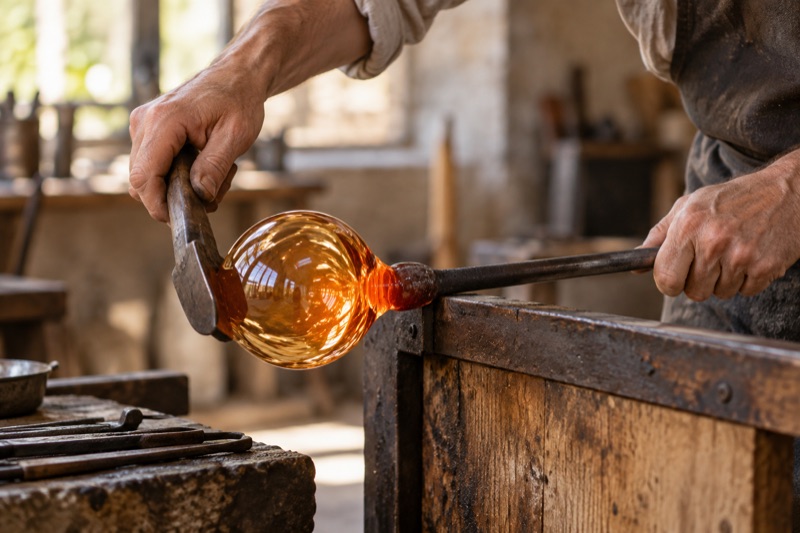
By the Verrerie's own account, its glassmakers capture small bubbles of carbon dioxide in the glass, and the bubble is no longer left to chance. It describes the house's glass as mouth-blown. Its site doesn't spell out the method, and neither will we. For how a gather becomes a piece, read how hand-blown glass is made.
Its own timeline adds frosted glass in 1980, later luminescent glass, and in 2018 verre écaille, glass fused with resin.
Visiting the workshops
At the Verrerie de Biot, on Chemin des Combes, watching the glassmakers is free, with no reservation, in the Halle des Verriers. The site also lists:
- An Écomusée du Verre, a museum of the glass tradition including bubbled glass.
- The Galerie Internationale du Verre Serge Lechaczynski, which hosts the annual Verriales.
- A showroom shop, and a restaurant with a shaded terrace.
- A glassblowing taster, the "Baptême du feu," of about 20 minutes, listed at €68 in October 2026.
- A guided visit in July and August only, listed at €9.
It closes on December 25, January 1 and from January 15 to 27. The town's page and the Verrerie's page list different hours, so check before you go.
The tourist office lists other workshops:
| Workshop | What it offers |
|---|---|
| Verrerie de Biot | The first glassworks in Biot: workshops, galleries and a large shop |
| Centre d'art du verre Pierini | Robert and Antoine Pierini, in a former oil mill; contemporary glass art |
| Verrerie du Val de Pôme | Daniel and Christophe Saba; hand-blown glass, known for fluted glass |
| Verrerie Farinelli | Sébastien Sappa, trained under Raphaël Farinelli; carries on the bubbled-glass tradition |
Some independent makers receive visitors only by appointment, the town says. Shops in the village sell glass at many price points, the tourist office adds.
Glass isn't the only reason to walk the village. The town's museums page lists the Musée d'Histoire et de Céramique Biotoises, the Musée national Fernand Léger, with paintings, ceramics and drawings by the artist, and the Écomusée du Verre.
The festival is the other way in. The town created the Biot International Glass Festival in 2018 with local glassmakers. The 2024 edition opened on Friday, September 20 with glassblowing workshops and demonstrations. Check the town's site for the next dates.
Getting there is simple. The tourist office says trains from Nice-Ville take about 25 minutes to Biot station, then a bus of about 10 minutes runs to the village. Drivers can leave the A8 at the Antibes Est exit for the Verrerie, which lists 500 parking spaces, free for the first 30 minutes (as of October 2026).
Glass and Grasse's perfume
Biot's glass and Grasse's perfume have both drawn official recognition. UNESCO listed skills related to perfume in the Pays de Grasse in 2018, and in 2023 added handmade glass production, a joint nomination by six countries including France. UNESCO's page names no French town; the Verrerie de Biot's site says the glassblowing gesture was recently recognized by UNESCO.
The state recognizes Biot's glassworks too. The official list of Entreprises du Patrimoine Vivant shows the Verrerie de Biot with a label running from November 2025 to November 2030. Its own listing describes tableware, mouth-blown. We explain the label in What Is an Entreprise du Patrimoine Vivant?, and the wider picture in our guide to French savoir-faire.
Glass and perfume meet in the bottle, but we found nothing tying a particular perfume house to a Biot workshop, so we won't suggest it.
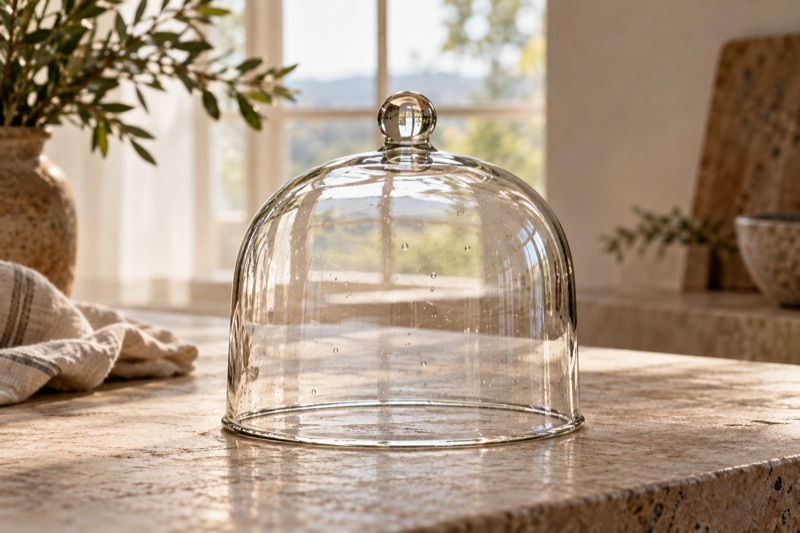
Le Bonne Pomme is presented under a handblown glass cloche, and it is designed in France. We don't tie that cloche to any workshop here. How a piece is made and where it is made are separate questions; our guide to designed in France versus made in France explains why the difference matters, and our glossary of candle labels does the same for the other craft words.
FAQ
What is Biot glass? Hand-blown glass from the village of Biot, known for the small bubbles trapped in it. The Verrerie de Biot, founded in 1956, started the tradition.
Why does Biot glass have bubbles? By the town's account, the first bubble was a flaw in one of Éloi Monod's pieces, which he turned into a feature. The Verrerie says the bubble is no longer left to chance.
Is there a Biot glass factory you can visit? Yes. The Verrerie de Biot lets visitors watch glassmakers for free, and the tourist office lists other workshops and galleries in the village.
Can you watch glassblowing in Biot? Yes. The tourist office says visitors can watch glassmakers make a piece from start to finish, at the furnaces and blowpipes. Color and pattern are added by pigmentation and molding.
Where can you buy Biot glassware? At the Verrerie's showroom and at workshops and shops in the village, which sell pieces at many price points.