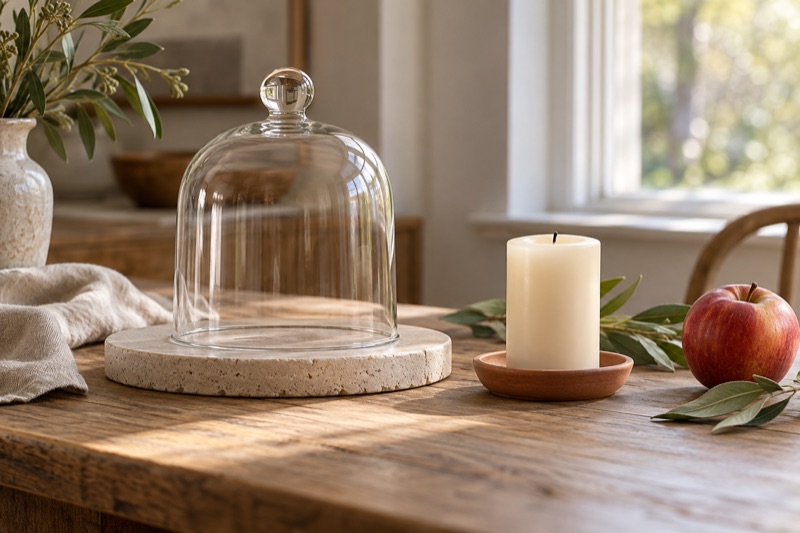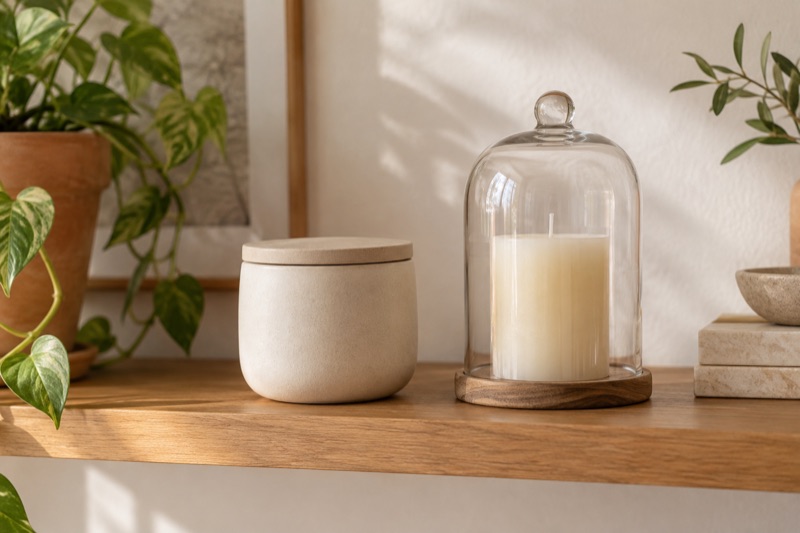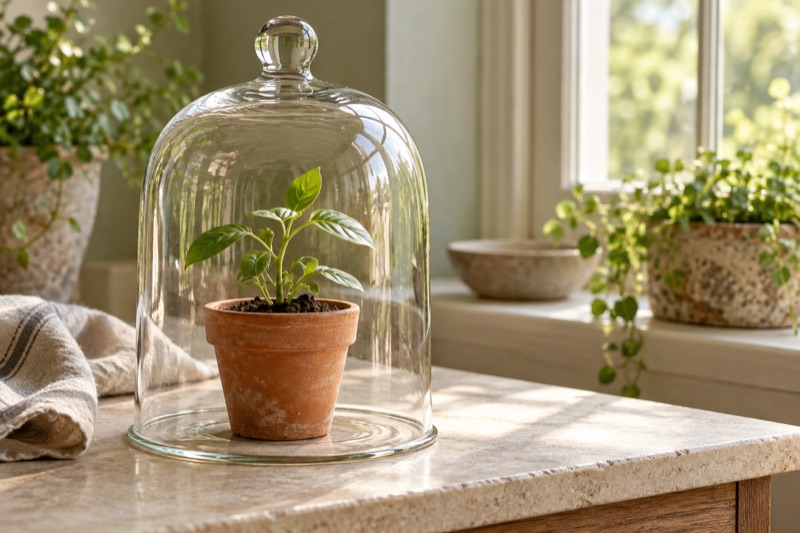
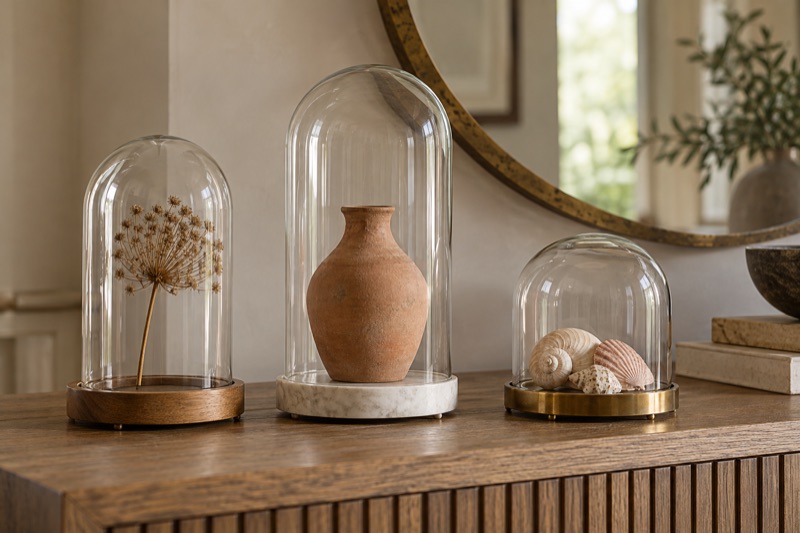
A glass cloche turns one small thing into a display. Put something under it that reads as a single shape: a scented wax object, a few dried stems, a single fruit, a small collection or a piece of pottery. Then give the dome a base that suits the room and a spot near eye level, such as a mantel, a console, a kitchen counter or a bookshelf, and change what's inside with the seasons.
One rule comes before any of these ideas. Never put a lit candle under a cloche, whatever its size, shape or vents. Burn candles in the open and keep the glass for unlit pieces. How to Use a Candle Cloche explains why, and how to pair a dome with candles you do burn.
What to put in a glass cloche
The Victorians put almost anything under glass. George P. Landow's review of Under Glass: A Victorian Obsession, John Whitenight's history of the form, lists wax fruit and flowers, shell work, skeleton leaves and taxidermy among the contents. What Is a Glass Cloche? covers the history. Today's arrangements are sparer, and five kinds of object work best:
- Wax and scented objects. The best candle cloche ideas start with a candle you never light: a sculptural candle, a wax fruit, a scented wax piece. The glass keeps dust off a painted or carved surface and slows the loss of fragrance, as Does a Lid Keep a Candle's Scent? explains. It's also the oldest pairing on this list: see wax fruit under glass.
- Dried botanicals. A poppy seed head, three stems of lavender or wheat, a dried hydrangea head, a curl of moss. Keep them few and let the stems show.
- A single fruit. A quince, a pomegranate, a pear with its leaf on. Real fruit is a display for days, not weeks, so check it each morning and swap it out at the first soft spot. A wax or ceramic fruit stays put.
- Small collections. Shells, sea glass, a few old keys, a pocket watch on its chain. Three to five pieces of one kind look collected. A mix of everything looks stored.
- Ceramics. A bud vase, a small lidded pot, a figurine. One clear silhouette works best.
Whatever you choose, it should read as one shape through the glass. Several small things work when they share a material or a color.
Choosing scale and base
Scale. As a rule of eye, the object should fill about half to two-thirds of the dome's height, with clear air on every side. Too tight and it looks trapped; too loose and it looks lost. Then size the dome to its spot. A tall dome needs a deep mantel or a console. A shelf needs a short one, with room above to lift it off.
Base. A glass cloche with a base reads as one finished object, and it moves in one piece. The base also sets the tone:
| Base | How it reads | Where it works |
|---|---|---|
| Wood | Warm, plain, a little rustic | Kitchen, bookshelf, a French country room |
| Marble or stone | Cool and weighty | Console, kitchen counter, bathroom |
| Gold or brass | Formal; it glows in lamplight | Mantel, dining room |
| Metal tray | Gathers the dome and a few companions into one group | Entry table, bar cart |
| Pedestal or cake stand | Lifts a small object toward eye level | Kitchen, sideboard |
| Wicker or rattan | Relaxed and summery | Summer swaps, a casual shelf |
A glass cloche with a wood base is the easiest to live with, because it suits almost any room. A glass cloche with a gold base is dressier and looks best where it catches evening light. On marble or other stone, set any wax piece on a small dish: the Natural Stone Institute notes that an oil-based stain will darken stone.
On the mantel
Principle: give the cloche a partner. A dome is a mid-height object, so it looks best against something taller. On an asymmetric mantel, set the cloche toward one end and balance it with tall candlesticks or a jug of branches at the other, with a mirror or a painting leaning behind. On a symmetric one, use a matched pair of cloches on either side of the center.
If you light candles on the same mantel, a glass cloche with matches, long matches standing upright under a small dome, keeps them at hand and looks intentional. Skip it in a house with young children: the National Fire Protection Association advises keeping matches and lighters up high, out of children's reach, in a locked cabinet.
Keep wax off the mantel whenever the fire is lit. For arrangements by season, see Mantel Decor Ideas for Every Season.
On a console or entry table
Principle: build a group of three. Pair something tall (a lamp, branches in a jug) with something flat (a tray, a stack of books), and set the cloche between them. A glass cloche with a metal tray becomes a landing place, with the dome on one side and a dish for keys on the other. Keep the dome back from the front edge, where bags and coats swing past.
A scented piece earns its place here, because you pass it many times a day. Le Bonne Pomme is one: an apple of hand-poured soy and beeswax, hand-painted one by one and presented under a handblown glass cloche. Displayed under its cloche, it scents a room without being lit. Keep it out of direct sunlight and away from heat sources, which rules out a console under a bright window or beside a radiator.
In the kitchen
Principle: let it work, then let it rest. In a kitchen, a dome on a cake stand is a working cover for pastries, cheese or a tart. Between uses, put something on display: a small pyramid of lemons, a single quince on a wooden board, a stoneware pot. A pedestal base lifts these clear of a busy counter.
Keep scented pieces apart from food, and keep any wax away from the stove, the oven and the toaster. Here, ceramics and fruit do better than a scented candle.
On a bookshelf
Principle: break the run of spines. A small dome set between rows of books, or on a short stack lying flat, gives the eye somewhere to rest. Mini cloches suit shelves best: fill them with a single shell, a seed head or a small collection. Place them at eye level or just below, so you look into the glass rather than up at the base, and leave enough height to lift the dome off. For spacing and rhythm, see Bookshelf Styling Ideas That Don't Look Staged.
Seasonal swaps
Principle: keep the dome, change what's under it. The base and the spot can stay all year.
- Spring: a sprig of blossom or catkins, or a few ceramic eggs on moss.
- Summer: shells and sea glass on a wicker or pale wood base.
- Autumn: a quince or an apple, acorns, a small gourd on dark wood.
- Winter: pine cones, a sprig of evergreen, a single glass ornament on a gold base.
As the light changes, move domes away from sunny windows. Glass keeps out dust, not light. The Canadian Conservation Institute rates most plant-based colorants as highly sensitive to light and notes that glass alone won't stop them fading. The National Candle Association warns that candles may fade in bright light, too.
Some pieces don't need swapping. A painted wax apple under its own cloche, like Le Bonne Pomme, looks like autumn fruit in October and a still life in June. For candles beyond the cloche, from mantels to the bath, see Decorative Candle Ideas.
FAQ
What do you put in a glass cloche? Anything small that reads as one shape: an unlit scented wax object, dried botanicals, a single fruit, a small collection of shells or keys, or a piece of pottery. Change it with the seasons.
Can you put a candle under a glass dome? Only an unlit one. Never light a candle under a cloche of any kind. Burn it in the open, put it out, and let the wax cool before you cover it. How to Use a Candle Cloche has the details.
Does a glass cloche need a base? No, but a glass cloche with a base looks finished, protects the surface and moves in one piece. Without one, set the dome on a tray or a plate.
Where does a cloche look best? Near eye level and against something taller: on a mantel in front of a mirror, on a console beside a lamp, on a bookshelf between books. Keep it out of direct sun and away from heat.