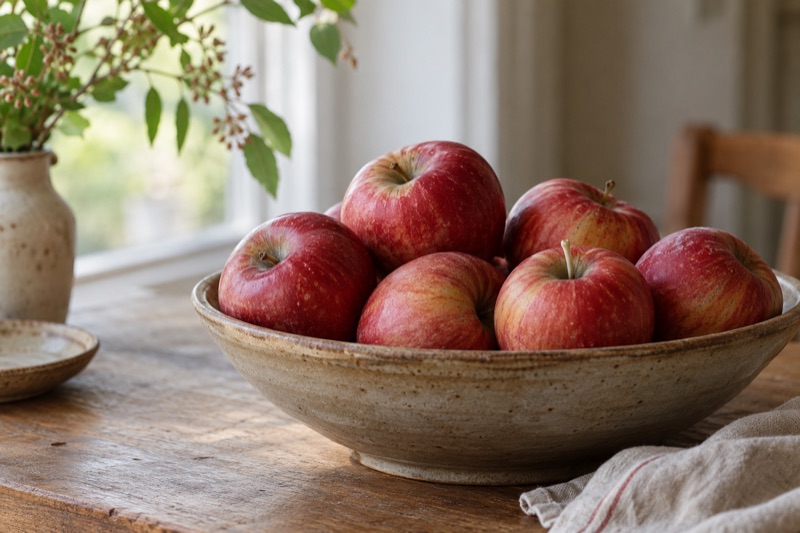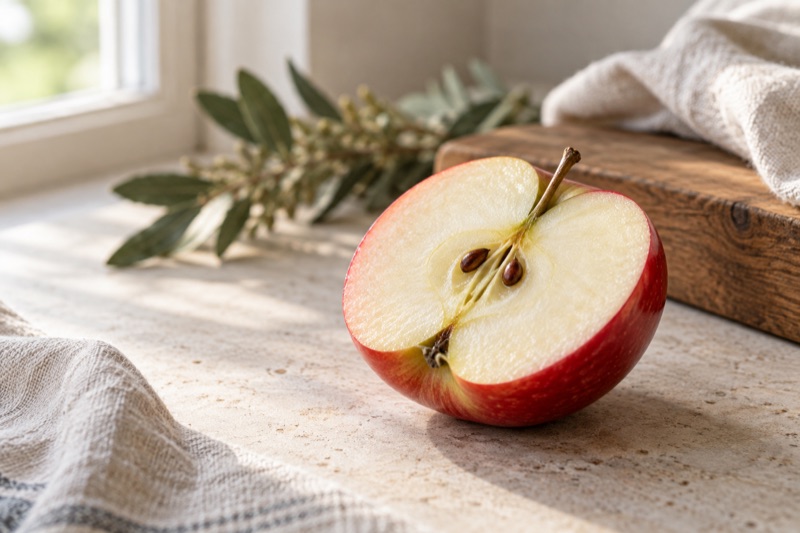
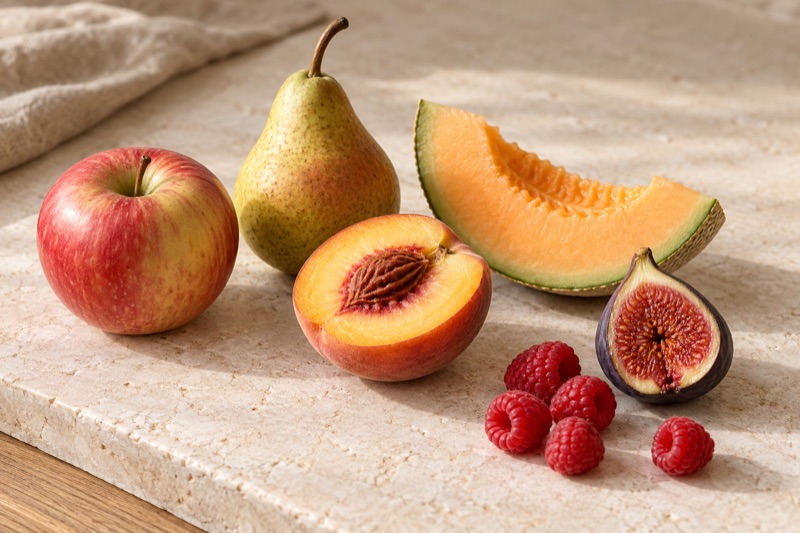
Fruity fragrance notes are rarely made from fruit. Apple, pear, peach and melon can't be pressed into an oil the way a bergamot rind can, so perfumers build each one as an accord: a small composition of aroma molecules, some of which also occur in the real fruit. This glossary covers six fruit notes (apple, pear, peach, melon, fig and red berries) and gives, for each, how it's built, what it smells like and what it pairs with.
Our worked example is one scented apple. Le Bonne Pomme publishes its notes as a pyramid: crisp apple skin, melon and peach at the top, rose and red berries at the heart, and caramel, musk and wood at the base. Four of the six notes below appear on it. Pear and fig don't, and each entry says so.
How fruit notes are made
A note is a descriptor, not an ingredient. Wikipedia defines notes) as descriptors of the scents you can perceive when a perfume is applied. "Apple" on a label tells you what you'll smell, not what went in. Our guide to reading fragrance notes covers top, heart and base.
Citrus is the best-known exception. Bergamot oil is cold-pressed from the rind. Many other fruits give no usable oil, and the fragrance encyclopedia Osmoz says so of apple, peach and melon: no essential oil can be extracted, so the note is reproduced in the lab.
Perfumers build these notes from aroma molecules. Two families do most of the work. Esters are responsible for the aroma of many fruits, including apples, pears and strawberries. Lactones are cyclic esters that contribute much of the flavor of fruit and dairy, and one of them, gamma-decalactone, has a characteristic peach flavor. An accord is the balance of several such materials, tuned until the whole reads as fruit.
Fruit notes aren't always about the fruit: fig is built from the whole tree. And botany can help with pairing. Apples, pears, peaches, strawberries and raspberries all belong to the rose family, Rosaceae.
Apple
How it's built. Osmoz says apple is reproduced in the lab from other ingredients, such as Verdox, which adds a woody facet, and cis-3-hexenyl acetate, which gives green accents. Real apples are complicated: a 2016 review of apple aroma says more than 300 compounds have been identified, with esters the main volatiles in ripe fruit. What Does an Apple Candle Smell Like? walks through the accord.
What it smells like. Osmoz calls it fruity, green and juicy. It runs from cold, crisp skin to baked fruit with spice, and the notes list tells you which end you're getting. Apple Candles Without the Cinnamon is about the crisp end.
Pairs with. Pear, melon, rose, light woods and musk keep it fresh. Spice and vanilla push it toward baked.
In Le Bonne Pomme. Crisp apple skin, at the top.
Pear
How it's built. The Fragrance Foundry, a perfumery supplier, says natural pear extraction hasn't succeeded for perfumery, so the note is composed. Its perfumers build it around hexyl acetate, then add materials for a rosy touch, sweetness and a watery skin effect. The dose matters: hexyl acetate reads as fresh fruit at a low level and as pear candy when overdone. It's a real pear compound, too. A 2016 study of Bartlett pears by researchers at the Technical University of Munich found it among the highest-concentration aroma compounds, alongside a "pear ester" the authors describe as pear-like with a metallic note.
What it smells like. Juicy, green and sweet, with a crisp edge and a floral side, and placed at the top of a fragrance. The Good Scents Company lists hexyl acetate as fruity, green and sweet, with apple, pear and banana notes, which is why pear and apple accords sit so close together.
Pairs with. Perfumes listed on Osmoz's pear page set it beside citrus such as grapefruit and bergamot, other fruit such as blackcurrant and raspberry, and violet leaf, mimosa and green tea.
In Le Bonne Pomme. Not on its notes list.
Peach
How it's built. Osmoz says peach is reproduced in the lab, particularly from gamma-undecalactone, a lactone. The perfume writer Victoria Frolova describes lactones on Bois de Jasmin as milky, creamy materials, and names gamma-undecalactone as the peach-skin material that Jacques Guerlain wove into a mossy-woody accord in 1919. The French fragrance brand Bon Parfumeur adds that perfumers favor peach accords over extracts partly because peaches are seasonal, and an accord lets them control the note.
What it smells like. Velvety, fruity and sweet. Osmoz says perfumers often use it to bring a velvety, fruity note to floral bouquets, and the lactones give it a creamy, milky edge.
Pairs with. White flowers, rose, vanilla and woods. Guerlain's Mitsouko, created in 1919, is a fruity chypre with bergamot at the top and peach in the heart alongside rose, iris, clove and jasmine. Bon Parfumeur suggests vanilla, cedar or sandalwood, jasmine, and raspberry or cherry.
In Le Bonne Pomme. At the top, with crisp apple skin and melon. Placement isn't fixed: Mitsouko lists peach in the heart.
Melon
How it's built. Osmoz says no essential oil can be obtained from melon, and that lab techniques like headspace are used to reproduce the fruit's fragrance. It sums the note up as aquatic, fruity and juicy, and says it builds water-fruit accords. A related molecule has a place in the story. Calone was discovered at Pfizer in 1966 and has been used as a scent component since the 1980s, mainly for watery, fresh accords. It became a dominant note in marine perfumes from the 1990s, and its descriptors include sea breeze, fresh, watery, green and melon.
What it smells like. Cool and watery rather than sugary, with a green edge.
Pairs with. Apple and peach, as at the top of Le Bonne Pomme, and citrus and green notes. In an apple fragrance, melon can keep the fruit from turning sugary.
In Le Bonne Pomme. At the top.
Fig
What it smells like. Green and milky with a woody dryness: leaf and sap first, then a creamy, coconut-like sweetness, then bark. In Osmoz's listings, one fig perfume is described as juicy but not sweet, and another as a milky-woody scent with a green opening.
How it's built. Premiere Peau, a fragrance house, says in its glossary that fig is a constructed note, with no commercial fig essential oil. By its account the accord rests on stemone, a green material, and gamma-octalactone, a creamy lactone. Perfumers often build the whole tree, not just the fruit. A review of Diptyque's Philosykos describes leaves, coconut milk, fig wood and cedar.
The note is recent. Wikipedia credits perfumer Olivia Giacobetti with developing the use of fig as a perfume note, especially with Premier Figuier for L'Artisan Parfumeur in 1994. It also cites Chandler Burr saying her 1996 Diptyque scent, Philosykos, is often credited with the late-1990s fig craze.
Pairs with. Woods, herbs and Mediterranean notes. Premiere Peau lists basil, lavender, rosemary and sage, and olive, cypress and salt.
In Le Bonne Pomme. Not on its notes list.
Red berries
How it's built. "Red berries" names a family, not one fruit, and a perfumer chooses which berry to evoke. Raspberry ketone is the primary aroma compound of red raspberries, yet the fruit holds only about 1 to 4 mg per kilogram, and the compound is described as one of the most expensive natural flavor components. It's sometimes used in perfumery. Strawberry has its own materials. Ethyl methylphenylglycidate is nicknamed strawberry aldehyde even though it has no aldehyde group.
What it smells like. Tart, sweet and jammy. One strawberry molecule shows how close berry sits to caramel. Furaneol smells caramel-like at high concentrations and of sweet strawberry when dilute. That's an illustration of the bridge between the two notes, not a statement about any formula.
Pairs with. Rose, which shares a family with raspberry and strawberry, and fruit such as peach and pear. Bon Parfumeur suggests raspberry with peach, and Osmoz lists it alongside pear.
In Le Bonne Pomme. At the heart, with rose.
Reading a fruit note on a label
A few words on a notes list tell you more than the fruit's name does.
| If the notes say | It usually points to | Because |
|---|---|---|
| Skin or peel | The crisp end of apple | It names the tart peel, not the baked fruit |
| Cream, milk or coconut | Lactones, as in peach and fig | Lactones smell milky and creamy, and some read as coconut |
| Leaf, sap or wood | Green fig | Fig is built from the tree, not just the fruit |
| Water, marine or aquatic | Melon-style freshness | Melon builds water-fruit accords |
| Jam or caramel | Berry meeting caramel | The two notes sit close, as furaneol shows |
These are reading aids, not rules. Each maker builds its own accord, so the full pyramid tells you more than any single word.
Pairing fruit with florals and woods
A fruit note rarely stands alone. What surrounds it decides whether it reads as fresh, ripe or gourmand.
| Pair with | What it does | Where to see it |
|---|---|---|
| Rose | Gives light fruit some body, and rose is related to apple, pear, peach and berries | Le Bonne Pomme's heart: rose and red berries |
| White flowers | Rounds peach into something creamier and more floral | Bon Parfumeur suggests jasmine and lily of the valley; Bois de Jasmin names tuberose |
| Moss and chypre | Sets peach over a dark, mossy base | Mitsouko, a fruity chypre |
| Woods | Dries fruit and adds shade | Philosykos's fig wood and cedar; Verdox's woody apple |
| Musk and caramel | Softens the base | Le Bonne Pomme's base: caramel, musk and wood |
The pyramid shows the logic. Cool, crisp fruit goes at the top, floral and berry at the heart, and something warm and dry underneath. It also shows why two apple fragrances can smell nothing alike: what sits around the apple matters as much as the apple.
Le Bonne Pomme, the worked example
Le Bonne Pomme is a sculptural apple: hand-poured soy and beeswax, hand-painted one by one and presented under a handblown glass cloche. It's designed in France, and its fragrance is by Mane, the French fragrance house founded in 1871. Displayed under its cloche, it scents a room without being lit, for about 60 days, depending on room size.
It can be lit, but isn't meant to be: the painted finish will melt and the wax may drip, which is not a defect. For the wider story of the unlit candle, see Candles That Scent a Room Without Being Lit, and for the object itself, our guide to fruit-shaped candles.
Frequently asked questions
What does a fig candle smell like?
Expect it to lean green, milky and woody rather than jammy, because that's how perfumers build the note: fig leaf and sap, a creamy, coconut-like sweetness and wood. Read the notes list for leaf, wood, coconut or milk.
What does fig smell like?
In perfumery, the fig note is usually the whole tree: green leaf and sap, milky fruit and dry bark. It reads as green and creamy more than sweet.
Are fruit notes made from real fruit?
Mostly not. Apple, peach and melon yield no essential oil, so they're rebuilt from aroma molecules. Citrus is the main exception, because its oil is pressed from the rind.
Which of these notes are in Le Bonne Pomme?
Apple (as crisp apple skin), melon, peach and red berries. Pear and fig aren't on its published notes.
Can a fruit note smell different from one candle to the next?
Yes. A fruit note is a descriptor, and each maker builds its own accord. Read the full pyramid, because what sits around the fruit changes how it reads.