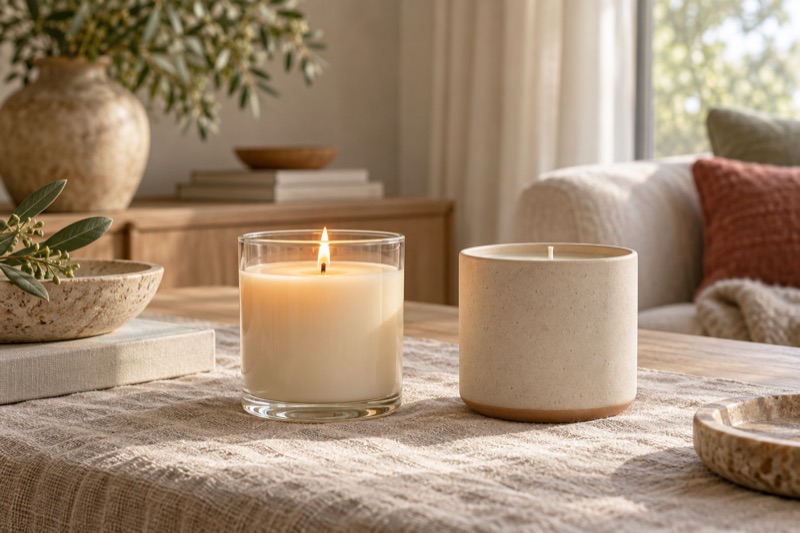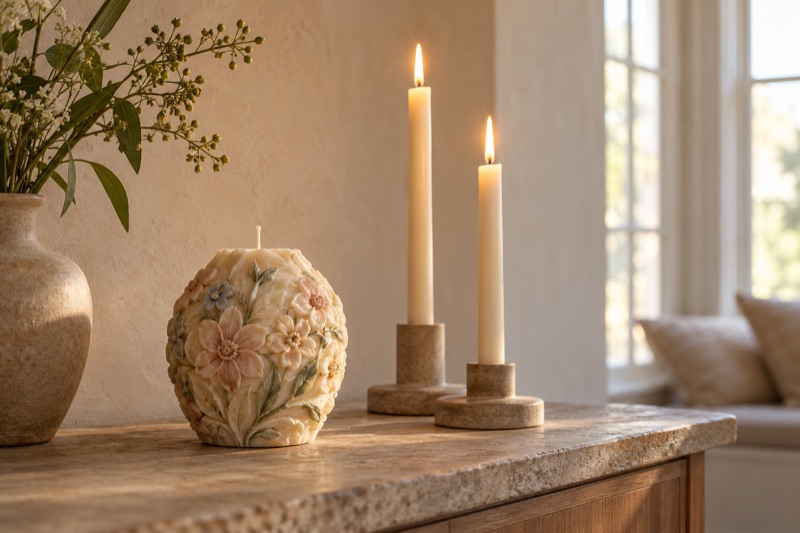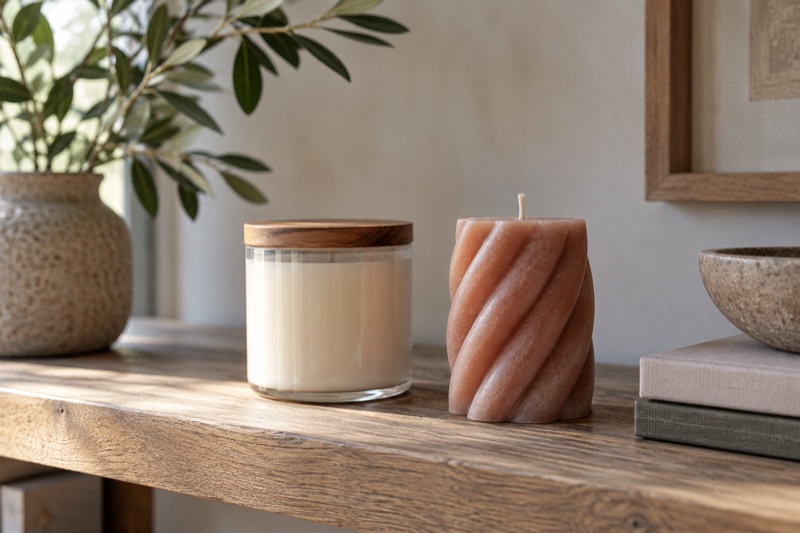
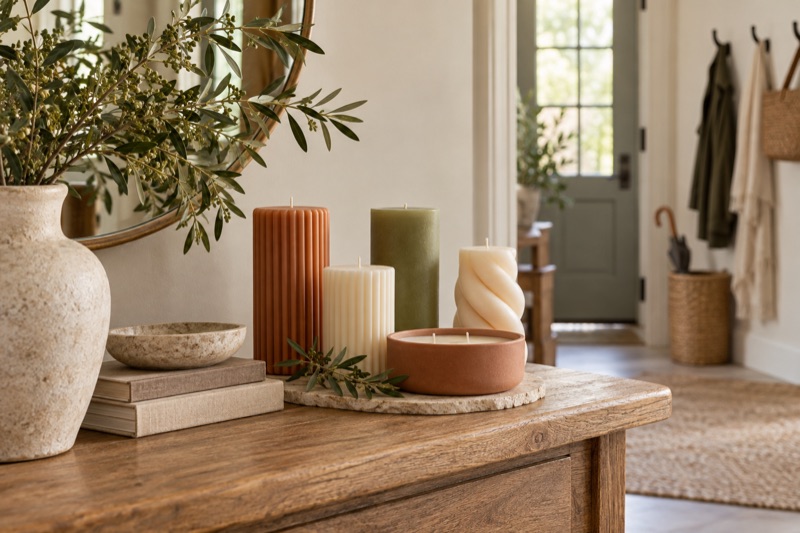
Most jar candles give off only a faint scent until they're lit. Some candles do scent a room without being lit, and they tend to be objects made for that job: more wax open to the air, a fragrance chosen to travel at room temperature, and a form meant to be displayed rather than burned. If you're looking for candles that smell without being lit, that's the distinction worth knowing.
This guide explains why an ordinary candle depends on its flame, what makes an unlit one work, how long the scent lasts and where to put one. It also untangles "cold diffuser," a term that means two very different things.
What it means for a candle to scent a room unlit
Candle makers have a name for the scent of a candle that isn't burning: cold throw. Its counterpart, hot throw, is the scent while it burns. CandleScience, a candle-making supplier, defines cold throw as the strength of fragrance "before a candle has been burned for the first time" (CandleScience). We compare the two in full in Cold Throw vs Hot Throw: What Each Means for Your Candle.
Cold throw is usually judged up close, in a shop, with the lid off and your nose near the jar. Scenting a room is a higher bar. The fragrance has to leave solid wax at room temperature, steadily, and reach you on the other side of the sofa.
Several things can do that without a flame, and they work in different ways.
| Needs a flame or power? | How the scent gets out | What to expect unlit | |
|---|---|---|---|
| Jar candle | Made to be lit | Fragrance evaporates from a pool of melted wax | Faint unless you lean in |
| Candle made to be displayed unlit | No | Fragrance evaporates from the wax's exposed surface | Made to scent the room around it |
| Scented wax sachet | No, and it has no wick | Fragrance evaporates from wax at room temperature | Suited to drawers and wardrobes |
| Reed diffuser | No | Oil climbs the reeds and evaporates from them | A steady background scent |
| Electric cold-air diffuser | Needs power | A machine turns fragrance oil into a fine mist | Depends on the device and its settings |
So candles that don't need to be lit do exist, but they're a specific kind of object rather than any candle left on a shelf. If you want a candle without a flame or a wick at all, a scented wax sachet is the closest thing. For the non-candle options, How to Scent a Room Without Lighting a Candle goes further, and Reed Diffuser vs Candle (and the Third Option) weighs the two most common choices.
Why most candles need a flame
A lit candle is a small fragrance machine. The flame melts the top of the wax into a liquid pool, and fragrance escapes from that warm surface far faster than from solid wax. CandleScience treats a full melt pool as the foundation of a strong hot throw (CandleScience).
Heat is the reason. As a liquid warms, a greater share of its molecules have enough energy to escape into the air, so its vapor pressure rises (OpenStax Chemistry). Melted wax is, by definition, warmer than the solid wax on your shelf, so it gives up its fragrance more readily.
Unlit, a jar candle has three things working against it:
- Little exposed surface. Only the top of the wax meets the air: a single disc the width of the jar, often sitting below the rim.
- A modest share of fragrance. Fragrance is a small fraction of the wax by weight. CandleScience's own worked example is one ounce of fragrance to a pound of wax, about 6 percent (CandleScience), and every wax has a maximum it can hold.
- Room temperature. Without heat, solid wax lets its fragrance go slowly.
None of this is a flaw. A jar candle is designed around its hot throw, and a good one does that job well. It just isn't built to fill a room while it sits cold. If you're weighing whether a decorative candle should be lit at all, see Should Decorative Candles Be Lit?
What makes a candle work unlit
A candle meant to be displayed unlit has to manage without a melt pool, so it relies on other things.
Exposed surface
Fragrance leaves wax from its surface, so the more wax that's open to the air, the more places it has to leave from. A sculpted candle standing in the open exposes its top, its sides and every curve. A jar candle of similar weight exposes one flat circle.
Fragrance and wax chosen for room temperature
With no melt pool to rely on, a maker designing for unlit use is working to a different brief. The fragrance and the wax are chosen for how they behave at room temperature, not for how they perform once melted.
Top notes that travel
Fragrances are described as a pyramid of top, heart and base notes, sorted by how quickly they evaporate. Top notes are small, light molecules that evaporate quickly; base notes are larger, heavier ones that evaporate slowly (Wikipedia). In perfume, the top notes give the first impression, typically citrus and green, and the base notes come through later (Rodrigues et al., Molecules, 2021).
That ordering matters even more without heat. At room temperature, the most volatile notes are the ones best able to reach across a room. The heavier base notes are still there, but they work closer to the object.
The cloche
A glass cover changes the air around the wax. In a closed space, the air above an evaporating material fills with vapor until evaporation and condensation balance out (OpenStax Chemistry). Under a cloche, fragrance gathers in the air beneath the glass rather than drifting off at once, and lifting the glass releases it together. Cire Trudon, the Paris candlemaker, has displayed candles under glass bells since opening its Paris boutique, and describes lifting them to reveal the scent as a house ritual (Trudon).
A cloche also does the plainer job of keeping dust and fingertips off a painted surface.
Our own Le Bonne Pomme is one candle made this way. It is a 50 g (1.76 oz) apple of hand-poured soy and beeswax, hand-painted one by one and presented under a handblown glass cloche. It's designed for cold diffusion: displayed under its cloche, it scents a room without being lit. The fragrance, by Mane, the French fragrance house founded in 1871, opens on crisp apple skin, melon and peach, with rose and red berries at the heart and caramel, musk and wood at the base. It can be lit, but it isn't meant for burning. The painted finish will melt and the wax may drip, which is expected rather than a defect.
How long the scent lasts, and what fades first
An unlit jar candle loses fragrance slowly, because so little of its wax meets the air. A lid, a cool room and a spot out of the sun slow it further. We cover storage and shelf life in How Long Do Unlit Candles Last, and Do They Lose Their Scent?
A candle designed for cold diffusion works the other way. Its purpose is to give its fragrance to the room, so the scent is spent as it does its job. Le Bonne Pomme's fragrance lasts about 60 days, depending on room size.
What fades first follows the pyramid. Top notes are the most volatile, so they thin out first; the heart and base, which evaporate more slowly, hold on longer. An unlit candle is likely to smell brightest early on and quieter at the top as the weeks pass.
Heat and sun speed everything up. Warmth raises the rate at which fragrance evaporates, and direct heat can soften wax, so keep any unlit candle out of direct sunlight and away from heat sources.
Then there's your own nose. With repeated exposure to the same odor, people habituate to it and notice it less (Pellegrino et al., Physiology & Behavior, 2017). A scent you live with can seem to fade before it actually has. Judge it when you come back in from outside, or ask someone who has just arrived.
Where to place an unlit candle, room by room
A few rules hold everywhere:
- Keep it out of direct sun and away from heat. That rules out sunny windowsills, radiators, the area around a stove, a mantel above a working fireplace and the top of any appliance that runs warm.
- Put it where you pass or sit. Scent is strongest near its source, so a candle on the route between rooms does more than one tucked into a corner.
- Expect the room to change the result. CandleScience lists high ceilings, humidity and drafty rooms among the things that change how a scent comes across. A small room with the door closed holds fragrance; a tall, open space spreads it thin.
Entryway
A console or hall table is the first thing a visitor passes, and a visitor arrives with a fresh nose. That makes the entry one of the best places for an unlit candle, as long as it isn't beside a radiator.
Living room
A side table by the sofa or a low shelf keeps the candle near where people actually spend time. A mantel works if the fireplace below it isn't in use.
Bathroom
For a candle in the bathroom without burning one, this is the easiest room in the house. It's small and the door is often closed, so scent builds instead of drifting away. Choose a shelf out of the shower's spray and away from a sunny window.
Bedroom
A dresser or nightstand works well. The National Fire Protection Association advises blowing out all candles before you leave a room or go to bed (NFPA). A candle you never light is simply a scented object on the dresser.
Guest room
Set it out before guests arrive. They'll notice it more than you will, because their noses haven't adjusted to it yet.
Kitchen
Keep it well away from the stove and oven. Cooking smells compete with any fragrance, so the kitchen is often better served by a candle in the next room.
If you're packing one for a trip or carrying one as a gift, Can You Take a Candle on a Plane? covers what's allowed. And if someone tells you a candle left unlit is bad luck, Is It Bad Luck to Have an Unlit Candle? Meanings and Superstitions rounds up where those beliefs come from.
"Cold diffuser" vs cold-air diffuser
"Cold diffuser" names two unrelated things, which makes it a confusing term to search.
In search results, it usually means an electric cold-air or nebulizing diffuser. These are machines. AromaTech, one maker, describes its units as using filtered room air to turn fragrance oil into "an ultra-dry micro mist," without water, alcohol or heat (AromaTech). They need power and a supply of fragrance oil.
The other meaning is passive: a scented object releasing fragrance at room temperature, with no power and no flame. That is the sense we use in this journal.
| Electric cold-air diffuser | Passive cold diffusion | |
|---|---|---|
| Power | Electric | None |
| What holds the fragrance | A supply of fragrance oil | Wax or another solid |
| How scent reaches the room | The machine breaks oil into a fine, dry mist | Fragrance evaporates from the surface |
| What sits in the room | A device | The object itself |
Which suits you depends on whether you want a device or an object. What Is a Cold Diffuser? Two Very Different Things explains both in more detail.
The short version
Most candles need their flame to fill a room. If you want scent without one, look for something made to be displayed unlit: plenty of exposed wax, a fragrance with bright top notes, and a form you'd rather look at than burn. Place it out of the sun and away from heat, somewhere you pass every day.
That is the thinking behind Le Bonne Pomme: a hand-painted apple of soy and beeswax that scents a room from under its glass cloche for about 60 days, depending on room size.
FAQ
How long does a candle scent last without burning?
It depends on the candle. A jar candle kept unlit with its lid on loses fragrance slowly, because only its top surface meets the air. A candle designed for cold diffusion is meant to release its fragrance into the room, so it's used up as it works. Le Bonne Pomme, for example, lasts about 60 days, depending on room size.
How many candles do you need to scent a room without lighting them?
There's no reliable formula. How strongly an unlit candle reads depends on its fragrance and on the room: its size, its ceiling height and how much air moves through it. Start with one near where you spend time, give it a few days, and ask a visitor what they notice. Add a second elsewhere in the room only if you want more.
What's a good candle for a bathroom if you don't want to burn it?
One made to scent a room unlit, set on a shelf out of the shower's spray and away from direct sun. A bathroom's small size and closed door help an unlit candle do its job.