To scent a room without lighting a candle, use something that releases fragrance on its own: a reed diffuser, a room or linen spray, a scented object made to work unlit, a sachet, a bowl of scented lava rock or, while you're home to watch it, a simmer pot on the stove. They differ in strength, in how long they last, in how much tending they need and in what they look like on a shelf.
Below is how each works, a table to compare them, and a guide to choosing by room. Only the simmer pot needs heat, and none of them needs a plug.
Why go flameless
A lit candle asks for attention. The National Candle Association's rule while a candle burns is never to leave it unattended (NCA), and the National Fire Protection Association advises blowing out every candle before you leave a room or go to bed (NFPA). Most of the options below keep working while you're out, asleep or in another room.
Flameless scent also reaches places a flame can't: a drawer, a wardrobe, a bookshelf, a guest room you set up the day before.
Start with fresh air, though. Germany's Fraunhofer WKI, whose researchers study indoor air, puts it plainly on its information platform: "Cleaning and ventilation are better than using fragrance." Fragrance is for adding a scent you like, not for covering one you don't.
Reed diffusers
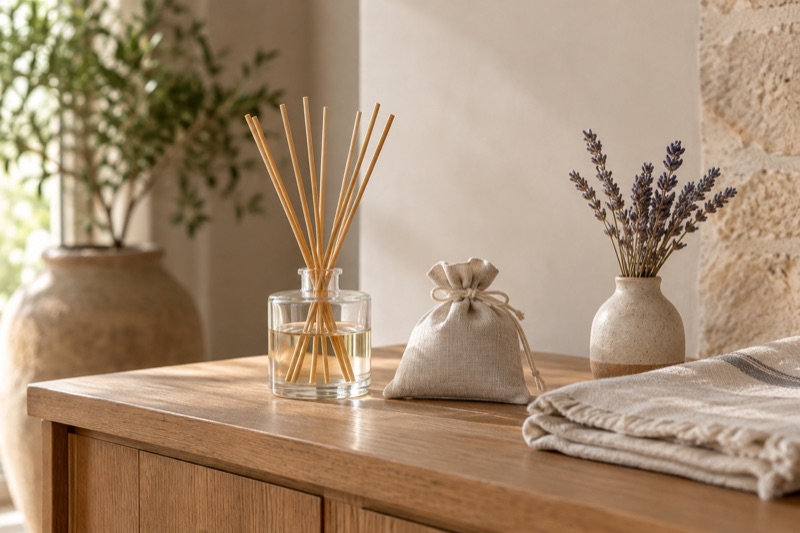
A reed diffuser is a bottle of fragrance oil with a bundle of porous sticks, usually rattan, standing in it. The oil climbs the reeds by the same capillary action that draws water up a paper towel (USGS), then evaporates from the exposed ends.
Strength is adjustable. Diptyque's instructions, for example, are to soak the sticks for five to six hours, turn them over, and repeat every month. You add or remove sticks to make the scent stronger or softer, and a stopper pauses it (Diptyque).
Turning gives a lift, but it spends oil faster. Rituals, by its own account, says each flip shortens the bottle's life, and that its regular-size reed diffusers last up to around three months (Rituals). Heat and moving air use the oil up sooner too.
Read the label for placement. Muji's, for one, warns against contact with wooden, polished and painted surfaces, because the oil may cause damage, and against placing the bottle near heat or open flames (Muji). A small tray takes care of the first.
Best for: a steady background scent in a hall, living room or bathroom. For a closer look against candles, see Reed Diffuser vs Candle (and the Third Option).
Room and linen sprays
A spray is scent on demand. Diptyque describes its room sprays as formulated to resemble "an eau de toilette for the home", and like a perfume, a spray works at the moment you use it: a few spritzes before guests arrive, or into a room that needs refreshing. When it fades, you spray again.
Linen sprays aim the same idea at fabric: sheets, pillowcases, curtains, cushions. Some room sprays do both; Diptyque says one of its room sprays can also be used on curtains, fabric wall coverings and cushions (Diptyque). Check the label for which fabrics a spray suits before using it on anything delicate.
Best for: quick changes, guest arrivals and bed linen. Least suited to a constant background scent.
Unlit scented objects and wax ovals
These are pieces of scented wax made to be kept rather than burned. Fragrance leaves the wax's surface at room temperature, so they work with no flame, no power and no oil to top up. Candle makers call this kind of unlit scent cold throw; Cold Throw vs Hot Throw explains how it differs from a candle's scent while burning.
- Wax ovals. Diptyque's scented ovals are wax tablets framed in a ceramic ring, with a cotton cord, designed for small spaces such as drawers, cupboards, wardrobes and small bathrooms. By Diptyque's account, each releases fragrance for at least three months (Diptyque).
- Wax sachets. Small molded tablets of scented wax, often set with dried botanicals and hung on a ribbon. CandleScience, a candle-making supplier, suggests them for closets, drawers and bathrooms, and warns against places hot enough to melt the wax, such as a car (CandleScience).
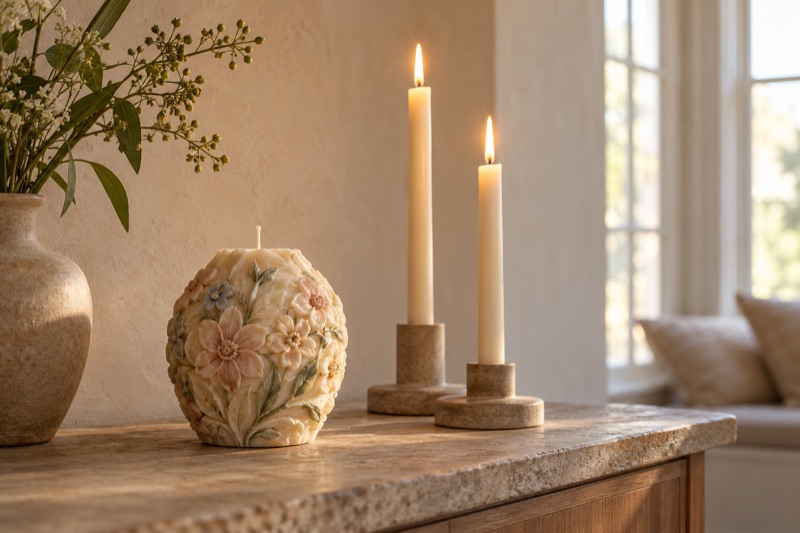
- Display pieces. Some candles are designed to scent a whole room unlit. They rely on plenty of exposed wax and a fragrance chosen for room temperature, which we explain in Candles That Scent a Room Without Being Lit. Our Le Bonne Pomme is one: an apple of hand-poured soy and beeswax, hand-painted one by one and presented under a handblown glass cloche. Displayed under its cloche, it scents a room without being lit, for about 60 days, depending on room size.
Care is the same for all three: keep them out of direct sun and away from heat. A display piece that can also be lit raises its own question, which Should Decorative Candles Be Lit? answers.
Sachets, lava rock and simmer pots
Sachets
A sachet is a small bag or pad of scented material, traditionally tucked among clothes and linens (Dictionary.com). Filled with dried flowers or herbs, it works at close range, which makes it a drawer and wardrobe option rather than a way to scent a whole room.
Lava rock
Lava rock is volcanic stone full of small holes, called vesicles, left as gas escapes from lava while it hardens (USGS). Those pores take up drops of fragrance oil. The perfume house Mad et Len makes potpourri vessels of lava stone that, by its own account, capture fragrance and release it continuously, without combustion, and sells refill oils to scent them again (Mad et Len). The strength depends on how much oil you add, and you add more when it fades.
Simmer pots
A simmer pot is a saucepan of water kept at a low simmer with citrus peel, whole spices or herbs in it, so the steam carries their scent through the kitchen and beyond. It's the one option here that uses heat, and it only works while it's on. Treat it as cooking: if you're simmering, the NFPA advises checking it regularly, staying in the kitchen and using a timer as a reminder (NFPA). Top up the water so the pot never boils dry.
Comparison table
| Option | Strength | How long it lasts | Upkeep | Needs heat or power? | How it looks |
|---|---|---|---|---|---|
| Reed diffuser | Steady background; more reeds for more scent | Weeks to months per bottle (Rituals: up to around three months, regular size) | Turn reeds, refill, protect the surface below | No | Bottle and reeds on display |
| Room or linen spray | Immediate, on demand | Until it fades, then spray again | Spray when needed | No | A bottle, kept anywhere |
| Unlit display piece | Made to scent the room around it | Le Bonne Pomme: about 60 days, depending on room size | Keep out of sun and away from heat | No | A decorative object |
| Wax oval or wax sachet | Close range, small spaces | Diptyque's ovals: at least three months, by its account | Keep out of sun and heat | No | Hidden in a drawer, or hung |
| Sachet | Close range | Until the contents fade | Replace when faint | No | Hidden |
| Lava rock | Depends on the oil you add | Until you scent it again | Add oil when it fades | No | A bowl or vessel of stone |
| Simmer pot | Fills the kitchen while it simmers | Only while it's on | Stay nearby, top up water | Stove heat | A pot on the stove |
The lifespans come from each maker's own figures, and rooms vary, so treat them as guides rather than a ranking.
Choosing by room
- Entryway. A reed diffuser or display piece on a console is the first thing a visitor passes, and a visitor arrives with a fresh nose.
- Living room. One steady source near where people sit, plus a spray before guests if you want a lift.
- Bathroom. Small and often closed, so scent builds. A reed diffuser on a tray, or an unlit piece on a shelf out of the shower's spray, does well here. There's more in How to Make Your Bathroom Smell Good, Always.
- Bedroom. There's nothing to blow out at night. Use a linen spray on the sheets if its label allows, a sachet in the drawer, or an unlit piece on the dresser.
- Closets and drawers. Sachets, wax ovals and wax sachets, which are made for small, closed spaces.
- Kitchen. A simmer pot when you're home anyway. Keep wax pieces well away from the stove and oven.
- Guest room. Set out a diffuser or unlit piece a day ahead. Guests will notice it more than you do, because people habituate to odors they live with (Pellegrino et al., 2017).
FAQ
How do you make your house smell good without candles?
Air it out first, then give each main room one steady source, such as a reed diffuser or an unlit scented piece, and keep a spray for moments when you want more. Sachets or wax ovals take care of drawers and wardrobes.
How do you make your house smell good without plug-ins?
Everything in this guide works without an outlet. Reed diffusers, sprays, unlit wax pieces, sachets and lava rock need no power at all, and a simmer pot needs only the stove. If you're curious about electric options that don't use heat, What Is a Cold Diffuser? Two Very Different Things explains cold-air diffusers.
How do you make a room smell good without a candle?
Match the option to the room. In a small room with the door closed, start with one reed diffuser or unlit piece and give it a few days. In a large or open room, put it where people sit or pass, since scent is strongest near its source.