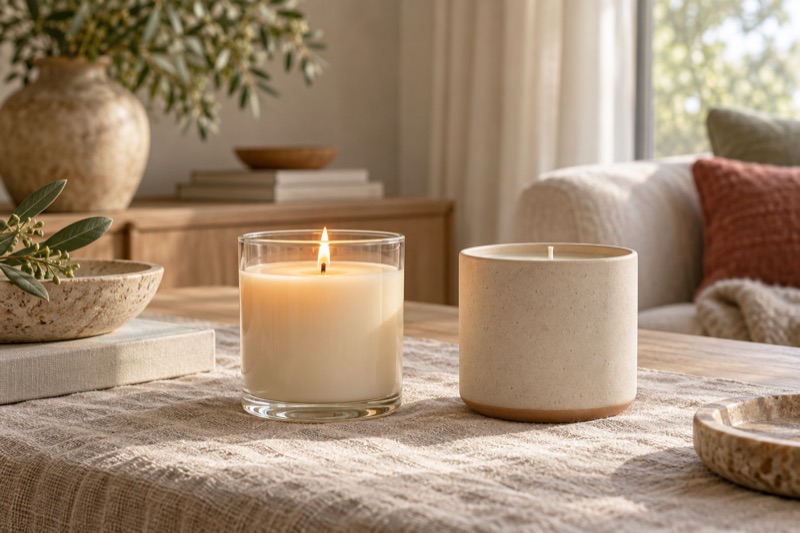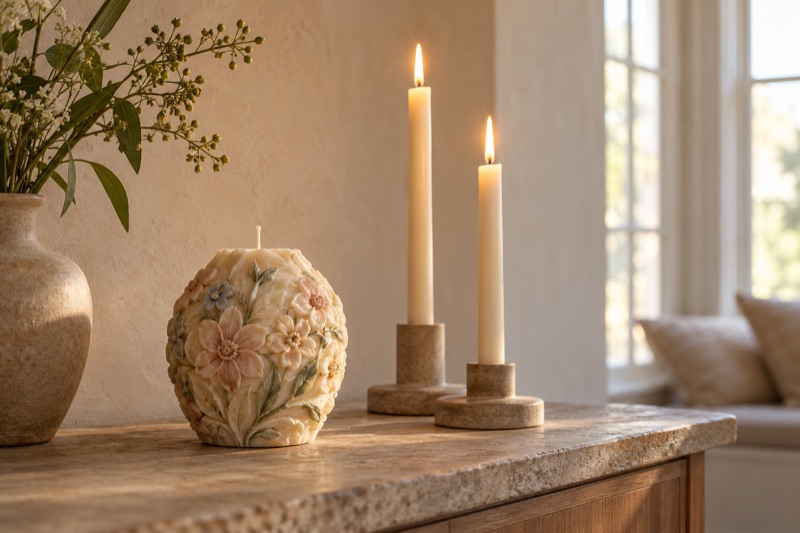
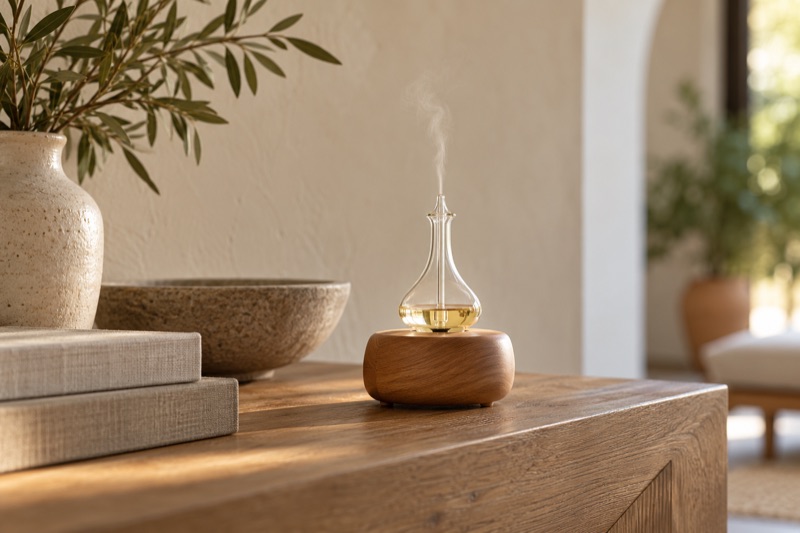
A cold diffuser scents a room without heat, and the term covers two very different things. Most often it means an electric cold-air diffuser, also sold as a nebulizing diffuser: a machine that uses air to break fragrance oil into a fine mist. It can also mean passive cold diffusion, in which a scented object, such as a candle made to be displayed unlit, releases fragrance at room temperature with no power and no flame.
Both are "cold" for the same reason: nothing is heated. Beyond that they have little in common, so here is how each works and where each makes sense.
Two meanings of "cold diffuser"
| Electric cold-air diffuser | Passive cold diffusion | |
|---|---|---|
| Also called | Nebulizing diffuser, waterless diffuser, home fragrance nebulizer | Unlit scent, cold throw |
| Power | Electric | None |
| What holds the fragrance | A bottle of fragrance oil | Wax or another scented material |
| How it reaches the room | Air breaks the oil into a fine, dry mist, by its makers' accounts | Fragrance evaporates from the surface |
| How you control it | Intensity settings and timers | Placement |
| Upkeep | Oil refills and a power supply | Keep it out of direct sun and away from heat |
| What sits in the room | A device, or a unit linked to the HVAC system | The object itself |
In search results, the first meaning dominates. In this journal, and on our own product, we use the second.
Cold-air (nebulizing) diffusers
A cold-air diffuser is an appliance. AromaTech, one maker, uses "cold-air diffusion" and "nebulizing technology" as two names for the same thing. By its own account, its machines draw filtered air from the room and use it to turn fragrance oil into "an ultra-dry micro mist," with no water, alcohol or heat. An internal filter keeps dust out of the process, intensity is adjustable, and many models have a control panel for setting hours of operation. Some wall-mounted units can connect to a home's HVAC system (AromaTech).
Aroma360 describes the same principle in its own guide: filtered, pressurized air breaks fragrance oil into an ultra-fine, dry mist, without heat or water. It says its diffusers are programmable, with adjustable intensity, in sizes from single rooms to entire buildings, and that cold-air diffusers are commonplace in hotels and business settings (Aroma360).
Both makers set their devices against diffusers that rely on water or heat. Claims about coverage and scent quality are theirs; we haven't tested them.
In practice, a home fragrance nebulizer asks for three things: an outlet (or a connection to your HVAC system), a steady supply of oil, and a place for the device itself. In return, it gives you control. You can set how strong the scent is and when it runs.
Passive cold diffusion
Passive cold diffusion is simpler. Fragrance leaves a scented material by evaporating at room temperature, with the most volatile molecules, the ones perceived as top notes, leaving first (HKBU Department of Chemistry). Warmth speeds that up, because more molecules have the energy to escape (OpenStax Chemistry). There's no mist and no machine. The object is the diffuser.
Several familiar things work this way: wax sachets and ovals in a drawer, scented lava stone, and, with a liquid instead of a solid, a reed diffuser. How to Scent a Room Without Lighting a Candle compares them.
A few candles do too. Candle makers call a candle's unlit scent its cold throw, and most candles are built for their scent while burning instead. Cold Throw vs Hot Throw: What Each Means for Your Candle explains the difference, and Candles That Scent a Room Without Being Lit covers what lets some candles work unlit.
Our Le Bonne Pomme is a cold diffuser in this second sense, and a candle as well. It's a 50 g (1.76 oz) apple of hand-poured soy and beeswax, hand-painted one by one and presented under a handblown glass cloche, with a fragrance by Mane, the French fragrance house founded in 1871. It's designed for cold diffusion: displayed under its cloche, it scents a room without being lit, for about 60 days, depending on room size. It can be lit, but isn't meant to be: the painted finish will melt and the wax may drip, which is not a defect. Should Decorative Candles Be Lit? looks at that choice.
Which suits which room
- Large or open-plan spaces, or a whole home. This is where the makers position electric cold-air diffusers, with units sized for big rooms and some that run through the HVAC system.
- Scent on a schedule. If you want fragrance to start before you get home or stop at night, a device with a timer does that. An object can't.
- Small rooms and single surfaces. An entry console, a bathroom shelf, a nightstand, a guest room. A passive piece needs no outlet or cord, and there's no device to see.
- Drawers and wardrobes. Wax sachets and ovals, which are made for small, closed spaces.
- Rooms where looks matter. If you'd rather see an object than an appliance, passive diffusion is the one that doubles as decor.
The two can share a home: a device in a large living area, an object in the rooms around it.
FAQ
Is a nebulizer the same as a cold-air diffuser?
In home fragrance, the terms are used for the same thing. AromaTech, for one, calls its cold-air diffusion "nebulizing technology." Both describe breaking fragrance oil into a fine mist with air, rather than with water or heat.
Does a cold-air diffuser use water?
Not according to its makers. AromaTech and Aroma360 both say their devices use no water and no heat.
Do you need electricity for cold diffusion?
Only for the electric kind. Passive cold diffusion needs no power, because the fragrance evaporates from the object itself.
Can a candle be a cold diffuser?
Yes, if it's made to scent a room unlit. Most candles depend on their flame. Le Bonne Pomme is designed for cold diffusion, and it can be lit, though it isn't meant to be.