A reed diffuser scents a room steadily, day and night, with no flame and little upkeep. A candle's scent is at its fullest while it burns, but it works only while it's lit and someone is in the room to watch it. So the better choice depends on whether you want scent in the background or scent as an occasion. There's also a third option worth adding to the comparison: a scented object made to work unlit.
Here's how each works, which lasts longer, and which suits a bathroom, a bedroom or a rental.
Quick verdict
| Reed diffuser | Candle | Unlit scented object | |
|---|---|---|---|
| How it scents | Oil climbs the reeds and evaporates | A flame melts the wax, and fragrance rises from the warm pool | Fragrance evaporates from the wax at room temperature |
| When it works | All the time | Only while lit | All the time |
| Strength | Steady; more reeds for more scent | Fullest while burning | Made to scent the room around it |
| How long it lasts | Weeks to months per bottle | A set number of burn hours | Le Bonne Pomme: about 60 days, depending on room size |
| Upkeep | Turn the reeds, refill, protect the surface | Trim the wick, watch the flame | Keep out of sun and away from heat |
| Open flame | No | Yes | No |
| What you see | A bottle and reeds | A jar or pillar, and the flame | The object itself |
- Choose a reed diffuser for steady, hands-off scent in a room you pass through often.
- Choose a candle when you want light and atmosphere as well as scent, and you'll be there to enjoy it.
- Choose an unlit scented object when you want steady scent from something worth looking at, with no oil and no flame.
How reed diffusers work
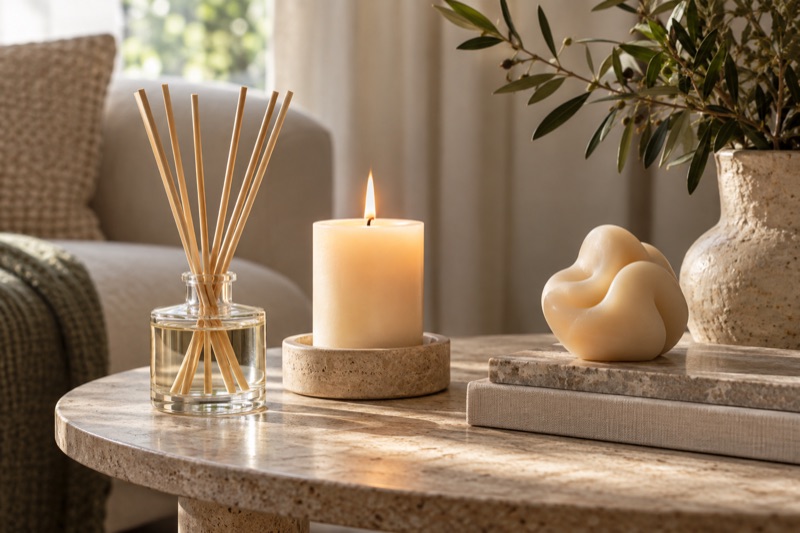
A reed diffuser is a bottle of fragrance oil with porous sticks, usually rattan, standing in it. The oil climbs the reeds by the same capillary action that draws water up a paper towel (USGS) and evaporates from their exposed ends.
A reed diffuser does work, quietly, and you control it with the reeds. Diptyque's instructions, for example, are to soak the sticks for five to six hours, turn them, and repeat every month, adding or removing sticks to make the scent stronger or softer (Diptyque). Turning gives a lift but uses oil faster; Rituals, by its own account, says every flip shortens the bottle's life (Rituals).
A reed diffuser has no flame, but it has cautions of its own. Muji's label, for one, warns against contact with wooden, polished and painted surfaces, because the oil may cause damage, and against placing it near heat or open flames (Muji). For more flameless options, see How to Scent a Room Without Lighting a Candle.
How candles work
A burning candle melts the top of its wax into a liquid pool, and fragrance escapes from that warm surface much faster than from solid wax. CandleScience, a candle-making supplier, calls a full melt pool fundamental to a strong hot throw, the trade term for a candle's scent while it burns (CandleScience). Unlit, the same candle gives off its gentler cold throw; Cold Throw vs Hot Throw: What Each Means for Your Candle explains why.
A candle's life is counted in burn hours, and good habits stretch them. The National Candle Association (NCA) advises trimming the wick to ¼ inch before lighting and burning a candle for no more than four hours at a time, and says candles burn up to 25 percent longer when the wick is trimmed every couple of hours (NCA).
Then there's the flame itself. In 2020–2024, US fire departments responded to an estimated average of 5,894 home fires a year in which candles were the heat source, according to the National Fire Protection Association. More than half started because something that could burn was too close to the candle, and 36 percent started in the bedroom (NFPA). The NFPA's advice is to keep candles at least 12 inches from anything that can burn and to blow them out before leaving a room or going to bed. The NCA adds: never leave a burning candle unattended (NCA).
None of that makes candles a poor choice. It makes them a choice for when you're there.
The third option: unlit scented objects
Between the bottle and the flame sits a third kind of home fragrance: scented wax made to be kept rather than burned. These pieces rely on plenty of exposed wax and a fragrance chosen to travel at room temperature, which we explain in Candles That Scent a Room Without Being Lit.
They range from small wax tablets for drawers, such as Diptyque's scented ovals, which by Diptyque's account release fragrance for at least three months (Diptyque), to pieces designed to scent a whole room. Our Le Bonne Pomme is one of the latter: an apple of hand-poured soy and beeswax, hand-painted one by one and presented under a handblown glass cloche. Displayed under its cloche, it scents a room without being lit, for about 60 days, depending on room size. It's a candle as well. It can be lit, but isn't meant to be: the painted finish will melt and the wax may drip, which is not a defect. Should Decorative Candles Be Lit? looks at that choice.
Compared with a reed diffuser, there's no oil to spill and no reeds to turn. Compared with a candle, there's no flame to watch. The trade-off is control: you can't add reeds or light a wick for more, so placement does the work.
Which lasts longer
The three are measured differently, so the honest answer is that it depends on how you use them.
- A reed diffuser spends its oil around the clock. Rituals, by its own account, puts its regular size at up to around three months and its minis at about three weeks. Warmth, drafts and frequent turning shorten that.
- A candle spends its burn hours only while lit, so an evening-at-a-time candle can last for weeks. Unlit on the shelf, highly fragrant candles have a life span of 6 to 12 months, depending on the scent, according to the NCA. How Long Do Unlit Candles Last, and Do They Lose Their Scent? covers that clock.
- An unlit scented object gives its fragrance to the room continuously from the day you set it out. For Le Bonne Pomme, that's about 60 days, depending on room size.
Choose by how you'd use it rather than by the number on the box.
Which is better for bathrooms, bedrooms and rentals
Bathrooms
A bathroom is small and often closed, so scent builds. A reed diffuser on a tray, or an unlit piece on a shelf out of the shower's spray, keeps the room scented between visits. A candle suits a long bath, as long as you blow it out when you leave the room. There's more in How to Make Your Bathroom Smell Good, Always.
Bedrooms
With so many candle fires starting in bedrooms, the NFPA's advice to blow out candles before bed matters most here. A reed diffuser or an unlit piece on the dresser carries the scent through the night; a candle belongs to the evening.
Rentals and guest rooms
In a place you can't supervise, flameless options make sense: a reed diffuser or an unlit object works with no one tending it. Mind the furniture, though. Labels like Muji's warn that reed diffuser oil may damage wooden, polished or painted surfaces, which matters more in a home you'll hand back, so use a tray.
A note on indoor air
If indoor air is part of your question, go to researchers rather than marketing. Exposure scientists Asit Kumar Mishra and Marie Coggins, writing in The Conversation in 2024, point out that home fragrances can mask odors but don't clean the air, and suggest using them in larger rooms with the windows open. Fraunhofer WKI's indoor-air platform notes that burning candles release substances into room air and recommends ventilating regularly when using them (Fraunhofer WKI). It also lists room fragrance products among those designed to release volatile compounds (Fraunhofer WKI). We don't make health claims for any of these options, our own included.
FAQ
Are reed diffusers safer than candles?
On fire risk, a reed diffuser has no open flame, which is what the NFPA's candle fire figures are about. It has its own label cautions: keep it away from heat and open flames, and off polished or painted surfaces. Beyond that, we don't make health claims; the indoor-air note above points to the research.
Does a reed diffuser or a candle last longer?
They're counted differently. A reed diffuser runs continuously for weeks to months per bottle; a candle lasts a set number of burn hours, spread over however many evenings you light it. An unlit scented object, like a reed diffuser, works continuously.
Is a candle better than a diffuser?
For light and atmosphere while you're in the room, a candle. For steady scent around the clock with no flame, a reed diffuser or an unlit scented object.
Do reed diffusers work?
Yes. The oil rises through the reeds and evaporates from them, giving a steady, gentle scent. For more, add reeds or turn them; for less, take some out.