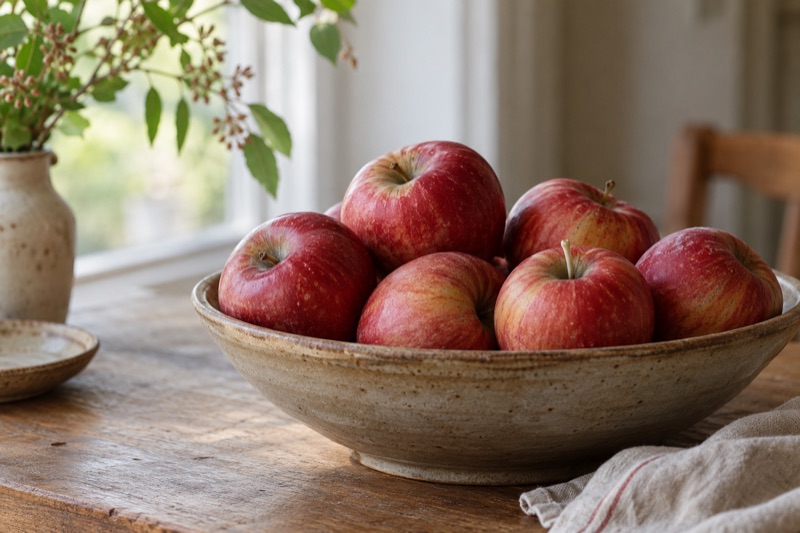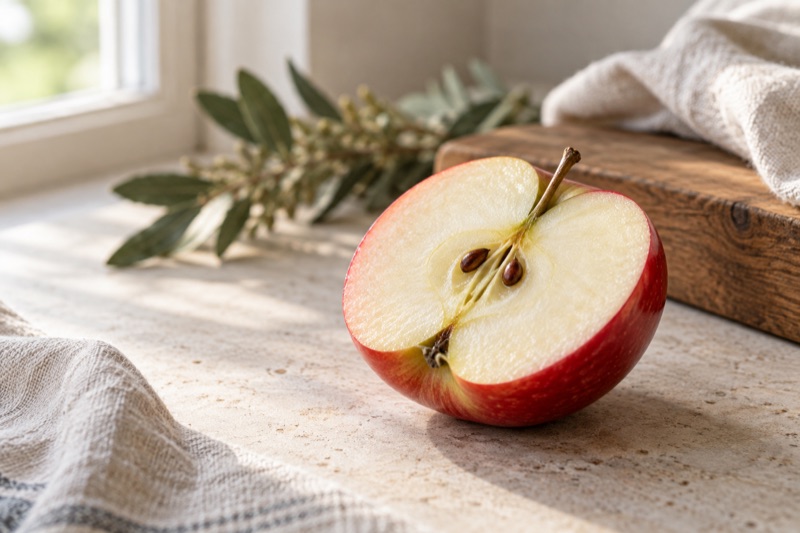
Pommette is the French word for the cheekbone: the rounded, highest point of the cheek, just below the eye. It's built from pomme, "apple," and the diminutive -ette, so it literally means "little apple." In English, the pommette meaning is simply "cheekbone," and it's pronounced roughly pom-ET.
That small word carries a good deal of French with it. Here's what the dictionaries say, where the word came from, and how the apple turns up in everyday French.
Pommette, defined
Larousse defines pommette as the most prominent part of the cheek, below the eye, and gives its origin in three words: diminutif de pomme, a diminutive of apple. Its French-English dictionary translates it as "cheekbone."
The word is old. The Académie française dates it to the 12th century. The Trésor de la langue française (TLFi) finds an early form, pumete, around 1140, when it meant "little apple." The face came later. TLFi's first citation for the cheek is from 1561, in the surgeon Ambroise Paré's anatomy: la pommette ou os jugal, "the pommette, or cheekbone."
The Académie files the facial sense under analogy: a small, round rise, like the fruit. French writers had compared faces to apples long before. Guillaume de Lorris's Roman de la Rose (about 1225–30) gives one figure a face like an apple, red and white all over. As late as 1867, the novelist Ferdinand Fabre described a face as fresh comme une pommette de septembre, like a little September apple. TLFi's examples of the cheek include pommettes that are round, rosy and rouges de fièvre, flushed with fever.
Not every pommette is on a face. The dictionaries record other senses, most of them now rare:
| Sense | Where it's recorded |
|---|---|
| A little apple (now old-fashioned) | TLFi |
| A wood or metal ornament shaped like a small apple or ball, as on andirons | Académie française, TLFi |
| The rounded metal plate on the butt of a wooden pistol, until the 19th century | Larousse, Académie française |
| A tool for picking apples and pears | Littré, cited in TLFi |
| Small knots of thread on shirt cuffs | Académie française, 4th edition (1762) |
The apple in French
Pomme comes from the Latin pomum, "the fruit of a tree," which took on the sense of "apple" only in late Latin, according to TLFi. French still gives the word to many round things: a shower head is a pomme de douche, a pinecone a pomme de pin, the rose of a watering can a pomme d'arrosoir. The apple also runs through French idiom.
| Expression | Word for word | Meaning |
|---|---|---|
| Tomber dans les pommes | To fall into the apples | To faint |
| Haut comme trois pommes | As tall as three apples | Very small, said especially of a child |
| Pomme de terre | Apple of the earth | Potato |
| La pomme de discorde | The apple of discord | A bone of contention |
| Aux pommes | With apples | First-rate (slang) |
| Ma pomme | My apple | Me, yours truly (slang) |
Tomber dans les pommes is familiar French for fainting, and nobody is sure why. Larousse reports two readings: that it's a corruption of pâmes, as in pâmoison, a swoon, an idea that follows the linguist Albert Dauzat; or that it grew from être dans les pommes cuites, "to be in the stewed apples," which George Sand used in her letters for being worn out. Larousse calls both "only hypotheses."
Haut comme trois pommes describes someone very small, usually a child, per the Académie française. The dictionaries we checked don't explain the three apples, so we won't either.
Pomme de terre, "apple of the earth," was first modeled on the Latin malum terrae, a name given to plants such as cyclamen and mandrake. For the potato itself, TLFi suggests the phrase was probably borrowed again, from the Dutch aardappel or the German Erdapfel, both "earth apple." That sense spread in France in the second half of the 18th century, helped by the agronomist Parmentier, who championed the tuber from 1773.
La pomme de discorde comes from Greek myth: the apple Paris had to award to the most beautiful of three goddesses, Hera, Athena and Aphrodite. Today it means any subject of conflict. TLFi's first French citation is from 1626, in Agrippa d'Aubigné.
Aux pommes and ma pomme are slang. TLFi dates ma pomme, meaning "me," to 1890.
One old phrase matters to anyone who loves scent. In the 13th century, a pome d'ambre was an apple-shaped jewel that held perfume, a sense TLFi traces to Jean de Meun's part of the Roman de la Rose. English kept it as pomander, from the Old French pome d'embre, "apple of ambergris" (Oxford Learner's Dictionaries). The apple has been a shape for fragrance for a very long time.
Le Bonne Pomme
Our own apple holds a scent too. Le Bonne Pomme is a sculptural apple of hand-poured soy and beeswax, hand-painted one by one and presented under a handblown glass cloche. Designed in France, it's made for cold diffusion: displayed under its cloche, it scents a room without being lit.
The fragrance is by Mane, the French fragrance house founded in 1871. It opens on crisp apple skin, melon and peach, moves to rose and red berries, and settles on caramel, musk and wood. For more on how that accord is built, read what an apple candle smells like and our notes on apple candles without the cinnamon. For apples in wax, old and new, see our guide to fruit-shaped candles.
FAQ
What does pommette mean in English? Cheekbone. Word for word, it means "little apple," from pomme and the diminutive -ette.
Does pommette mean apple in French? It once did. TLFi records pommette as "little apple" from the 12th century but marks that sense as old-fashioned. Today a French speaker hears "cheekbone."
How do you pronounce pommette? The dictionary transcription is [pɔmɛt]. In English, say it roughly as pom-ET.
What does tomber dans les pommes mean? To faint. It's familiar French, and its origin is uncertain.